
A kids jogger retail display distortion review helps buyers distinguish the presentation method from the garment’s original condition. A clip, fold or hanging arrangement may leave visible marks or change how the waistband appears. The useful question is what happened to an identified sample under documented handling, not whether every jogger should be displayed in one universal way.
This guide sets out five checks for a product-specific display trial. It covers temporary retail handling rather than knee reinforcement, growth allowance or washing-related leg torque. Retain the garment reference and proposed display setup together. Any alternative described here is a development scenario subject to supplier feasibility, not a claim that Sew Apparels currently supplies particular hangers or retail fixtures.
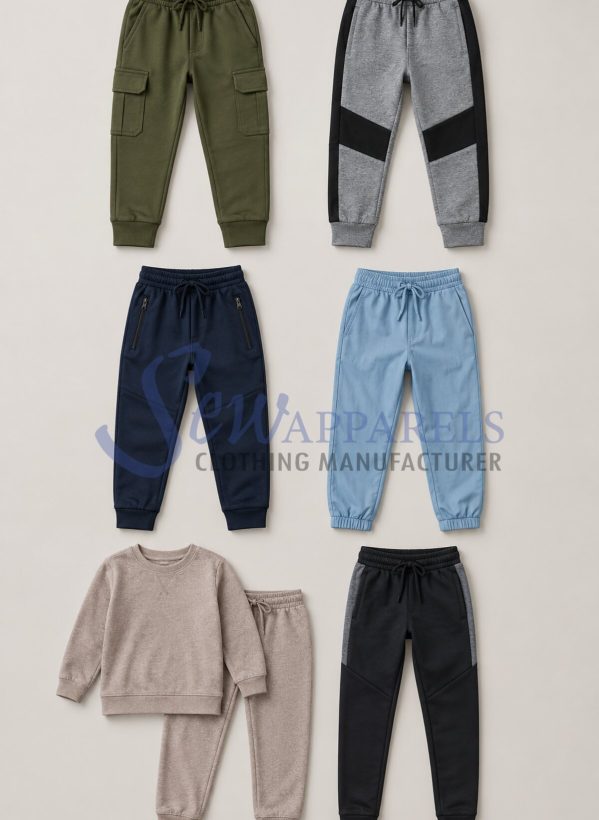
1. Kids Jogger Retail Display Distortion: Define the Setup
Begin the kids jogger retail display distortion review with a description of how the garment will be presented. State whether the proposed arrangement uses clips, a supporting hanger, a folded shelf presentation or another identified method. Record the actual setup instead of using a general instruction such as display neatly.
A kids jogger hanger specification should retain the fixture reference, relevant contact areas and any information supplied by its source. Identify the parts that touch the fabric or waistband. Where the team does not know a detail, leave a request for clarification rather than assume the fixture matches another hanger used during sampling.
For children jogger display presentation, record the intended garment orientation and where the display supports it. A front-facing presentation and a folded arrangement can create different contact positions. Describe the proposed version so the trial can be reproduced and the buyer can see which configuration the observations address.
The kids jogger hanger versus fold comparison should start as two named options with separately identified samples. Do not assume either option is superior for every fabric, size or retail environment. Ask the responsible team which comparison would answer the buyer’s actual concern and which conditions it needs to keep consistent.
Keep the proposed retail method distinct from the shipment packing method. A garment may arrive folded but later be clipped for display. If the buyer wants to review that sequence, document both stages and the transition between them. Otherwise the team may wrongly assign an incoming packing mark to the retail fixture.
2. Map Clip Placement against Waistband and Fabric
The kids jogger retail display distortion review should identify where the proposed fixture contacts the garment. Record the placement on the actual sample using the product drawing or a clear written description. The technical team needs that location to interpret observations; the word waistband alone may not identify which layer or seam is being contacted.
For kids jogger clip placement review, connect each contact point with the selected garment version. State whether a clip touches the outer fabric, a waistband fold, a seam or another documented area. Do not prescribe a universal clip position or clamping pressure for an unknown fixture and garment combination.
A kids jogger waistband display stretch question should distinguish the relaxed reference from the displayed appearance. Ask the technical team how it will observe the proposed setup and what measurements, if any, are appropriate. A change in the hanging silhouette does not by itself prove permanent elastic damage or establish a cause.
Record kids jogger hanger clip marks with their position and observation state. Note whether a mark was already visible before the trial, appeared while the garment was displayed or was observed after removal. Use consistent descriptions rather than broad labels such as faulty waistband when the evidence only shows a local contact mark.
Review the inside and outside of the contact area where the agreed inspection requires it. Keep seams, labels, decorative details and material layers identifiable. If the team proposes changing a contact position, treat that as a revised display setup requiring its own record, rather than assume it resolves every earlier observation.
3. Compare Displayed and Retained Garments
A kids jogger retail display distortion review benefits from a documented starting condition and a suitable retained comparison. Ask the responsible technical party to identify the sample arrangement and observation plan. This article supplies no universal hanging duration, recovery time, allowable indentation or waistband extension limit.
The kids jogger retained display control entry should name the comparison garment, its version and its handling history. Record how it was kept while the other garment was displayed. If the samples differ in fabric, size, construction or previous treatment, preserve those differences so the reviewer can assess whether the comparison is useful.
For kids jogger unpacked retail appearance, record the condition at the agreed starting point. If an incoming fold mark is visible, note it before the fixture trial begins. An identified baseline prevents the team from treating every later visible feature as something caused by the display method.
A kids jogger hanging sample trial should retain the fixture reference, placement, start and removal information and the observation conditions selected by the team. Use the actual trial values provided by the responsible party. Do not invent a duration because a completed-looking worksheet seems easier to read.
Maintain clear sample identification throughout the comparison. GS1’s GTIN Management Standard explains consistent identification of trade items in supply chains. That context can support keeping the retail item reference aligned with its records; it is not a display-damage test method or an instruction to allocate a new GTIN for every sample trial.
Use an internal sample code to distinguish a test garment from a retained garment without confusing that code with the retail item identity. Record both where relevant. A sample identifier explains which physical item was handled, while the product reference connects the observation with the intended retail configuration.
4. Record Marks after the Defined Display Trial
The kids jogger retail display distortion review should separate observations made during display from those made after removal. Ask the technical team to define the observation stages and any agreed post-removal assessment. Keep those stages visible in the record instead of compressing them into a single statement that the garment recovered.
For kids jogger fold pressure marks, describe the actual location and starting condition. Record the fold arrangement and any relevant stacking or contact information supplied for the trial. Do not assign a permanent-damage diagnosis from an unexplained crease or assume a different folding arrangement will remove every mark.
The kids jogger clipping damage observation entry should distinguish a visible contact mark from a confirmed technical finding. Use the terminology supported by the reviewer. If further inspection is requested, name the next action and sample reference rather than presenting an unresolved observation as proof of component failure.
A children jogger retail fold distortion comparison may need observations before unfolding and after the agreed handling step. Record what was done between those observations. If a garment was pressed, steamed or cleaned, preserve that treatment history; otherwise the report may imply recovery occurred without any intervention.
For children jogger display care, keep any proposed treatment aligned with the actual product’s substantiated care instructions. FTC care-labeling guidance explains the need for reliable support for care instructions and accessible care information at the point of sale. A display mark does not justify an unsupported ironing or steaming instruction.
Ask the qualified team to determine what the observations support for this garment and display method. A single trial is not evidence that all colours, sizes or future batches behave identically. Where the comparison is limited, retain that limitation in the decision instead of turning a sample result into an unrestricted performance claim.
5. Approve Display Instructions and Recovery Observations
Complete the kids jogger retail display distortion review with the selected presentation method and the scope of its assessment. Reconcile the garment reference, fixture identity, placement record and technical response. The approved instruction should describe the configuration actually reviewed instead of leaving staff to interpret an undocumented alternative.
A kids jogger display method approval can identify the selected setup, sample references, review date and response owner. Preserve conditions or further actions attached to the decision. If the team approves a specific display arrangement, do not broaden that response to every hanger, fold or waistband construction.
For kids jogger retail handling instructions, provide the confirmed placement and handling information in language the retail team can use. Keep unresolved technical questions separate from those instructions. A request awaiting review should not appear beside approved directions without a clear indication of its status.
Retain any post-removal observations with their stated conditions. If the review includes recovery, name the assessment stage and the responsible party’s conclusion. Do not promise that marks disappear within a particular time or that the elastic returns to its original condition without relevant evidence for the actual product.
When the fixture, garment or proposed handling changes, identify what needs review again. A previous approval provides useful history but does not automatically cover a different contact area or material. Keep the revised display version connected with its sample and response so later staff can trace the decision.
Kids Jogger Retail Display Distortion Trial Card
The following fields organise a display review without supplying invented trial conditions or acceptance limits. Fill them from the actual proposal and agreed observation plan. A missing field should lead to a named information request rather than an assumed answer.
| Review field | Information to retain | Question to resolve |
|---|---|---|
| Garment identity | Version, sample code and starting condition | Which physical garment is being reviewed? |
| Display setup | Hanger, clip or fold reference | Can the proposed presentation be reproduced? |
| Contact placement | Actual waistband and fabric contact areas | Where is the garment supported? |
| Trial conditions | Team-selected duration and handling history | What happened between observations? |
| Retained comparison | Control reference and storage history | Which differences limit comparison? |
| Post-removal review | Observation stage and technical response | What does the evidence support? |
| Selected instruction | Approved setup and response scope | Does the retail handoff match the reviewed version? |
Use the card to keep a display decision connected with evidence rather than a general visual preference. Buyers can compare proposed methods more clearly when each sample’s identity, contact positions and handling are documented. An unresolved mark remains an investigation item until the appropriate response establishes what action is needed.
Kids Jogger Retail Display Distortion: Prepare the Handoff
For custom kids jogger manufacturing, share the display proposal through the kids jogger manufacturing page alongside the product brief and packaging questions. The supplier needs the actual configuration to assess feasibility. This guide supplies no fixture availability promise, minimum order, price or lead time.
For private label kids jogger production, use the kids jogger buying guides to connect presentation with the wider garment development record. A kids jogger retail display distortion review is ready for its stated handoff when the setup, starting condition, retained comparison, observations and selected instruction can be traced together. Name any further review action before treating the display method as finally approved.
For custom kids jogger manufacturing, include the garment version, fixture references, destination and quantities in the quotation brief. Identify unconfirmed display assumptions separately.
For private label kids jogger production, retain the selected handling instruction with the approved garment and packing versions.
If the waistband component changes, use the elastic supplier change review before relying on earlier display observations. A changed component needs its own identified comparison.