
A kids joggers leg twisting after washing review starts with a traceable garment, an original alignment record and a documented care procedure. A seam that appears to turn around the leg needs a clear before-and-after comparison. The buyer should distinguish the observation from its possible cause before asking for a fabric or pattern correction.
This guide sets out five checks for laundering-related leg alignment. It does not cover knee reinforcement, added growth room or temporary retail display marks. Keep the affected sample, fabric reference and garment revision together. An appearance complaint can guide an investigation, but it does not by itself establish fabric spirality, incorrect cutting or a universal solution.
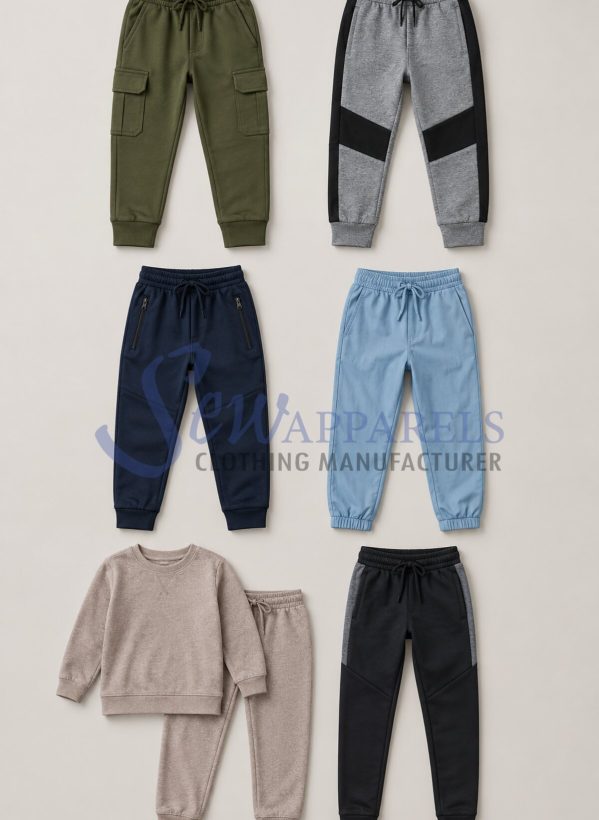
1. Kids Joggers Leg Twisting After Washing: Record the Baseline
Begin the kids joggers leg twisting after washing review before the selected care treatment. Identify the sample, size, fabric and construction revision. Record how the garment is arranged for observation and which seams are being assessed. A later report becomes much harder to interpret if the starting condition was never documented.
The kids joggers original seam skew record should describe the actual garment rather than assume that every seam began in a perfectly straight position. If the original sample already shows a departure from the intended line, retain that observation. It is different from a change recorded after washing and should remain separately identifiable.
For children jogger side seam rotation, state which leg and which part of the seam the observation concerns. Describe the relationship with the approved garment drawing. A comment such as twisted leg can refer to several visible features; an identified location gives the technician a more useful starting point.
A kids joggers left right leg rotation comparison should record both sides without presuming they behave identically. Use the same arrangement and observation convention where the technical plan requires comparison. Keep the left and right entries separate so the team can see whether the complaint relates to one leg or a broader change.
Include relevant handling history with the starting record. If the garment was previously washed, steamed, stretched or worn for fitting, identify that state. An item received as an original sample may still have a treatment history. Do not compare it with an untreated reference without explaining the difference.
2. Agree the Garment Reference Points
The kids joggers leg twisting after washing review needs reference points that can be identified again after treatment. Ask the responsible technician or laboratory to define the appropriate observation or measurement arrangement. The buyer can supply the concern and garment drawing; the technical party should select a method suitable for the actual article.
A kids joggers garment reference mark map should identify the agreed positions on each leg and retain the method version. Make the relationship between the drawing and the physical sample clear. If marking is part of the selected procedure, ask the responsible party how it is applied and recorded rather than inventing a marking pattern.
For kids joggers side seam torque observation, retain the location, direction convention and sample state used by the reviewer. A visual note and a measured result are different records. Do not convert a general impression into a percentage or angle without the applicable procedure and its actual measurements.
The kids joggers knitted panel test scope entry should explain which material construction and garment configuration the selected method addresses. ISO 16322-1:2005 addresses percentage change in wale spirality after laundering in weft-knitted jersey garments. Have the laboratory determine applicability to the actual jogger; its scope should not be treated as a universal method for every fabric and garment.
A kids jogger knitted panel spirality investigation should therefore begin with the identified material and the laboratory’s scope decision. Retain the selected procedure with the reported findings. Results from unlike procedures may not be directly comparable, so do not combine them into one acceptance decision without the appropriate technical explanation.
Keep reference-point changes visible between trials. If a reviewer changes the observation arrangement, record why and which sample uses the new method. Otherwise a different setup can appear to show improvement even though the comparison basis changed. A revised method needs its own clearly stated interpretation.
3. Use Matched Home-Care Conditions
A kids joggers leg twisting after washing comparison should preserve the selected washing and drying conditions. Ask the laboratory or responsible technical team to define the appropriate combination for the intended evaluation. Retain the actual procedure reference and garment care context; a general note that both samples were washed may not establish comparable treatment.
For kids joggers matched home care condition, identify which samples received the agreed procedure and which stayed as references. ISO 6330:2021 specifies domestic washing and drying procedures for textile testing. It provides treatment context, not a universal acceptable amount of jogger leg rotation. The chosen parameters need to be recorded with the result.
The kids joggers washed jogger leg comparison should connect each garment with its treatment and observation state. Keep the sample code beside the procedure record. If the garments received different preparation or drying arrangements, retain that difference rather than describing the comparison as matched without qualification.
A kids jogger wash torque observation should state when it was made in relation to the treatment. Use the stages selected by the responsible team and preserve any further preparation. A garment assessed immediately after one handling step and another assessed after a different sequence may not provide the comparison the buyer intended.
Retain deviations from the agreed plan. If a required condition was not recorded or the sample was handled differently, name the limitation and ask the reviewer whether another trial is needed. A complete-looking report should not conceal an unknown treatment history. The decision depends on the actual procedure used.
Do not invent a wash temperature, cycle count, drying route or conditioning interval for an unidentified product. The brief should request those details from the responsible technical party. Keeping the method and result connected is more useful than supplying generic instructions that may not match the garment or the selected standard.
4. Separate Rotation from Leg-Length Change
The kids joggers leg twisting after washing review should keep alignment observations separate from changes in dimensions. A leg can appear different after care for more than one reason. Ask the technician to explain which records address rotation and which address length or another dimensional change.
The kids joggers leg length versus twisting entry should retain the agreed measurement positions and each result’s meaning. Do not use a shorter finished length as proof of seam rotation, or a rotated seam as proof of a specific shrinkage percentage. The investigation should describe the actual findings without merging separate questions.
For kids jogger after wash alignment, compare the documented reference points in the selected arrangement. Preserve the original and treated records together. If the sample was repositioned or the observation convention changed, state that clearly so the technical party can determine whether the comparison remains valid.
A kids joggers after wash panel alignment review should identify whether the reported observation concerns the assembled garment, a panel or another defined sample. Those findings have different scopes. A separate fabric specimen may provide useful evidence, but its result should not silently replace an observation on the actual jogger.
Use a concrete comment to make the handoff understandable. For example, the buyer can report that the identified right side seam changed its visible position relative to the agreed reference after the documented procedure, while listing the left leg separately. That is an illustrative reporting approach, not a claim that a particular sample passed or failed.
Where the cause remains unresolved, keep the record as an investigation. Ask the reviewer what further comparison would distinguish material behavior from garment construction or sample history. Do not promise that rotating a pattern piece, changing a seam or adding a reinforcement panel will correct an unexplained observation.
5. Document the Fabric or Pattern Follow-Up
Complete the kids joggers leg twisting after washing review with a response tied to the affected sample and selected method. The technical team should identify what the evidence supports and what action is proposed. Keep an investigation request separate from an approved correction and a revised sample that has actually been reviewed.
A kids joggers jogger alignment correction request should identify the symptom, garment reference, supporting observations and proposed next action. Name the responsible reviewer and retain the response. The buyer should be able to see whether the team is requesting further evidence, evaluating a fabric option or reviewing a construction revision.
For kids joggers twisted leg sample review, keep the revised sample separate from the original garment in the record. Identify any changed material, pattern or assembly detail. If several variables changed, preserve them all; do not attribute a different result to one adjustment without a suitable comparison.
Ask the responsible party to define the acceptance basis for the actual product and method. This article supplies no allowable rotation percentage or pass criterion. A method identifies how a result is obtained; the buyer’s decision still needs an appropriate, documented requirement and a response scoped to the evidence.
When a revision is selected, reconcile the garment drawing, fabric reference and sample comments. Mark the current approved version clearly while retaining earlier findings as history. Any remaining action should have an owner and status. A report ready for review should not be presented as final production approval.
Kids Joggers Leg Twisting After Washing Record
The following fields keep the observation and follow-up connected. Populate them with the selected team’s actual procedure and sample information. They are review prompts, not a substitute for the laboratory method or product-specific acceptance requirements.
| Record field | Information to retain | Interpretation question |
|---|---|---|
| Original garment | Sample, fabric and construction revision | Was the starting alignment recorded? |
| Reference map | Left and right observation positions | Can the same points be identified again? |
| Care procedure | Selected washing and drying record | Were the comparison conditions matched? |
| Alignment change | Direction, location and actual findings | What changed relative to the reference? |
| Dimensional record | Separate length and other relevant measurements | Is rotation distinguished from length change? |
| Technical response | Scope, proposed action and revised sample | What does the reviewer recommend next? |
Kids Joggers Leg Twisting After Washing: Prepare the Brief
For custom kids jogger manufacturing, share the affected garment reference through the kids jogger manufacturing page with the original alignment, treatment record and review questions. The supplier needs the actual configuration before assessing feasibility. This guide promises no minimum order, price, lead time or automatic correction.
For private label kids jogger production, use the kids jogger buying guides to connect wash alignment with the wider development specification. A kids joggers leg twisting after washing brief is ready for its stated handoff when the reference points, care conditions, separate dimensional findings and technician response can be traced together. Keep unresolved actions visible before releasing a revised garment version.
For custom kids jogger manufacturing, attach identified before-and-after records, the selected care procedure, intended market and colour-size quantities to the quotation brief. Keep the proposed correction separate from an approved revision.
For private label kids jogger production, reconcile the selected fabric and pattern versions with the actual sample decision before confirming order assumptions.
Use the retail display distortion review for fixture-related observations. Display marks and laundering-related rotation need separate handling histories and comparison records.