
Kids pajama set separate size combinations require a clear definition of what the customer orders and what the packing team must deliver. A buyer may want one top size and another trouser size, but that preference needs an approved assortment structure, component identity and accurate contents description. Without those records, a mixed-size offer can create confusion between a deliberate combination and a packing error.
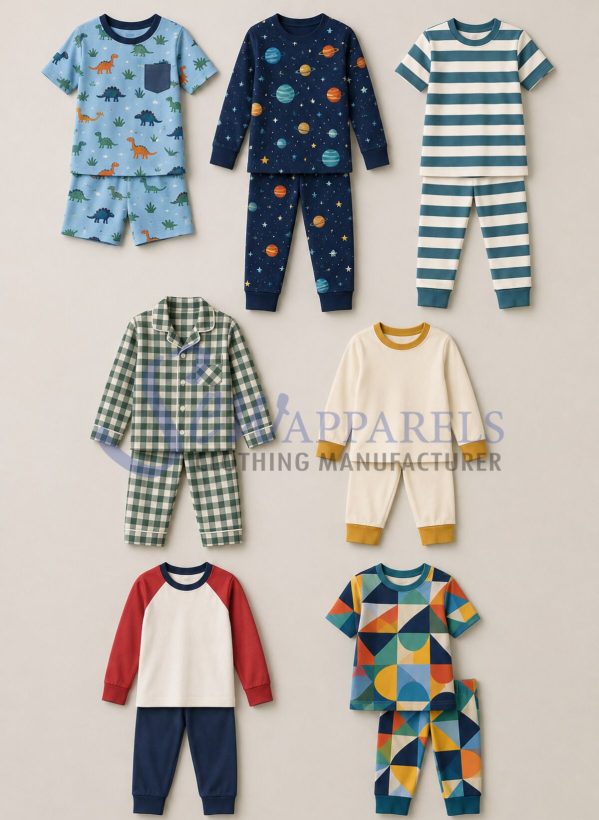
This guide uses five checks to organise orderable combinations, bundle identification and returns. It addresses assortment operations rather than body ease or garment measurement development. Discuss the intended size range, market and sales format through Sew Apparels’ custom kids pajama sets manufacturing page. Treat each proposed combination as a defined offering needing review; do not assume that every pairing is feasible or already available.
1. Kids Pajama Set Separate Size Combinations: Define the Sales Unit
Children pajama top bottom size pairing starts with a sales decision. Will customers buy independently identified pieces, choose components through a configurable order, or select a fixed packaged set? These formats need different records and instructions. Write down the intended format before building a list of sizes. A packing team cannot resolve an unclear sales model simply by placing two garments together.
For kids pajama set separate size combinations, distinguish the component from the finished sales unit. A top can have its own product identity even when it is packed into a fixed set. A bundle record should identify the exact top and trousers included, including relevant colour or artwork references. Do not rely on a broad set name if several different contents could fit that description.
A kids pajama separate size bundle should state both component sizes clearly in the buyer’s working records and proposed customer presentation. Explain whether the pieces can also be ordered individually. If that option remains a development proposal, keep it labelled as such. Avoid promising universal interchangeability or availability before the supplier and responsible product team have reviewed the actual assortment.
Use kids pajama sets sleepwear set sales unit as a defined field in the assortment brief. Record whether one order line represents a single piece or the complete two-piece set. This helps purchasing, packing and customer service discuss the same quantity. It also prevents a quotation or inventory report from comparing component units with finished sets as though they were equivalent.
2. Map the permitted combinations explicitly
A kids sleepwear size combination assortment should list the pairings the buyer intends to offer. Do not assume that every top size can be combined with every bottom size. Start with a controlled list, identify the reason for each pairing and ask the responsible teams to review it. Keep proposed pairings separate from approved, orderable combinations.
Kids pajama set separate size combinations should link each row to exact component references. Kids pajama sets different top bottom sizes is a useful planning topic, but the phrase alone does not tell a packer which garments belong together. Record the actual top size, bottom size, component version and selected colourway. If a component is revised, determine which combination rows are affected before releasing updated packing instructions.
The kids pajama sets permitted size combination matrix should also include review status. A combination awaiting product review should not appear as ready to pack. If a brand begins with a limited assortment, keep the unapproved possibilities outside the active ordering list. Expanding later is easier when the initial rows are clear and changes can be traced.
A combination matrix for the buyer brief
Use the following structure with your actual component and set identifiers. The size labels below are placeholders illustrating the record relationship; they are not recommended pairings or statements about available inventory. Confirm each proposed offering with the relevant supplier and product reviewers.
| Combination status | Top record | Bottom record | Set record | Decision required |
|---|---|---|---|---|
| Proposed pairing A | Top size and component ID | Different bottom size and component ID | Proposed bundle reference | Confirm exact contents and applicable review |
| Proposed pairing B | Top size and current revision | Bottom size and current revision | Separate proposed bundle reference | Check distinct ordering and packing identity |
| Approved pairing | Accepted component reference | Accepted component reference | Released set identifier | Record approver, date and packing instruction version |
| Replacement request | Original top reference | Requested replacement reference | Original set and proposed change | Review eligibility and reconcile components |
3. Preserve the reviewed requirements of each piece
Kids pajama sets component sleepwear review status should remain visible when pieces are combined. A mixed-size bundle does not erase requirements that apply to the actual garments or their presentation. Record the intended market and identify who reviews the proposed offering. If only one component has completed the necessary assessment, keep the whole combination’s status clear instead of treating a partial record as full approval.
Kids pajama set separate size combinations must preserve relevant product evidence rather than use bundling as a workaround. The CPSC children’s sleepwear guidance explains that classification depends on factors including construction, intended use, marketing and fabric features. Specific infant and tight-fitting criteria need careful review; a bundle description does not establish an exemption. Have the responsible team determine the requirements for the actual garments and offering.
Kids pajama sets separate pajama piece identity should connect each item to its approved product record, not merely to the bundle name. Keep the relevant size, material and revision information available to reviewers. If a replacement piece or alternative colourway is introduced, check which evidence and customer information need updating. Do not assume that a familiar set name makes the new contents equivalent to the original.
Kids pajama sets size combination approval should distinguish assortment approval from fit or compliance approval. The packing team may confirm that the correct pieces have been selected, while another responsible team still needs to review the offering. Use separate fields where necessary so one completed task does not silently imply that every other requirement is complete.
4. Link bundle identity to exact contents
A pajama set mixed size identifier needs a defined relationship with its component records. The internal bundle reference should lead to one approved contents list. If the organisation uses an external identification standard, ask the responsible team to apply it to the actual sales format. An internal code can support operations, but it should not be presented as automatically satisfying every trading-partner requirement.
For kids pajama set separate size combinations, the GS1 predefined-assortment rule (section 2.9) is relevant when the offer is a fixed physical bundle sold as one trade item. It calls for a new GTIN when an included trade item is changed, added or replaced. Component identities remain distinct from the assortment identity. Have the responsible identification team apply the rule to the actual offering and packaging hierarchy; do not treat every configurable order as the same fixed-assortment scenario.
Kids pajama sets mixed size bundle identifier should therefore be recorded alongside the exact contents and approved format. If the top changes from one product reference to another, review the set record before reusing its identifier. A similar visual appearance does not establish identical contents. Preserve the change history so a buyer can identify what an earlier order actually contained.
Kids pajama sets fixed sleepwear bundle contents should be available in the packing instruction, order record and relevant customer presentation. These records should agree. If the packer receives a permitted-combination matrix but the order system describes a different pair, resolve the discrepancy before packing. Do not ask the team to guess which document is more recent.
Kids pajama sets bundle content verification can use a documented comparison between the order, component references and released set row. Define who performs that comparison and what happens when a component is missing or mismatched. A barcode or label can help identify an item, but the operational rule must still specify the relationship being checked.
5. Plan returns and replacement reconciliation
Kids pajama sets pajama set return reconciliation should identify both the original combination and the pieces received back. A returned top from one bundle must not silently become the missing top in a different bundle. Record the component reference, size and condition through the brand’s approved return process. Keep the original order relationship available to customer service.
Kids pajama set separate size combinations need an agreed replacement policy before the offer goes live. Decide who can authorise a component replacement and how the new contents will be recorded. Do not promise that any returned piece can be exchanged into any set. Eligibility depends on the actual offering, product review and operational policy.
Kids pajama sets pajama replacement piece tracking should connect the replacement to the original set record and approval decision. If the replacement changes the defined contents, ask the responsible teams to review the identifier and customer information. Update the affected inventory and order records rather than leaving the original set description unchanged.
Reconcile component quantities separately from completed-set quantities. When a top is replaced, record the movement of that top instead of treating it as a complete new set. The same principle helps identify shortages during packing. This is an operational record structure, not a guarantee that a particular stock system or supplier currently supports configurable bundles.
Buyer questions before releasing the assortment
Can a brand offer every possible size pairing?
Start with reviewed combinations rather than an unlimited promise. Kids pajama set separate size combinations should be selected through the actual product and operations process. Confirm that component identity, customer information and packing instructions remain clear for each proposed row.
Does a mixed-size set need a different identifier?
Apply the identification rules relevant to the actual sales unit. For a fixed physical assortment, its exact contents matter to the GS1 rule described above. Ask the responsible team to distinguish that scenario from independently sold pieces or a configurable order.
What should a startup brand provide first?
Share the proposed top and bottom pairings, intended market and sales format. For custom kids pajama set manufacturing, identify the component references and decisions needing supplier input. For private label kids pajama set production, include the proposed packaging and customer contents description in the same brief.
Kids Pajama Set Separate Size Combinations: Release Checklist
Kids pajama set separate size combinations become manageable when one approved matrix connects component sizes, identities, set contents and review status. Define the sales format first, then release the permitted rows with consistent order and packing records. Keep replacement decisions traceable to the original combination.
The Kids Pajama Buying Guides connect this assortment decision with related development topics. Bring the proposed combination matrix into the product discussion so the relevant teams can review the actual offering before it is presented as orderable.
For custom kids pajama set manufacturing, submit the proposed pairing matrix, destination and quantities for supplier review.
For private label kids pajama set production, keep the released component and packing versions with the quotation.
Review sleepwear fit development separately; a permitted size pairing does not establish that each piece meets its fit specification.