
Mesh versus solid back work vests should be compared on the actual wearer, load and work setting rather than on the appearance of a fabric swatch. A visible open back does not by itself prove better comfort, and a continuous panel does not automatically provide better service life. The useful question is which construction meets the agreed access, movement, care and presentation needs with evidence the buyer can review.
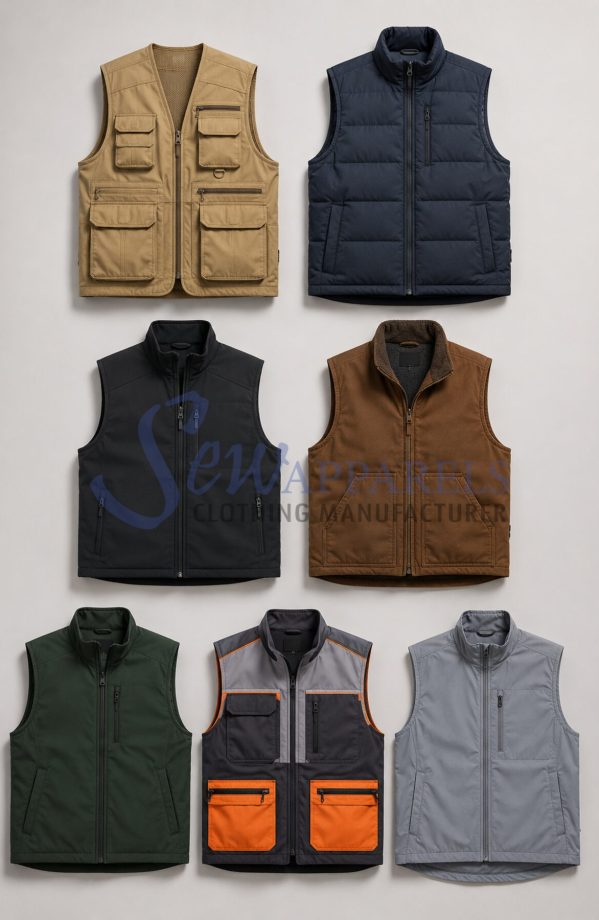
This buyer checklist helps turn a work vest back construction choice into a controlled sample comparison. It covers fabric identity, layering, airflow evidence, snag exposure and care review. Keep the existing pocket layout stable while comparing back options so the team can identify what changed. Use the work vests utility pocket layout review to define the carried items and access sequence for both samples before comparing their backs. Use the results to write an approval brief rather than a universal claim about every mesh or woven vest.
1. Define the job before comparing mesh versus solid back work vests
Start with the role and the expected daily tasks. An indoor maintenance team, an outdoor installation crew and a retail stockroom team may all use utility vests, but their working conditions differ. Record whether wearers reach overhead, lean against shelving, sit for long periods or carry equipment across the back. List the usual shirt, jacket or other companion equipment. These details determine what a useful work vest back panel wearer review should include.
Separate ordinary garment preferences from any protective equipment requirement. A utility vest specification is not evidence of high visibility, flame resistance or protection from heat. If a role needs a regulated protective garment, identify that requirement independently with the responsible specialist. Do not use a mesh comparison to replace the required safety assessment or to suggest that a ventilation feature prevents a workplace injury.
Prepare a simple task sheet with the expected load, movement sequence, contact surfaces and care route. Mark which observations are essential and which are preferences. For example, a team may prioritise compatibility with a jacket over a large decoration area. Another may need a back panel that stays tidy after frequent handling. Agree those priorities before opening the sample package.
2. Compare like-for-like samples and record the back specification
When reviewing mesh versus solid back work vests, a mesh back work vest comparison becomes difficult to interpret when size, pocket weight and front fabric all change at once. Request paired samples with the same nominal size, front construction, pocket arrangement and closures where practical. Record unavoidable differences. Give every sample a unique reference and retain an unchanged control so reviewers can distinguish construction effects from fit or finishing differences.
The work vest back fabric specification should identify composition, construction, mass, colour, finish and supplier material reference. For mesh, record the visible opening structure and how it connects to the surrounding panels. For a work vest solid panel material, identify the weave or knit and any backing or finish. The words “mesh” and “solid” alone leave too much room for substitution.
Inspect the back on the body as well as flat. Check the shoulder junction, side seams, armholes and lower edge for twisting, pulling or uneven drape. Load the front pockets with the agreed tool set and observe whether the back is pulled out of position. Photograph the same views for both samples, using consistent posture and camera distance so the comparison remains readable.
Keep measurements separate from opinions. A wearer can report that a panel feels restrictive, while the sample record shows where the restriction appears during reaching. The combination is more useful than either item alone. Avoid treating one person’s preference as a purchasing decision for every size and body shape.
3. Review airflow evidence without promising wearer cooling
For mesh versus solid back work vests, distinguish material airflow from the experience of wearing a complete garment. A panel can be partly covered by a jacket, a chair, a backpack or other equipment. Pocket load may also change its position. A fabric result therefore needs a clear description of the material tested and the conditions used before it supports a product statement.
ASTM D737 describes measurement of textile fabric air permeability. Its public scope includes a broad range of fabric constructions. A laboratory can advise whether the selected material and proposed comparison are suitable. An air permeability result is fabric evidence; it is not by itself a whole-garment cooling result or proof of heat protection.
Build the work vest airflow claim evidence file around traceable material references and the actual report. Ask the laboratory to explain units, specimen identity, conditioning and relevant limitations. Compare results obtained under compatible conditions. Do not invent a universal airflow threshold or combine values reported in different units without a correct conversion and a clear basis for comparison.
A practical work vest ventilation sample protocol can complement material testing with observations. Use the intended shirt, a defined pocket load and the same movement sequence for both samples. Record the environment and the duration of the comparison. Ask wearers about perceived comfort, restriction and contact points. Describe this as a wearer trial; it is not a controlled thermal performance certification.
4. Check snag exposure and construction durability
Mesh versus solid back work vests can encounter different contact conditions depending on the workplace. Inspect shelving edges, hook-and-loop fasteners on companion equipment and objects that may contact the back during normal use. Do not deliberately expose wearers to hazardous surfaces. First review samples safely and define an appropriate evaluation route with the buyer and laboratory.
A work vest mesh snag observation should identify the location, appearance and consequence of a defect. Record a pulled loop, distortion, opening growth or damage at a seam separately. Note whether the defect affects appearance, movement or panel attachment. Counting marks without describing them can hide a serious local problem or exaggerate a minor cosmetic change.
ASTM D3939/D3939M explains important limits of the Mace snag method. Its public scope excludes open constructions such as net. Do not prescribe that method automatically for an open mesh back. Ask a competent laboratory to select an appropriate method and explain its applicability to the actual fabric and intended use.
Include work vest mesh durability questions in the sample review: do the joining seams remain stable, does the edge finish catch during normal handling, and do openings change after care? For the solid option, check rubbing marks, surface damage and seam distortion under the same intended conditions. Neither construction should be approved on its name alone.
5. Run a care and layering review on both options
The care stage of a mesh versus solid back work vests comparison should follow the proposed garment care route and an agreed evaluation plan. Record sample identity before washing and retain the control. Check back dimensions, panel alignment, colour appearance, edge condition and the operation of nearby closures after care. Agree the number of trial cycles and acceptance criteria with the buyer; there is no single count that proves suitability for every programme.
A work vest mesh care trial also needs attention to the surrounding garment. A stable mesh panel can still be pulled out of shape by a changing front fabric or seam. Similarly, a solid back utility vest sample may perform well on its own but feel different once pockets are loaded and the intended shirt is worn underneath. Review the complete assembly.
Repeat the work vest intended layer trial with the same companion garments used at the first fitting. Ask wearers to reach, bend and sit within a safe task sequence. Compare armhole comfort, shoulder movement and whether the back rides upward. Record changes in actual fit instead of relying on a statement that the sample “looks fine” on a hanger.
Check decoration plans separately. If a back logo is required, confirm its placement and whether the proposed construction supports the chosen application. A move from one panel type to another may require a different artwork area or approval sample. Do not assume the original branding approval transfers to a changed substrate.
6. Use a selection matrix and close the approval brief
A work vest back construction matrix makes the mesh versus solid back work vests decision easier to review. List each requirement, the observation for each sample, the evidence reference and the decision owner. Use “not evaluated” where evidence is missing rather than filling a gap with an assumed pass. Separate mandatory requirements from desirable features so an attractive option does not override an unresolved functional issue.
- Material identity: supplier reference, composition, construction and finish.
- Loaded fit: pocket contents, intended layers and movement observations.
- Airflow evidence: report reference, compatible conditions and claim limits.
- Contact performance: observed defects and an appropriate evaluation route.
- Care response: dimensions, seams, colour and panel alignment.
- Approval: accepted version, restrictions and items requiring another sample.
For a work vest mesh versus woven back review, avoid reducing the matrix to an unsupported score. A lower preference rating may matter less than failure to meet a required fit condition. Explain why the chosen sample meets the defined brief and what evidence supports that conclusion. If both options remain suitable, commercial considerations can be reviewed without changing the performance record.
For mesh versus solid back work vests, a useful work vest back selection brief contains the accepted sample reference, material code, construction drawing and relevant reports. Add the approved pocket load, layer combination and care instructions. State which changes require renewed review, such as a new mesh structure, altered panel size or a different supplier material. This protects repeat orders from quiet specification drift.
From comparison to a manufacturing discussion
Bring the completed mesh versus solid back work vests record to a custom work vest manufacturing discussion. Confirm material availability, sampling scope, branding and the quotation basis before treating a development option as an order commitment. Buyers planning private label work vest production should retain the accepted construction and artwork version together. Any minimum quantity, sample charge or production schedule needs confirmation for the specific programme.
Use our work vest manufacturing page for the product discussion and the Work Vests Buying Guides to coordinate related pocket and layering decisions. The aim is a coherent specification in which the back, front, carried load and intended layers are approved together.
Buyer questions
Is mesh always the better choice?
No. A mesh versus solid back work vests decision depends on the intended role, actual fabric, loaded fit and care response. Visible openings do not remove the need for sample evidence. Choose against the agreed requirements and retain the reasons for approval.
Can one laboratory report cover every mesh?
No. A report applies to its identified material and test conditions. A different structure, finish or supplier reference needs review. Ask the laboratory whether its method is appropriate, especially for an open construction.
What should be approved before bulk production?
Approve the identified sample, material specification, back construction, loaded fit, care response and branding position. Keep unresolved observations open until corrected and reviewed. A clear decision record is more useful than a general promise that one back type is superior.