
A work t shirts print durability laundry trial should show how an identified decoration behaves on an identified garment through an agreed washing and drying route. A logo that looks good before cleaning may develop cracks, lifted edges or colour change afterwards. Buyers need evidence that connects the sample, decoration process and care conditions instead of relying on an unsupported statement that a print is washable.
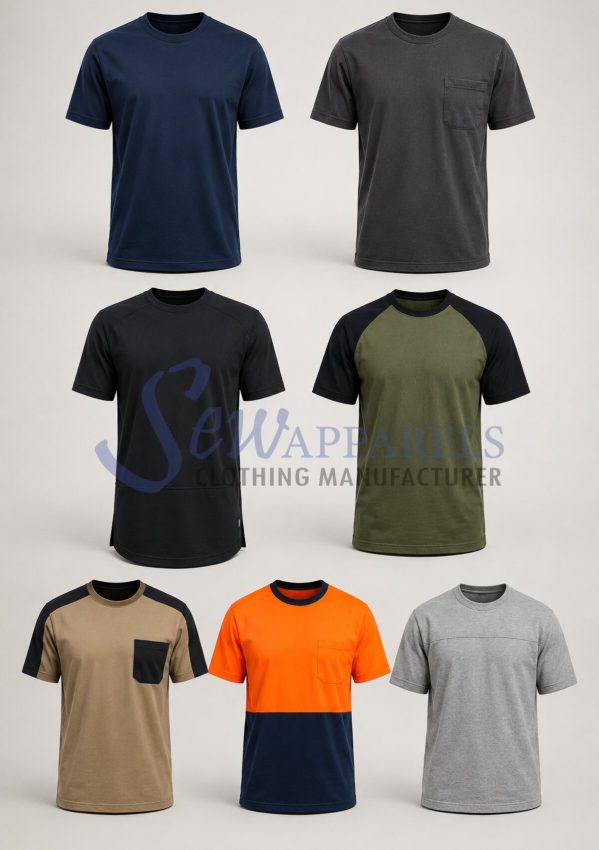
Use the custom work T-shirts manufacturing page for product enquiries. The Work T-Shirts Buying Guides provides related construction, branding and finishing routes. This article sets out six checks for planning and reviewing a laundry trial. It does not prescribe a universal cycle count, acceptance grade or expected service life.
Why a work t shirts print durability laundry trial needs a defined question
Begin with the use case. A tee washed at home, a uniform processed by a contracted laundry and a garment cleaned under a specialised workplace arrangement may face different conditions. Identify the intended care route and the claim the buyer wants to support. Then decide which observations are needed to judge the decoration after that route.
Keep the work t shirts print durability laundry trial question narrow enough to answer. A work shirt print fading care trial examines colour appearance, while a peeling review examines attachment failure. Both can matter, but one result does not automatically establish the other. List the required outcomes before the samples enter the trial so an attractive colour result does not hide an unacceptable edge or surface defect.
A useful work tee decoration wash evidence pack includes the approved sample identity, process record, original appearance, cleaning details and observations at named checkpoints. It should also state what the trial cannot establish. A controlled result is evidence for the tested configuration and conditions; transferring it to another fabric, print system or care route needs a reasoned review.
1. Fix the sample identity and retain an unwashed reference
Start the work t shirts print durability laundry trial with work t shirts print substrate identity. Record fabric composition, construction, colour, finish and garment reference. Include the decoration method, supplier product references where available, artwork dimensions and application record. Do not describe several materially different samples only as printed work tees.
Keep a work t shirts unwashed decoration reference alongside the tested samples. Use a sample from the same approved configuration and identify it clearly. Photograph the entire garment and relevant close-ups before cleaning. The reference allows the team to distinguish a defect already present at application from a change that appeared during the laundry sequence.
Mark the inspection areas consistently. Fine text, large solid shapes, colour boundaries and transfer edges can behave differently. Name those areas on a simple artwork map so later reviewers compare the same locations. Record the original condition of each area and avoid selecting only the best part of a large print for the baseline image.
Do not change the specimen midway through the sequence without recording it. If a sample is lost, damaged for an unrelated reason or replaced, preserve that event in the file. A checkpoint photo from another garment cannot silently continue the history of the original sample. Clear identity makes the final comparison credible.
2. Select the washing and drying route before testing
For domestic care, ISO 6330:2021 describes washing and drying procedures for textile testing. Its public abstract identifies washing and drying as parts of a complete test and notes that equipment and detergent differences can affect results. Use an agreed procedure and its actual record; this scope does not provide a universal print durability pass mark.
A work t shirts industrial care decoration trial needs an appropriate industrial context. ISO 15797:2017 covers procedures and equipment for evaluating workwear intended for industrial laundering. Its abstract describes simulation and notes that an intended laundry’s actual process may also need checking for compatibility. It is not an operating recipe for commercial laundries or automatic approval of a decoration.
Write the selected route into the work t shirts print durability laundry trial brief. State the washing procedure, drying or finishing procedure, checkpoints and the person responsible for the record. If the buyer requires a laboratory standard, the laboratory should use the full applicable method. A brief informal wash should be reported as an informal screening trial, not represented as standard testing.
Discuss work t shirts laundry process print suitability with the responsible technical team before approval. Include intended detergents, finishing exposure and handling where relevant to the agreed route. A transfer supplier’s recommendation can inform planning, but it needs to match the actual substrate and use. Do not substitute a general catalogue claim for the finished garment’s evidence.
3. Inspect cracks, peeling and edge lifting separately
A uniform tee print cracking inspection should distinguish fine surface lines, visible breaks through the design and loss of printed material. Record the location, extent and checkpoint at which a change appears. Use consistent viewing conditions and garment presentation. Comparing a stretched sample with a relaxed baseline can exaggerate or conceal a difference.
For work t shirts print cracking after cleaning, record whether the change is visible at rest and under any agreed extension. The extension condition should be defined by the reviewer and relevant to use. Do not pull the garment unpredictably until it cracks and treat that as a repeatable result. Keep separate notes for cleaning exposure and any additional handling assessment.
A work t shirt print peel sample record should identify whether material is detaching and where. An edge curling upward, a local blister and a section missing from the surface are different observations. Photograph the defect without tearing more material away just to make the image clearer. If a separate adhesion method is required, identify that method and its result independently.
Include a work t shirts transfer edge lifting record for corners, fine lettering and perimeter areas. Compare those positions across checkpoints. Ask whether the change first appeared after washing, drying or later handling when the record allows that distinction. An edge observation is useful evidence, but it does not alone establish a cause such as application temperature or pressure.
In a work t shirts print durability laundry trial, resist diagnosing the entire process from one visible failure. Preserve application records and sample identity for investigation. Several factors may need review, including fabric finish, decoration materials, application settings and care conditions. Corrective trials should change identified variables so the team can learn from the comparison.
4. Compare colour and appearance under consistent conditions
A work t shirts ink colour change comparison should use the same reference, lighting arrangement and sample presentation at each checkpoint. Record visible fading, altered shade, staining and changes in gloss separately. If a formal colour assessment is required, specify the method and equipment with the laboratory rather than assigning an invented numerical grade from a casual photograph.
Keep image capture consistent enough to support review. A camera’s automatic exposure or a different light source can make a print look brighter or duller without a corresponding product change. Include the retained reference where practical and record any change in the photography setup. Use photographs to document observations; do not treat them as a replacement for every required assessment.
Review the surrounding fabric as well as the logo. Fabric colour change, distortion or puckering can affect the overall appearance even if the ink remains attached. Document those changes separately so the decoration is not blamed for an unrelated garment issue. The finished uniform has to be judged as a combination of fabric, construction and branding.
The work t shirts print durability laundry trial report should explain how comparisons were made. A short record of lighting, sample relaxation and inspection position helps another reviewer understand the evidence. If the baseline image is unusable, state that limitation.
5. Agree a scorecard and review the complete garment
Create a work t shirts print failure mode scorecard before the final work t shirts print durability laundry trial review. Use separate fields for cracking, peeling, edge lifting, colour change, legibility and overall appearance as relevant. Define the buyer’s acceptance criteria and escalation process. The categories can be descriptive where appropriate; numerical scoring should have a defined basis and consistent application.
A work tee print adhesion observation should be recorded as a specific entry in the inspection file. Describe what the reviewer saw at an identified location and checkpoint. Avoid turning a visual observation into a quantified bond-strength result. If the buyer needs that measurement, arrange a suitable assessment and report it under its own method.
Work t shirts complete garment decoration approval should consider whether the logo remains readable and usable on the cleaned garment. Check artwork placement, garment dimensions and any relevant layering condition alongside the decoration’s surface. A print can remain intact while shrinking fabric changes its visual proportion or position relative to the approved brief.
A work t shirts print durability laundry trial should finish with an explicit decision: accepted for the defined scope, awaiting evidence or requiring correction. Name the sample and procedure covered by that decision. Do not use a broad approval message that leaves the team uncertain whether it refers to artwork appearance, an early sample or the completed trial.
6. Limit the claim and control production changes
Work t shirts print wash claim evidence must connect the wording of the claim to the actual trial. Record the tested configuration and care conditions. A result at agreed checkpoints does not automatically establish unlimited washability, compatibility with every laundry or a guaranteed lifetime. Avoid replacing the recorded scope with a stronger marketing phrase.
Retain the approved reference, report and application information for production comparison. If the fabric finish, colour, decoration material, artwork coverage or application process changes, review whether the earlier evidence remains applicable. Record the review and any additional trial required. If the revised route uses enzymes, retain the process and comparison records described in the work T-shirt enzyme finish evidence review alongside the decoration trial.
For custom work t shirt manufacturing enquiries, send the intended care route and decoration requirements with the garment brief. Ask which evidence is included in the proposed scope and what remains to be agreed. This makes quotation discussions more useful than asking for a washable print without identifying the conditions behind that request.
Startup brands considering private label work t shirt production can approve one documented configuration before expanding artwork or fabric options. Keep costs, quantities and test arrangements specific to the enquiry.
Questions buyers should settle before release
Does a domestic wash result approve industrial laundry?
Do not assume the routes are interchangeable. Identify the intended process and review the evidence appropriate to it. Report any untested conditions clearly so the buyer can decide what further evaluation is needed.
Can one logo colour represent every artwork variation?
Review whether the decoration materials, coverage and application remain comparable. Document why a prior result is considered relevant. Where a change could affect performance, evaluate the revised configuration instead of silently extending the approval.
What should the final handover contain?
A complete work t shirts print durability laundry trial handover includes sample identity, the unwashed reference, process records, checkpoint observations and the release decision. It gives production and purchasing teams a shared record of what was tested, what passed the agreed criteria and what claims the evidence supports.