
Patient gown procurement size allocation connects the institution’s approved garment sizes with the quantities needed by each department. A supplier cannot build a reliable assortment from a single total and an instruction to provide “mixed sizes.” The buyer needs a documented size block, a recognizable code, department-level quantities and a clear way to check the delivered packs against the order.
This guide explains a purchasing workflow for ordinary patient apparel. It does not define medical needs, protective performance or a universal patient size distribution. Use anonymised institutional records and approved garment references. Clinical suitability, coverage and handling decisions belong to the institution’s authorized staff. Do not send patient names, diagnoses or other personal records as part of a clothing quotation.
The practical output is a department-by-size worksheet that joins a specified garment to a buyer-entered quantity. It should make unfamiliar variants easy to recognize, expose missing approvals and keep opening stock separate from replacement orders. These six critical checks support a quotation that both parties can reconcile.
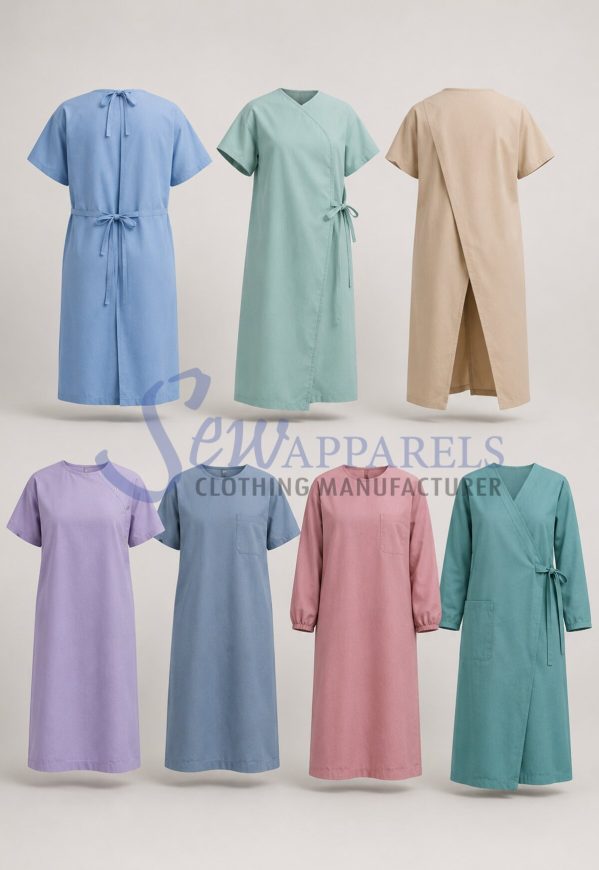
1. Define the departments covered by patient gown procurement size allocation
Start with the departments included in the purchase, their garment requirements and the responsible approver. Different departments may request different gown references, but do not assume that a department name automatically implies a particular fabric, opening, length or size range. Record the approved use description supplied by the institution and identify any unresolved specification questions.
A hospital patient gown size inventory plan needs a defined stock boundary. State whether it covers a central linen store, department stock, a new facility opening or a replacement programme. Separate garments already available from garments being ordered. Otherwise, a department request can be counted once in the central stock estimate and again in the individual purchase quantity.
Prepare a patient gown department quantity matrix with a named department code and the garment variants it is authorized to request. Use codes that the buyer can reconcile without personal information. If two units share the same stock pool, record that relationship. If they need separate issue packs, make that visible even when their garment specification is identical.
2. Translate institutional sizing information into approved garment blocks
Use patient gown institution sizing data to identify the size assortment the buyer actually requires. The source can be anonymised garment issue records, approved size reviews or the institution’s own planning process. Record the period and scope of the information. Historical issues are an input to the buyer’s decision, not proof that the next order must follow an identical ratio.
Patient gown procurement size allocation requires a consistent distinction between a size label and a garment block. “Large” is not a complete specification. Assign each requested block an approved measurement reference and revision. State which dimensions, tolerances and assessment conditions the buyer has agreed. Do not substitute body dimensions for finished-garment dimensions without an approved interpretation.
A patient gown approved size reference should identify the sample or technical document used for approval. Keep that reference linked to the relevant fabric, construction and care route. A similarly named size from another style may not provide the same garment coverage or fit. The supplier should confirm its ability to make the requested block rather than silently replacing it with a familiar stock pattern.
For a patient gown bariatric size order brief, ask the institution to supply the intended garment specification and approval process. There is no universal size definition supplied by this worksheet. A patient gown large size supply enquiry should therefore include the approved dimensions and required variants, with the supplier’s capability and sample arrangements explicitly confirmed.
3. Review trial fit and coverage through authorized staff
Document patient gown fit block approval before finalizing the assortment. The institution should decide how samples will be assessed and which authorized staff can approve coverage, movement, assisted dressing and access requirements. Procurement should record the resulting approval and specification revision; it should not infer suitability from a generic size chart or a purchasing illustration.
A useful review asks whether the sample represents the garment that will be supplied. Confirm the material, block, length and relevant construction. Record any deviation. A sample made in a different fabric or with temporary components may be suitable for one limited review but insufficient for final approval. State that limitation rather than treating every trial as approval for production.
Keep patient gown procurement size allocation separate from the detailed back-closure design decision. The approved garment reference can identify the closure used, while the dedicated closure specification controls overlap, ties and access details. Do not change the closure arrangement simply to make the size matrix easier to fill.
Where the institution evaluates a sample after its intended care route, identify who authorized and performed that evaluation. Record which dimensions and appearance observations were checked and what remains unresolved. Do not claim that an ordinary garment is sterile, protective or clinically appropriate merely because a sample survived a care trial.
4. Use clear, consistent size and pack identification
Patient gown size label identification should distinguish the approved variants during receiving, storage and issue. Agree on the size text or code, location, relevant label construction and required assessment after the intended care process. A code that appears only on an outer carton may be inadequate once the garments leave that carton.
Create a patient gown size code system that connects the garment, approved technical document and order line. Avoid using one code for different blocks or fabric revisions unless the buyer has deliberately approved that relationship. If colour is used as an additional cue, keep a readable text or code reference too; the institution should decide the identification method appropriate for its workflow.
For patient gown size pack identification, define whether each pack contains one size or a specified assortment. State the department code if packing is department-specific. The pack label, quantity record and carton information should agree. This does not require patient-level data: department, style, size code, revision and quantity are usually the purchasing identifiers needed.
Within patient gown procurement size allocation, treat identification as an approved component of the garment and delivery specification. Ask the supplier to show the proposed label or code sample before production. Confirm what the supplier can provide and how the institution will evaluate readability and recognition, rather than assuming that every label remains legible under every care process.
5. Enter opening and replacement quantities from buyer records
Patient gown department size totals should be entered and approved by the buyer. Separate the opening order from garments already in usable stock, quantities in circulation and any additional reserve the institution chooses. This article does not prescribe a stock multiplier, replacement rate or department ratio. Those decisions depend on the institution’s actual operating information.
Document patient gown replacement order inputs such as the approved garment reference, recorded stock position, known losses or withdrawals and the period the order is intended to cover. Keep observations separate from forecasts. A damaged garment record may justify a replacement enquiry, but it does not establish the demand for every other size in the assortment.
When planning patient gown procurement size allocation, reconcile the department totals with the overall order. If a shared reserve is included, give it its own line instead of distributing it invisibly across every department. Distinguish individual gown quantities from pack quantities so a request for packs is not mistaken for the same number of garments.
The CDC guidance on healthcare laundry and bedding addresses institutional textile processing and handling. Use the facility’s responsible procedures when reviewing circulation, cleaning and storage arrangements. The guidance does not supply a gown size ratio or an inventory quantity, and the purchasing worksheet must not override the institution’s hygiene decisions.
6. Quote the documented assortment and record exclusions
A patient gown department RFQ table should give the supplier enough detail to price the requested variants. Include the style and revision, approved block code, identification, quantity unit, packing requirement and the buyer’s quantities. Ask the supplier to distinguish confirmed scope from assumptions, exclusions and items requiring sample approval.
Use patient gown procurement size allocation to compare quotations on the same assortment. A price for one standard block is not automatically comparable with a quote covering several separately approved blocks. Ask how development, identification, packing and requested quantity splits affect the offer. Do not invent fabric usage, a surcharge or a minimum order simply because a larger or less common variant appears on the worksheet.
For custom patient gown manufacturing discussions, the buyer should request confirmation of each required block and identification method. The CottonWorks sourcing and manufacturing resource library provides broader textile production and quality topics. It is background reading, not a source of patient-specific sizing, hospital inventory policy or proof of an individual supplier’s capabilities.
If a supplier proposes a substitution, record the proposed change and its effect on the approved references. Return it to the responsible buyer for review. Do not accept an alternative size name, material or pack mix as equivalent without checking the actual specification. The final quotation should show precisely which assortment will be supplied.
Build a department-by-size order worksheet
The patient gown procurement assortment worksheet below is an original purchasing checklist. It defines the information to collect; all quantities and acceptance criteria must come from the buyer’s approved process. Leave an unresolved field marked for review instead of filling it with a plausible estimate.
- Department: stock owner, department code and shared-pool relationship.
- Garment: style, fabric reference, construction and approved revision.
- Size block: code, approved measurement document and sample identity.
- Identification: garment label, pack label and carton reference.
- Quantity: unit, buyer-entered opening or replacement amount and approval source.
- Supply scope: supplier confirmation, assumptions, exclusions and pending approvals.
- Reconciliation: department total, order total, reserve line and signoff owner.
Patient gown assortment order signoff should confirm that the approved size codes match the quotation and the packing schedule. Check that the department totals reconcile, the required samples have been approved and no alternative block has been inserted without agreement. Retain the signed revision so receiving staff can check the delivered assortment against the same record.
For private label patient gown production, include any institution-approved identity requirements in that record. Patient gown procurement size allocation is complete only when the garment variants, buyer quantities and supply commitments refer to one agreed assortment. A total quantity alone cannot provide that assurance.
Prepare the next supplier conversation
Send department-level size requirements and approved gown references through the patient gown manufacturing product page for an assortment discussion. Use the patient gowns buying guides to coordinate the wider garment decisions. Confirm project-specific capabilities, quantities and sample arrangements before ordering.
Frequently asked questions
Can the supplier choose a general mixed-size ratio?
The institution should approve the ratio from its own information. Patient gown procurement size allocation should record buyer-entered quantities for identified blocks, with any supplier proposal clearly presented for review rather than treated as confirmed demand.
Is a size name enough to specify a larger gown?
No. Use an approved garment block and measurement reference. Ask the supplier to confirm that it can produce that specification; a generic label such as large or bariatric does not define the required dimensions or coverage.
Should the quotation include personal patient records?
No. Use anonymised planning information, approved garment specifications and department codes. Patient gown procurement size allocation is a stock and purchasing task, not a reason to disclose individual health or identity information.