
Patient gown rental versus purchase cost comparison starts with equivalent supply requirements, not the lowest number on two quotations. A garment purchase price and a recurring rental charge can cover different quantities, responsibilities and periods. Put both proposals into the same worksheet before deciding whether either total answers your institution’s actual procurement question.
This guide provides six checks for a transparent comparison using buyer-supplied quantities and documented service terms. It does not recommend a clinical supply model, claim standard garment life or promise savings. Rental is a comparison option to investigate with the relevant provider; it is not a statement that Sew Apparels supplies a rental service.
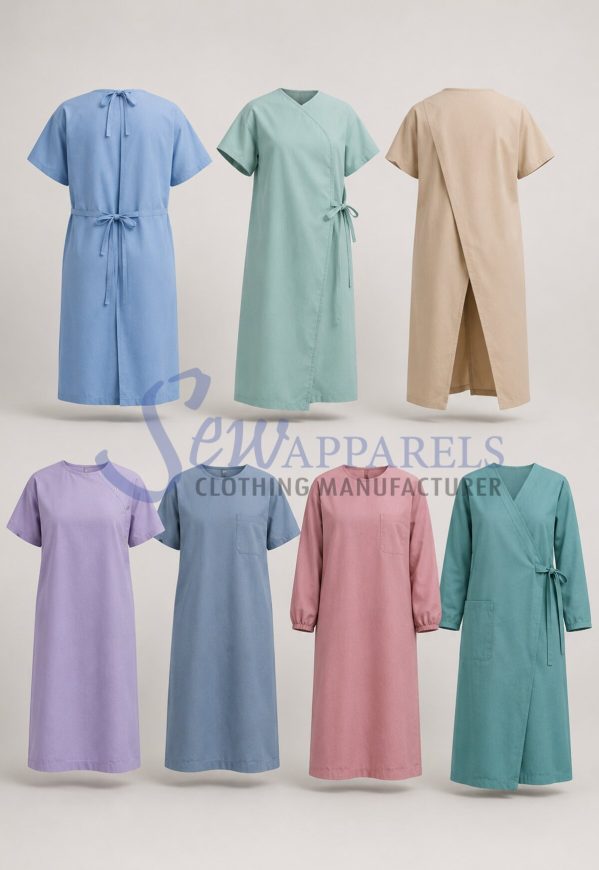
1. Set the scope for patient gown rental versus purchase cost comparison
Write a common review period, delivery location, currency and required garment specification at the top of the comparison. Define whether the requirement concerns initial stock, continuing replenishment or a combination. Record the institution-approved size assortment, closure, fabric and identification requirements so a lower-priced proposal cannot quietly substitute a different garment.
The CDC’s healthcare laundry guidance distinguishes facility-owned textiles processed for a laundry fee from processor-owned textiles supplied under a rental charge. That distinction helps identify ownership and service scope. The guidance concerns institutional laundry handling; it does not provide local rental prices or determine which commercial arrangement your institution should select.
Your patient gown supplier service scope should name the party responsible for clean supply, collection, processing, transport and stock records. Procurement, finance and the institution’s responsible operational team should agree these requirements before reviewing costs. Ordinary apparel specifications do not establish protective performance; any separate protective requirement needs its own verified specification and appropriate review.
For a patient gown rental versus purchase cost comparison, record the demand measure used by both bidders. Garments held in stock, garments delivered, garments issued and pieces processed are different counts. A charge per processed piece cannot be compared directly with a purchase price per garment without a supported activity estimate for the same period.
2. Separate acquisition costs from recurring charges
A patient gown ownership cost worksheet should show the opening garment quantity and the quoted acquisition amount separately from recurring services. Identify sample development, labels, packaging, freight and applicable charges by their stated inclusion or exclusion. Do not assume a purchase quote includes institutional laundry simply because the garment is intended for repeated use.
Define the patient gown purchase order cost scope with a quotation reference and revision date. Ask whether an amount is per piece, per shipment or a single development charge. If a price applies only to a specified assortment or order quantity, retain that condition beside the amount. Keep taxes and currency assumptions consistent under your institution’s accounting approach.
The patient gown rental quotation comparison needs equivalent detail: the charging unit, service frequency, included stock, minimum commitment and adjustment terms. Establish whether collection, replacement, repairs or identification are included. A bundled charge should remain one bundled line unless the provider supplies a valid breakdown; invented allocations give a misleading impression of precision.
Ask specifically about the patient gown rental minimum service charge. A minimum invoice may apply even when documented usage falls below the provider’s charging threshold. Record the contractual calculation method and review period, rather than multiplying a headline unit charge by a volume that does not meet the quoted conditions.
3. Map laundry, transport and stock responsibilities
Patient gown rental versus purchase cost comparison becomes useful when each recurring activity has one named owner. Create separate rows for collection, processing, packing, delivery and stock administration. Mark each as included, separately quoted, provided internally or unresolved. An unresolved cost is an unanswered question, not a zero.
Document patient gown laundry service exclusions using the provider’s written terms. These might concern the specified service boundary, special handling, processing location or collection arrangement; do not assume particular exclusions exist without confirmation. The institution’s responsible team should validate operational suitability independently of this commercial worksheet.
Patient gown transport cost allocation should distinguish supplier delivery from internal distribution. If a shared transport charge covers several products, ask finance to approve the allocation method and record its basis. Do not charge the entire shared amount to gowns in one model while allocating only a small share to the other.
List patient gown stock ownership responsibilities for counting, issuing, recovery, storage and reconciliation. Internal work may consume resources even when there is no separate supplier invoice. Use an approved accounting basis for those resources, or mark the amount unknown. A blank estimate should remain visible instead of being concealed inside an unsupported savings claim.
For wider sourcing background, the CottonWorks sourcing and manufacturing resource library offers educational material on production and supply-chain topics. It is a background resource, not evidence of a supplier’s rental capability, a local service price or a particular gown’s useful life.
Before advancing patient gown rental versus purchase cost comparison, ask both providers to confirm the same collection and delivery boundary in writing. Note the receiving location and any institution-provided handling resources. A provider’s silence is not acceptance of your worksheet assumptions; retain the question as unresolved until there is a documented response.
4. Record loss, repair and replacement assumptions
Use patient gown replacement assumption inputs from an identifiable institutional record, approved trial or written contractual condition. Note the period, denominator and limitations. A damaged garment, an unrecovered garment and a retired garment should not automatically be counted as three replacements if they describe the same piece.
A patient gown repair charge comparison should identify eligible work, approval responsibility and whether a repair is included in another charge. If a provider retains ownership, read how responsibility for damage is defined. If the institution owns the stock, obtain relevant repair or replacement quotations rather than estimating a universal service life.
Patient gown rental versus purchase cost comparison must also distinguish routine replenishment from exceptional charges. Record who approves the event and what evidence supports it. Keep unverified future quantities out of the confirmed total; place them in an explicitly labelled scenario with the source and reason for the assumption.
A patient gown loss rate sensitivity example can test how a buyer-selected assumption changes the arithmetic. Label it illustrative, use the same activity period and state the rate’s denominator. Do not present the chosen rate as industry data. Check whether the rental terms already include a loss allowance before adding another loss charge.
5. Build an auditable cost worksheet
Use the following six lines as a starting structure, adding a separate row whenever a quoted condition requires it. Each line needs an amount, unit, quantity or period, evidence reference and inclusion status. Keep the same currency and review boundary across both columns.
- Garment acquisition or opening commitment: buyer quantity multiplied by the applicable quoted price, or the rental arrangement’s documented opening commitment.
- Processing or bundled recurring service: supported activity multiplied by its charging basis, with any confirmed minimum applied as the agreement specifies.
- Transport and distribution: separately quoted or institutionally allocated charges that are not already inside another line.
- Storage and stock administration: approved internal allocations or supplier charges, with unresolved inputs clearly identified.
- Repair, loss and replacement: documented charges or explicitly labelled scenario inputs, checked for overlap.
- Other confirmed charges and credits: development, identification, contractual adjustments or approved credits, each with its own evidence.
For patient gown rental versus purchase cost comparison, total confirmed amounts separately from scenario amounts. If a bundled rental charge includes processing and transport, show those activities as included and avoid adding them again. Likewise, show refundable deposits separately under the institution’s accounting treatment rather than automatically presenting them as consumed expenditure.
Patient gown cost per issued garment assumptions need a supported issue count. Divide a comparable period total by that count only when the count has been defined and verified. It is an analytical measure, not necessarily the supplier’s billing unit. If the denominator is unknown, leave the result unresolved rather than manufacturing a convenient utilisation figure.
6. Test scenarios and close supplier questions
A patient gown procurement scenario table can contain a documented base case plus buyer-defined alternatives for activity, transport frequency or replacement quantity. Change one identified assumption at a time before combining changes. This makes it easier to see whether a difference comes from the commercial model, a service exclusion or an unsupported input.
Patient gown rental versus purchase cost comparison should show the assumptions beside each result, including any unavailable cost. If one proposal lacks a confirmed delivery charge, the worksheet cannot establish that it is cheaper on a complete basis. State the missing information and request an updated quotation instead of treating an incomplete total as a decision.
A patient gown purchase versus lease enquiry should also clarify whether the proposed agreement is rental, lease or a purchase with an attached service contract. Record the actual terms rather than using the labels interchangeably. Refer contractual interpretation, ownership transfer and accounting treatment to the institution’s appropriate reviewers.
Use a patient gown commercial comparison checklist at sign-off: equivalent specification, matched period, consistent units, supported quantities, verified inclusions, no duplicate charges, visible unknowns and current quotation references. Record who checked arithmetic, who accepted operational scope and which questions still prevent a complete comparison. Supplier selection remains the buyer’s decision.
Keep patient gown rental versus purchase cost comparison revisions under one reference. When a supplier changes its price or service scope, replace the affected input and retain the previous version. Recheck minimum charges, included activities and scenario calculations together so the amended comparison does not combine incompatible quotation versions.
Prepare a purchase enquiry with a clear comparison boundary
When exploring custom patient gown manufacturing, share the approved garment specification, size allocation, quantities and required delivery scope. Ask for an itemised purchase quotation that identifies inclusions and exclusions. Do not ask a garment supplier to silently absorb processing, rental stock management or other services outside the requested supply boundary.
For private label patient gown production, include the institution-approved identification and packing requirements with the enquiry. Keep patient information out of the commercial worksheet; aggregate procurement quantities and garment specifications are sufficient for this comparison. Retain the quotation version alongside the garment approval reference so revisions can be traced.
Review the patient gown product enquiry page for the relevant garment supply discussion, and use the patient gowns buying guides for related specification planning. Keep the purchase enquiry focused on the garment requirement; verify rental availability and service terms separately with the provider concerned.
The final patient gown rental versus purchase cost comparison should be a traceable decision record, not a claimed winner based on incomplete numbers. Preserve the common specification, buyer inputs, service map and unresolved questions. That record allows a procurement team to request comparable revisions and understand the basis of the figures before making its own decision.