
School leggings repeat order quantity planning starts with the size-level stock you can actually sell, the units already committed to customers and the replenishment terms your supplier has confirmed. A repeat order should not simply copy the first order’s size ratio. Sales, exchanges, stockouts and the school calendar can change the evidence behind the next purchase.
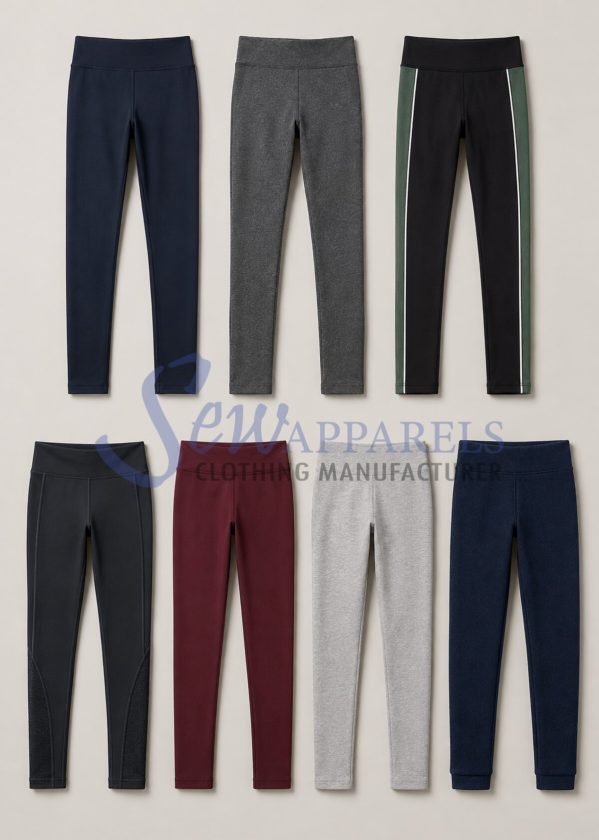
This guide provides five critical checks and a reorder worksheet for schoolwear buyers. It separates observed transactions from demand assumptions, shows how to reconcile incoming stock and explains how to compare quantity scenarios against quoted minimums. No demand figure, supplier lead time or safety-stock percentage is presented as a standard for your business. Any calculation needs dated inputs from your own records and the relevant supplier quotation.
School leggings repeat order quantity planning: define the decision
State what the order must accomplish: replace depleted sizes, support a confirmed school order, replenish for a new term or cover an identified selling period. These are different decisions. A large total quantity can still leave the buyer short of one size while increasing slow-moving stock in another. Use a separate row for each relevant size and colour combination, with a consistent product revision and unit definition.
Keep product development separate from replenishment quantities. This worksheet does not approve waistband comfort, knee recovery or a fabric substitution. If the repeat order includes a changed specification, identify that change and its approval requirements before comparing costs or quantities with the previous order. The calculation only represents the product and supply conditions recorded in its inputs.
1. Separate sales, exchanges and unavailable-stock periods
Build school leggings size level reorder data from transactions rather than a broad impression that one size is popular. Record sales, cancellations, returns and exchanges separately over a stated date range. A size exchange can move demand between rows without representing an additional customer purchase. Returned garments should enter saleable inventory only when they have been received, inspected and accepted under your own process.
The school leggings size specific sales history should include availability during the observation period. If a size was unavailable for part of the term, its low recorded sales do not establish low demand. Record the stockout dates and any reliable unfilled-order evidence. Do not invent lost sales by multiplying a short observation period without labeling the resulting assumption.
Use a worksheet field titled “school leggings legging exchanges versus sales” to reconcile the original size issued, the size returned and the replacement size supplied. This makes the operational meaning clear despite different reporting systems. Avoid subtracting the same return once from net sales and again from demand without documenting the accounting convention. The Australian Government’s inventory management guidance recommends maintaining sales and return records and reviewing stock regularly; it does not provide a leggings-specific forecast.
2. Reconcile usable stock, commitments and incoming units
Count the stock physically available and compare it with the system balance. Separate units on quality hold, damaged goods, samples and already allocated customer orders from freely available stock. The school leggings size level stock balance should show the location and count date. If a transfer between stores is planned, avoid counting the same units in both the sending and receiving location.
A school leggings confirmed incoming stock record should identify the purchase order, product variant, quantity, expected availability date and evidence supporting that date. A quotation or proposed order is not confirmed incoming inventory. Likewise, dispatched stock is not necessarily available for sale at the destination. Record the remaining transport, receipt and acceptance stages relevant to your operation.
For school leggings repeat order quantity planning, distinguish current availability from future availability. Incoming units due after the required selling date cannot automatically cover a shortage before that date. Show them in a separate dated column or scenario. If there is uncertainty, compare the consequence of including and excluding those units rather than hiding the uncertainty in a single total.
The GS1 guidance on size and colour variations explains separate GTIN identification for product variations within its system. Use consistent variant identities in purchasing and stock records. Identification helps distinguish the item being counted; it does not verify the quantity, predict demand or prove delivery timing.
3. School leggings repeat order quantity planning: confirm timing
The school leggings actual lead time reorder input should come from the supplier’s current confirmation, not a generic number copied from the previous season. Ask what starts the quoted timing: order acceptance, payment, material approval or another agreed event. Include dependencies such as fabric availability, trim confirmation, sampling changes and the buyer’s own approval steps where they apply.
Map factory readiness, transport, destination receipt and the point when stock becomes saleable. Record who owns each estimate and when it was checked. A school leggings term demand order needs this date sequence because production completion alone does not mean garments are available for term-start distribution. Keep conditional dates visibly conditional.
Discuss a school leggings schoolwear repeat purchase plan with the supplier before treating the purchasing date as settled. For custom school leggings manufacturing, the buyer can share the required receiving date and size-level quantities so the supplier can assess feasibility and quotation assumptions. This does not imply an advertised standard lead time or guaranteed delivery date.
4. Compare quantity scenarios against the quoted minimum basis
A school leggings replenishment stock calculation can start with a transparent relationship: the units required for the chosen period, plus an explicitly approved end-of-period reserve, less stock available for that requirement. Do not add an automatic percentage reserve. Document why the buyer selected a reserve and what uncertainty it addresses. If no reserve is approved, keep that input at zero rather than inventing one.
The school leggings stock coverage buyer inputs should state which commitments are already included in the requirement. Otherwise, a team may subtract allocated stock and also add the same committed orders to projected demand, producing an inconsistent result. Choose one clear treatment and retain it across scenarios. Negative calculated purchase requirements generally indicate no additional units for that scenario; they do not instruct the buyer to return stock.
Confirm the school leggings supplier minimum reorder basis in writing. A minimum may apply to the whole order, a colour, a fabric commitment or another quoted scope. Ask how quantities can be allocated across sizes and whether pack multiples apply. The school leggings repeat order MOQ must represent the current quote, not a quantity inferred from a previous order or an unsupported website claim.
School leggings repeat order quantity planning should show the difference between the calculated need and the orderable quantity. If a minimum or pack multiple creates extra units, identify where those units would go and their potential exposure to slow sales. Do not silently increase every size in the same proportion. Compare alternatives only when the supplier confirms they are feasible.
An illustrative size-level calculation
The following figures are invented solely to explain the calculation. They are not Sew Apparels demand, stock or supplier terms. Suppose one size has 40 saleable units on hand, of which 10 are committed to existing customer orders. Assume another 20 units are confirmed to become saleable before the required date. Available stock for additional demand would be 40 minus 10 plus 20, or 50 units.
Assume the buyer separately projects 75 additional units for the chosen period and explicitly approves a reserve of 5. The scenario requirement is therefore 80 units, and the additional purchase need is 80 minus 50, or 30 units. These assumptions exclude the already committed 10 from the additional demand figure. Including those commitments again would double-count them.
For a second scenario, assume the incoming 20 arrives too late to support this selling period. Available stock becomes 30, and the purchase need becomes 50. Neither scenario predicts the future: the difference shows why timing matters. Apply current supplier minimums only after confirming their scope. If an orderable quantity exceeds the calculated need, show the surplus separately rather than calling it forecast demand.
5. School leggings repeat order quantity planning: record assumptions
A school leggings replenishment assumption review should identify the source and date of each input. Mark observed sales, confirmed customer orders, counted stock, supplier confirmations and buyer forecasts as different evidence types. This lets a reviewer challenge an assumption without discarding reliable transaction records. Keep the worksheet revision linked to the quotation it was evaluated against.
Compare school leggings school term replenishment scenarios with the same product identity and reporting convention. For example, one scenario may use confirmed incoming stock while another excludes an uncertain arrival. State what would cause the buyer to choose one over the other. Do not describe a higher quantity as automatically safer when its cost and remaining-stock implications have not been reviewed.
School leggings repeat order quantity planning ends with an accountable decision, not simply a spreadsheet total. Record the chosen quantity by variant, unresolved supply questions, decision owner and review date. Recheck the worksheet when a delivery confirmation, exchange pattern, specification or school order materially changes. Preserve the prior version so the reasoning behind an order remains traceable.
The reorder worksheet fields to retain
Use a “school leggings legging order quantity worksheet” heading for the working record and retain the following fields for each product variant. A spreadsheet can support this process, but its formulas are only as reliable as the dated inputs and consistent unit definitions behind them.
- Product identity: approved revision, size, colour, internal code and applicable external identifier.
- Observed transactions: reporting period, sales, cancellations, returns, exchanges and availability gaps.
- Current inventory: counted saleable units, allocated commitments, held units and count date.
- Incoming inventory: confirmed order, quantity, availability date, dependencies and supporting confirmation.
- Demand scenario: additional period requirement, its basis, separately approved reserve and limitations.
- Purchasing constraints: quoted minimum scope, pack multiples, permissible size allocation and quote validity.
- Decision: calculated need, orderable quantity, resulting surplus, owner and next review trigger.
For private label school leggings production, align the worksheet with the approved product brief and labeling data. If the repeat product changes, flag that change before combining old and new inventory in a single planning row. Do not assume two garments are interchangeable merely because their size labels match.
Turn the calculation into a supplier brief
Share the required receiving date, product revision, size-level quantity scenario and the confirmations still needed through the school leggings manufacturing product page. Keep related development decisions connected through the existing School Leggings Buying Guides. These are the commercial and development destinations; the reorder worksheet gives the supplier a specific purchasing question to assess.
Frequently asked questions
Should a repeat order copy the original size ratio?
Only if current evidence supports that ratio. School leggings repeat order quantity planning should consider availability gaps, exchanges and remaining stock by size rather than assuming the opening allocation still fits demand.
Can a minimum order quantity become the forecast?
No. Keep calculated need and supplier purchasing constraints separate. Any extra quantity needs a deliberate decision and a visible record of the resulting stock exposure.
Does the worksheet guarantee that stock will not run out?
No. School leggings repeat order quantity planning documents assumptions and decisions; it cannot guarantee demand or supply outcomes. Review actual changes promptly and update the purchasing scenario using confirmed information.
A useful school leggings repeat order quantity planning record connects size-level evidence, stock timing and order constraints without pretending uncertainty has disappeared. That gives the buyer a clearer purchasing brief and a traceable reason for each repeat-order quantity.