
School leggings under uniform coverage planning should identify the exact outfit a schoolwear buyer wants to approve. Leggings worn beneath a named dress, skirt or pinafore create a different review question from leggings worn alone. The buyer needs a clear record of garment pairings, visible underlayer areas, approved observations and the school’s own decision.
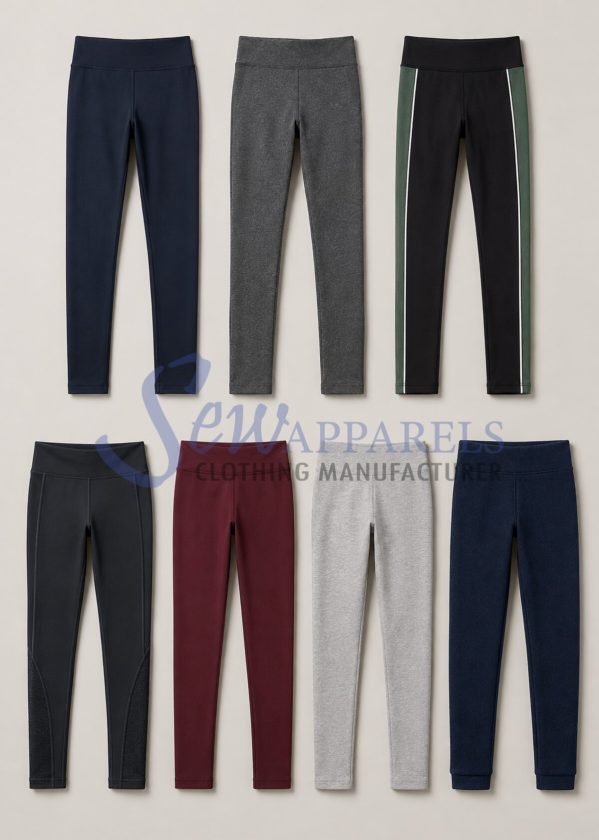
This guide provides five critical outfit checks and an approval matrix for procurement and development teams. It does not invent a school dress code, prescribe modesty standards or promise universal opacity. Start with requirements supplied by the school or authorized buyer, then assess actual garments in the combinations intended for the order.
School leggings under uniform coverage planning: define the scope
The approval should answer a specific question: is this identified leggings variant accepted as an underlayer with this identified outer garment and accessory combination? A sample labeled with a similar age or size is not necessarily the same pairing. Record the outer garment style, revision and size alongside the leggings reference and actual size.
Separate this outfit decision from knee recovery, seam integrity and material-friction investigation. Those concerns may need their own evidence, but they do not establish whether a visible leggings colour or length is accepted in the school outfit. Likewise, a layered review cannot approve standalone sportswear use simply because the garment is called leggings.
1. Record the school’s actual requirements and permitted role
School leggings school dress code inputs should identify the source, date and responsible decision maker. Record whether leggings are permitted under particular garments, whether a specified colour or visible length is required and which activities are included. If the school has not supplied a requirement, leave it unresolved rather than substituting a general assumption about what schools usually accept.
Clarify how the rule applies to the relevant season, age range or uniform option when the school distinguishes them. Do not assume that approval for one class, event or outfit extends to every situation. The buyer should obtain the relevant decision from the authorized school representative and attach that decision to the purchasing brief.
Include a school leggings standalone wear policy field. Record exactly whether standalone use is approved, excluded or outside the review’s scope. Where the brief concerns only an underlayer, state that boundary in the approval. It prevents a retailer or supplier from treating one layered sample review as evidence for a different use.
School leggings under uniform coverage planning should preserve the difference between a school requirement and a supplier proposal. A manufacturer can assess construction feasibility and provide samples; the manufacturer does not replace the school’s authority over the uniform combination. Keep both parties’ confirmations identifiable in the record.
2. Pair actual garment styles and sizes
A school leggings under pinafore outfit review needs the actual pinafore reference, leggings size and agreed layering arrangement. Include the outer garment’s adjustable settings where they affect the reviewed combination. A product photograph or age label alone cannot show how the selected items fit together in the intended size range.
For school leggings dress length pairing, record the approved outer dress length and the leggings’ finished length using the buyer’s agreed measurement references. The school leggings under uniform size pairing should identify both sizes independently. Do not require matching size labels if the brands use different systems; use the actual approved pairing and fit assessment.
Build a school leggings dress skirt outfit matrix with separate rows for materially different combinations. A change in outer garment style, leggings colour, length or size pairing can require a separate decision. Keep the reviewed sample revisions visible so the matrix cannot accidentally approve a substitute garment with a familiar product name.
Product identity supports this process. The FTC textile-labeling guide explains required fiber, origin and business-identity information for covered U.S. products. This is a market-specific labeling reference, not a school outfit rule or proof that two fabrics have the same appearance. Retain the supplier’s product specification and label data alongside the sample identity.
3. Observe visible areas during the approved review
School leggings under uniform coverage planning should define the observation before it starts. Specify the approved positions or movements, viewing conditions and garment combination. Record visible underlayer areas without making judgments about a wearer’s body. A school leggings classroom seated outfit review can document how the outer garment and underlayer appear in the agreed seated arrangement, within the school’s supplied criteria.
Use a respectful, supervised development process appropriate to the participants. Do not require uncomfortable poses, repeated exposure or activity beyond the agreed review. Stop if a participant is uncomfortable, and avoid collecting unnecessary personal details or identifiable images. The record should concern garment references, visible clothing areas and the authorized outfit decision.
The school leggings skirt hem coverage field should describe the relationship between the outer hem and the visible leggings area in the reviewed condition. Do not turn this into a universal acceptable hem measurement. A school leggings visible areas movement review should state which clothing regions were observed, what changed and which observations were not performed.
Distinguish a visible underlayer area from an opacity test result. If the buyer raises a separate fabric-opacity concern, identify that question and request suitable product-specific evaluation. This outfit matrix does not prescribe a squat test, certify opaque fabric or guarantee that lighting, stretch and every future garment will produce the same appearance.
4. Coordinate colour, length, socks and shoes
School leggings visible underlayer colour should be assessed with the actual outer garment and the approved viewing conditions. Record the colour reference rather than relying on a vague description such as “dark.” Where matching is required, retain the school or buyer’s accepted reference and describe how the sample was compared. Do not invent a universal colour tolerance.
The school leggings uniform sock interface should identify the selected sock length, leggings opening and shoe combination. Record whether the approved outfit intentionally shows a gap, overlap or another arrangement according to the supplied requirement. A different sock or shoe can change the visible result even when the leggings remain unchanged.
School leggings uniform length coordination should cover the relevant size pairings, not only the first sample. Check the actual finished lengths and accessory arrangement in the planned range, with any unreviewed combinations marked clearly. Avoid assuming that an accepted appearance in one size proves the same relationship across all grading steps.
Record the care state of each garment in the comparison. A new outer garment paired with previously cared-for leggings may represent a different condition from two new samples. The FTC care-labeling guidance discusses evidence-supported care instructions for covered U.S. garments and distinguishes care labeling for pieces sold as a unit. It does not approve an outfit combination or justify applying one garment’s care method to every separate item.
5. School leggings under uniform coverage planning: approve explicit limits
School leggings under uniform coverage planning ends with a traceable outfit decision. A school leggings approved uniform combination should identify the exact garments, sizes, colour, lengths, socks and shoes covered by the approval. Record who approved it, the applicable school requirement and any conditions attached to the decision.
The school leggings underlayer appearance approval should distinguish accepted, revise-and-review and not-evaluated combinations. Do not describe an unanswered row as approved because another row looks similar. Where an adjustment is proposed, identify which item changes and whether the original pairing evidence remains relevant.
A school leggings approved layered outfit reference should preserve the reviewed revisions and their limits. If standalone wear was not assessed, say so. If certain outer styles, sizes or care states remain outside the decision, list them. This gives purchasing and distribution teams a clear basis for selecting the approved combination rather than a broad claim that the leggings suit all uniforms.
An outfit approval matrix buyers can use
Use one row for each planned combination. The matrix below describes the fields to retain; it does not set a school policy or supply a standardized test method. Keep the supporting requirements and observations with the record so another reviewer can follow the decision.
| Required record | Outfit 1 | Outfit 2 |
|---|---|---|
| Requirement: school source, policy revision, permitted underlayer role and authorized reviewer. | ||
| Outer garment: named dress, skirt or pinafore, revision, size, length and relevant settings. | ||
| Leggings: product reference, revision, size, colour, finished length and care state. | ||
| Accessories: sock reference and length, shoe type and approved arrangement. | ||
| Observation: agreed positions, viewing conditions, visible clothing areas and unperformed observations. | ||
| Decision: accepted combination, required changes, scope limits and standalone-use status. | ||
| Change control: reviewer, approval date and trigger for a new pairing review. |
School leggings under uniform coverage planning should keep sample observations separate from the purchasing quantity. Once the outfit is approved, use its identity in the order brief. Do not treat an approval matrix as a demand forecast or assume the same size ratio is appropriate for every school.
Example: one leggings variant with two outer styles
Consider a hypothetical buyer reviewing the same leggings colour beneath a named dress and a named pinafore. The dress combination includes one sock arrangement; the pinafore combination uses another. Even though the leggings reference is unchanged, record separate rows because the outer length, visible areas and accessory interface may differ.
The first row may be accepted under the school’s supplied requirement while the second requires a different leggings length or sock selection. Record the actual decision without claiming one combination is universally better. If a sample revision is requested, retain its new identity and repeat the relevant pairing review before replacing the approval reference.
This school leggings under uniform coverage planning example contains no invented school rule or outcome. Its purpose is to show why each combination needs a decision. The school’s criteria, the actual garment fit and the recorded observations determine approval, not a generic preference for a particular style.
Prepare a clear underlayer development brief
For custom school leggings manufacturing, share the school-approved outfit list, actual size pairings and visible colour or length requirements with the supplier. Ask the supplier to confirm feasibility for proposed changes instead of assuming every configuration is currently available. For private label school leggings production, keep the outfit reference connected with the approved product specification and labeling information.
Discuss the relevant product brief through the school leggings manufacturing product page and keep development decisions organized through the existing School Leggings Buying Guides. The commercial page remains the supplier discussion destination; this article provides a focused approval structure for under-uniform pairings.
Frequently asked questions
Does underlayer approval allow leggings to be worn alone?
No automatic conclusion follows. School leggings under uniform coverage planning must record standalone-use status separately according to the school’s actual requirements and the evidence reviewed.
Can one outfit sample approve every size?
Do not assume so. Identify the reviewed size pairings and any further combinations requiring assessment. Label or age names alone do not establish the same fit and visible appearance.
Is this an opacity certification?
No. The matrix records a layered outfit decision under defined conditions. A separate material-performance question needs its own appropriate evaluation and evidence.
A useful school leggings under uniform coverage planning record gives the buyer an exact approved pairing, identifiable observations and clear boundaries. It supports consistent product decisions without inventing a dress code or overstating what one outfit sample can establish.