
School leggings underlayer cling review helps uniform buyers compare a particular pair of garments before approving a collection. A skirt that catches against leggings is an observation, not proof that either item is defective. The useful question is whether the named leggings and outer garment work together under recorded conditions, and what evidence supports that decision.
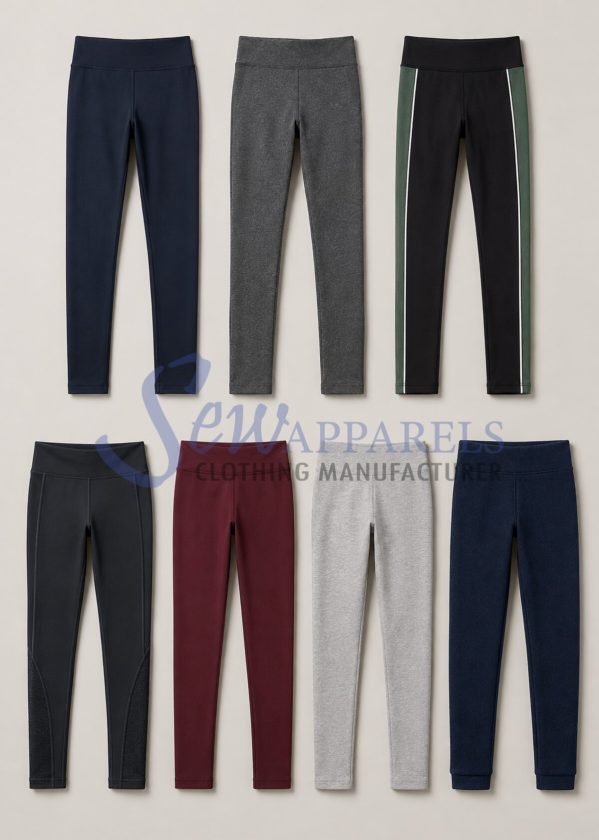
School leggings skirt cling can differ between an unlined skirt, a lined dress and a pinafore, even when the leggings remain unchanged. Buyers therefore need a layer-pair compatibility record rather than a general promise that a fabric will never cling. This guide sets out five critical checks for recording the pair, its care state, movement observations, specialist questions and approval limits.
The process concerns interaction between clothing layers. It does not replace waistband fitting, knee recovery assessment, school dress-code approval or a laboratory investigation of electrical properties. For collection development, start with the actual samples and preserve uncertainty until a comparison answers the purchasing question.
1. Identify the actual pair before comparing results
A school leggings underlayer cling review should identify both garments. Record the leggings style, sample revision, size, colour, fabric reference and finish information available from the supplier. Record the outer garment with equal care: its style, size, shell material, lining, construction revision and contact surface. A lining is part of the pair, not a detail to omit.
School leggings dress layer interaction cannot be assessed reliably by naming only the dress fibre. Two garments with similar declared composition may have different constructions, finishes or internal surfaces. Ask for the material specifications actually used in the samples; do not fill missing information with assumptions about what a school uniform normally contains.
Use a unique pair reference, such as Pair A, linked to the two sample identities. If a skirt or lining changes, create a new comparison entry. School leggings fabric pair comparison then remains traceable when purchasing staff, a pattern team and a material specialist discuss the same result. Retain the sample revision rather than relying on a supplier photograph or collection name.
Define the purchasing question
State what would make the pairing unacceptable for the intended uniform: repeated catching during an agreed movement, an outer layer that does not settle as expected, or a wearer reporting uncomfortable drag. Agree the observation method and acceptance wording before seeing the result. Avoid an arbitrary numerical limit that nobody has connected to the garment or use case.
2. Record material, care and comparison conditions
School leggings underlayer cling review needs the condition of each sample as well as its identity. Distinguish new garments from laundered garments, and record how they were stored before comparison. If a finish or treatment is reported, ask what documentation supports it and whether it applies to the delivered material, colour and production stage.
The FTC care-labeling guidance explains the need for reliable support for care instructions, including the garment as a whole. Its context is US care labeling. For this comparison, retain each item’s supported instructions rather than assuming the leggings and dress share a washing route. Different care histories must remain visible in the record.
School legging care cling conditions should describe the actual wash and dry procedures, any documented products used, cycle count and subsequent handling. If those details are unknown, label them unknown. Do not recommend extra heat, chemicals or a laundry additive as a solution without checking garment compatibility and the appropriate evidence.
ISO 6330:2021 describes domestic washing and drying procedures for textile testing. It can help a qualified laboratory specify preparation consistently; it is not a cling test or product certification. Identify the selected procedure and drying route when applicable. A stated laboratory cycle count does not automatically predict a garment’s lifetime in every household.
Keep comparable samples comparable
If one pair is freshly laundered and another is new, their difference cannot be attributed to material alone. Ask the specialist which preparation and environmental records are relevant to the comparison. Record departures rather than trying to make the report sound uniform. A useful school leggings underlayer cling review makes the limits of its preparation clear.
3. Separate observed catching from an assumed mechanism
School legging layering friction is a practical concern when one surface resists movement against another. Fit, contact area, seam placement or outer-layer construction may also matter. Describe what happened first: where the garment caught, which movement preceded it, and whether the outer layer settled after movement stopped. Do not turn an observation into a diagnosis.
School legging underlayer static questions should be recorded separately. Visible cling alone does not demonstrate electrical charging, establish its cause or substantiate an antistatic claim. If the buyer needs an electrical-property claim, a qualified specialist must advise on an appropriate method, sample preparation, interpretation and claim scope.
A school legging static evidence request should identify the proposed claim and actual material pair. Ask whether the available evidence addresses that claim, whether it covers the production material and what conditions it represents. A supplier’s descriptive phrase or a different fabric report is not an automatic approval for the finished leggings.
School leggings fabric surface interaction can also change when the inside of the outer garment changes. Record seams, lining surfaces or local construction details at the observed contact location. These notes guide investigation; they do not prove that one feature caused the issue. Keep proposed explanations in a separate column from directly observed facts.
4. Agree a controlled layered sample comparison
School leggings underlayer cling review becomes useful when the team can compare alternatives without changing everything at once. Agree the sample pairs, preparation, movement observations and review criteria with the relevant specialist. Where feasible, change one material or construction variable while retaining a documented baseline. Record unavoidable differences explicitly.
A school leggings layered sample trial might compare one leggings sample with two named outer garments, or compare two leggings revisions with the same skirt. These are development scenarios, subject to supplier feasibility and a suitable evaluation plan. They are not claims that a particular configuration is currently offered or that either comparison guarantees a better result.
For school legging outer layer movement, define ordinary, appropriate observations such as standing, walking and sitting when the review includes wearing samples. Note the contact location, whether adjustment was needed and whether the layer settled. Do not create stressful movements or expose a child to discomfort merely to produce an apparent failure.
A school legging layer comfort sample should fit the reviewer’s approved participation arrangements. Obtain appropriate permission, respect privacy and stop if discomfort occurs. Record wearer feedback without unnecessary personal information. A material comparison can begin with specialist handling assessments; wearer participation is not a reason to overlook suitability or consent.
Distinguish observation from laboratory evidence
A buyer trial can document the behaviour seen in its defined setting. It does not establish a universal performance rating. If a specialist recommends laboratory work, record its method, specimen identity, preparation, result and interpretation separately. Do not describe an informal movement review as standardized testing or claim that a washing standard measured cling.
5. Approve the pair with explicit evidence limits
The outcome of school leggings underlayer cling review should name the approved pair and its boundaries. School leggings outer garment compatibility is specific to the garments and conditions reviewed. Approval for one lined dress does not cover every skirt in the range, another lining supplier or an undocumented fabric finish change.
School leggings material pairing approval should state who reviewed the evidence, which revisions were accepted, which conditions were represented and what remains unresolved. Possible outcomes include approval within scope, further comparison required, or rejection of that pair pending a documented correction. Avoid replacing these distinctions with a single reassuring adjective.
Preserve an approved reference pair and the comparison record where practicable. If the supplier proposes a replacement material, compare it with the reference before carrying the approval forward. Keep commercial feasibility and performance acceptance separate: a convenient sourcing choice is not evidence of compatible garment behaviour.
School leggings underlayer cling review: build a compatibility record
A school leggings cling review worksheet can use a short sequence of labeled fields. It should be readable by someone who did not attend the trial and detailed enough to identify the physical samples. The following structure is an original purchasing aid, not a laboratory standard or a prescribed regulatory form.
- Pair identity: leggings and outer-garment styles, revisions, sizes, colours, material references and lining details.
- Preparation: new or laundered state, documented wash and dry routes, cycle count, handling and relevant conditions agreed with the specialist.
- Observation: movement or handling action, contact location, catching, settling, adjustment and appropriate wearer feedback.
- Interpretation: directly observed facts, proposed explanations, specialist questions and any laboratory evidence kept distinct.
- Decision: acceptance criterion, outcome, reviewer, date, limits and the next action for unresolved issues.
For example, a school leggings cling observation may record that a named skirt caught at a particular contact area during the agreed walking observation. The next step is to repeat the controlled comparison and investigate relevant differences, not to declare the leggings electrically defective. Record whether the same behaviour occurred again and whether another pair behaved differently.
School leggings underlayer cling review: prepare a product brief
For custom school leggings manufacturing, send the actual pair references, material information and comparison question with the development brief. The school leggings manufacturer page provides the relevant product enquiry route. Request confirmation of material availability, sample feasibility and quotation scope rather than assuming a minimum quantity, price or delivery schedule.
For private label school leggings production, preserve the approved specifications and change-control requirements in the purchase documentation. The school leggings buying guides connect this layer-pair review with other product-development decisions. Each decision needs its own evidence; a satisfactory layering observation does not automatically approve seam durability or garment fit.
School leggings underlayer cling review: buyer questions
Does fibre composition predict whether a skirt will cling?
Composition is useful identification information, but the actual pair also includes construction, surfaces, fit and preparation. Compare documented samples instead of treating a fibre name as a performance guarantee.
Can the buyer describe the leggings as antistatic?
Not on the basis of visible cling observations alone. Define the intended claim and ask a qualified specialist what evidence would substantiate it for the relevant product and conditions.
Must every outer garment be reviewed?
Approval should identify its coverage. If the collection contains different linings, materials or constructions, agree representative comparisons and their limits rather than assuming one sample covers all variants.
What is the final purchasing deliverable?
A traceable school leggings underlayer cling review ends with a named layer-pair record, documented observations, evidence boundaries and an approval decision. That record lets the team develop a compatible uniform pairing while avoiding unsupported claims and carrying unresolved assumptions into production.