
A school PE uniform house colour MOQ review should begin with confirmed demand, not an assumed minimum copied from another order. A school may need one coordinated kit divided across several house colours, yet the supplier may purchase fabric, rib, thread and decoration separately. The total pupil count therefore cannot explain whether every colour is feasible. Buyers need a clear allocation sheet connecting each house, garment, size and material with the supplier’s actual minimum basis.
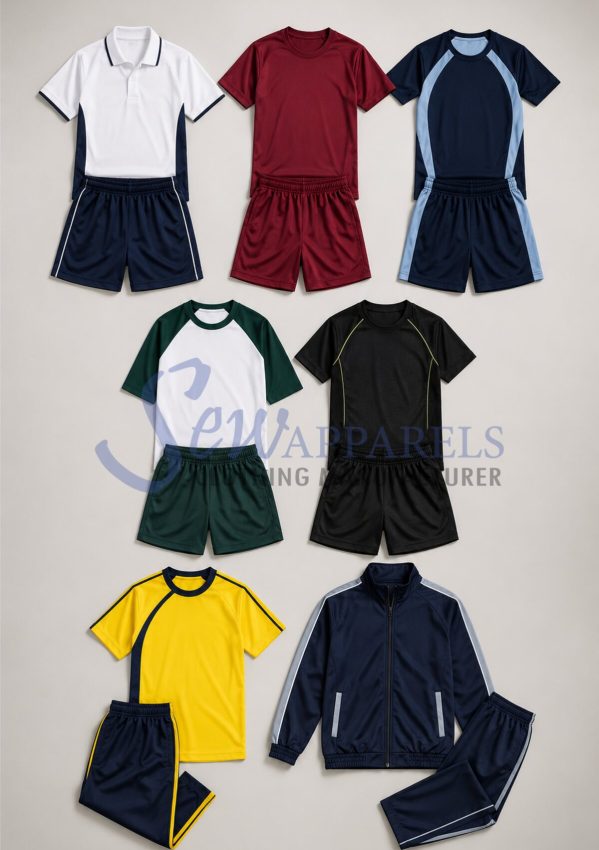
This guide explains five critical checks for comparing options without hiding excess stock. It focuses on order fragmentation and purchasing decisions rather than colour-block seam geometry. For a school PE uniform house colour MOQ brief, distinguish confirmed orders from optional reserves and forecasts. Keep personal pupil details outside the supplier worksheet; aggregated house and size quantities usually provide the commercial information needed for quotation.
1. Establish demand before testing minimums
Start with a dated garment list: tops, shorts, trousers or other approved pieces. Record whether a pupil buys a complete set or individual replacements, because one set does not always consume one of every item. Identify the approved size chart, school year, ordering deadline and delivery location. House allocation should reflect current confirmed requirements; do not silently increase a small house’s order to make the overall total look attractive.
The PE kit house colour minimum quantity belongs beside the demand for that colour, not only in a summary cell. Ask whether the stated minimum applies to finished pieces, a combined kit, each garment style or a fabric order. A school sports kit colour order split can show plenty of total demand while leaving one garment-colour combination below the supplier’s requirement. Check tops and bottoms separately before combining costs.
Give the school house kit colour allocation an owner and revision date. Use house codes rather than individual names, and keep confirmed orders, exchanges, staff samples and contingency quantities in separate columns. A reserve is a buyer decision with a budget and storage consequence. It is not evidence that pupils will purchase those garments later. Changes after approval should identify which material purchases or production plans are affected.
In the school PE uniforms house allocation size matrix, place garment sizes in columns and house colours in rows. Reconcile each row with its house total, each column with size demand and the complete matrix with the purchase order. Check whether a size designation means the same measurements across every garment. A top and bottom with identical printed size labels may still require different quantities when sold separately.
2. Separate fabric, garment and component minimums
A school PE uniform house colour MOQ can involve several independent constraints. A sewing facility may quote a style minimum; a mill may require a dye lot; a rib supplier may have its own colour run; a decoration supplier may charge setup independently of quantity. Ask which constraint governs each scenario and whether combining houses actually changes it. Obtain the answer in the quotation instead of treating a verbal general minimum as approval.
The PE uniform shared fabric MOQ should name the common fabric specification, usable width, finished weight, composition and colour. Fabric described as the same quality cannot automatically be pooled if finishing, shade or purchase timing differs. Record the purchase unit and conversion assumptions. Kilograms, metres and garment pieces are different measures, so a fabric minimum needs an approved consumption calculation before it can be compared with kit demand.
For school PE uniforms sports kit dyeing minimums, ask about each colour’s minimum purchase, permitted ordering increments, sampling scope and excess ownership. Distinguish material bought for production from finished garments delivered to the school. A supplier might retain unused fabric under agreed terms, or the buyer might need to purchase it; neither arrangement should be assumed. Specify where it is held, how long it is reserved and who authorises its later use.
Review school PE uniforms house trim quantity requirements for rib, elastic, printed badges, transfer sheets and other colour-dependent components. A small contrast panel can consume little fabric while still triggering a separate purchasing requirement. Confirm compatible thread and decoration quantities, too. Do not replace an approved component solely to clear a minimum without a sample review covering appearance, movement, care and the school’s identity requirements.
3. Compare shared bases with house-specific components
Prepare feasible design scenarios before asking for final costing. One option may use a common base garment with a house-specific component; another may use a fully coloured body. These are development proposals, not a statement that any supplier currently offers them. The school must confirm which visible house identifiers are mandatory, and the supplier must confirm material availability and construction feasibility before a scenario becomes an order.
Record school PE uniforms shared base garment colours alongside the unchanged technical specification. Explain exactly what remains common and what changes: body fabric, sleeves, side panels, collar, logo or packaging. Shared dark fabric may simplify one purchase but leave coloured rib or decoration fragmented. Evaluate the complete bill of materials rather than declaring the entire kit pooled because its largest panel uses a common colour.
The school PE uniforms PE fabric sharing feasibility review should consider both garment consumption and sample performance. Obtain a production-intent sample showing the selected components together. Check colour transfer, differential dimensional change, opacity during movement and decoration condition under the agreed care route. Pooling cannot justify abandoning an approved fabric or accepting an unsuitable contrast material. Record any revised specification and school approval before obtaining a revised quotation.
Keep a school PE uniform house colour MOQ comparison on one consistent demand basis. If Scenario A uses the exact confirmed orders and Scenario B adds finished stock, their per-piece quotations describe different purchases. Show the additional quantity and its reason separately. Similarly, a stock fabric alternative requires evidence of current availability and shade suitability; it is not a guaranteed shortcut for future replenishment.
4. Build a school PE uniform house colour MOQ scenario matrix
Use the following worksheet structure for the school PE uniforms PE kit minimum basis comparison. Each scenario should identify its garment list, confirmed house-size demand, shared material specification, supplier minimum unit, ordering increment, material requirement, purchased amount, excess disposition, quotation scope and approval status. Record unknowns as pending supplier confirmation. An empty minimum or cost cell must never be interpreted as zero.
| Required information | Scenario record and confirmation |
|---|---|
| Demand: house code, garment, ordered size quantities and confirmed total. | Record confirmed details; identify the owner and any open supplier question. |
| Common material: specification, colour, usable width and purchase unit. | Record confirmed details; identify the owner and any open supplier question. |
| House-specific material: component, consumption assumption and supplier minimum. | Record confirmed details; identify the owner and any open supplier question. |
| Purchasing result: required amount, ordered amount and unallocated remainder. | Record confirmed details; identify the owner and any open supplier question. |
| Commercial scope: samples, setup, packing, delivery basis and exclusions. | Record confirmed details; identify the owner and any open supplier question. |
| Decision: feasibility evidence, excess owner, approver and version. | Record confirmed details; identify the owner and any open supplier question. |
For an illustrative school PE uniform house colour MOQ calculation, suppose House A orders 36 tops and House B orders 18. If a supplier confirms a minimum of 30 finished tops per house colour, House B is short by 12 tops under that particular scenario. The combined 54 does not remove the colour-specific requirement. These figures are invented worksheet examples, not Sew Apparels minimums, forecasts or quotations. If the minimum instead concerns fabric metres, this finished-piece calculation is inappropriate.
Calculate school PE uniforms house colour excess stock by its actual form. Finished-piece excess is purchased pieces minus committed demand; unused material is purchased material minus approved consumption. Do not add metres to garment counts. A negative result signals an unmet requirement, not usable stock. Show whether a remainder can make complete kits, particular sizes or only one component before assigning any potential replenishment value.
Request school PE uniforms school sport kit quote scenarios on the same currency, delivery basis, size distribution, quality specification and payment assumptions. Ask suppliers to distinguish confirmed inclusions from optional costs. Review sample charges, artwork setup, minimum purchases, storage and repeat-order terms separately. A smaller initial invoice may leave an unresolved material liability; an apparently higher unit price may cover services excluded elsewhere.
5. Approve school PE uniform house colour MOQ stock and reorders
The school PE uniform house colour MOQ decision should include a written plan for leftovers and repeat orders. Identify who owns reserved fabric and completed garments, how quantities are reconciled, and when a new purchase is required. Define acceptable shade variation through an agreed reference and sample review. Keeping a colour name unchanged does not establish that a future batch will visually match an earlier one.
Prepare a school PE uniforms house demand supplier brief that includes the approved matrix, garment drawings, size chart, material references, decoration files, packing instructions and decision log. Label tentative quantities clearly. For school PE uniforms initial house kit order approval, verify that the purchase order agrees with the quotation and sealed sample. Do not let an allocation revision change fabric or delivery commitments without a documented commercial review.
Maintain school PE uniforms school sports colourway quantities as identifiable inventory records. If the distribution route uses GTINs, consult the GS1 GTIN Management Standard for trade-item identification decisions. This reference supports consistent identification; it does not determine garment MOQ, validate school demand or replace supplier inventory reconciliation. Use your approved item codes consistently on ordering, packing and exchange records.
Changing a fabric or component may also affect product information. For goods supplied to the United States, the FTC textile and wool labelling guidance explains fibre content, origin and responsible-business information for covered products. Apply the relevant destination requirements and check the actual material data. A house-colour change does not justify copying an old label without confirming that its declarations remain accurate.
School PE uniform house colour MOQ: buying questions
Can all house quantities satisfy one minimum?
Only when the supplier confirms that minimum’s scope permits aggregation. Common fabric purchases, garment style quantities and colour-specific components may follow different rules. Put the agreed aggregation basis in writing and reconcile every independent constraint.
Should the smallest house order more to meet a minimum?
Compare feasible alternatives and the full excess liability first. Extra garments need an approved budget, usable size distribution and stock owner. Future pupil demand remains uncertain; do not treat possible reorders as committed sales.
Does using a common base guarantee a cheaper kit?
No. Contrast components, decoration, sample development and handling may change the result. Compare complete quotations on one technical and commercial basis, then choose the option supported by evidence and school approval.
Prepare an actionable PE uniform enquiry
Use a school PE uniform house colour MOQ worksheet to state exactly what the buyer needs and which assumptions still require confirmation. For custom pe uniform manufacturing, share the garment list and aggregated house-size demand through the PE uniforms manufacturing page. For private label pe uniform production, add approved labels, artwork, sample expectations and the destination market. Consult the related technical topics in the PE uniforms buying guides before finalising the brief. The objective is a feasible, documented order—not a minimum promised without reviewing the product.