
PE UNIFORMS PRODUCT DEVELOPMENT
PE Uniforms Buying Guides
Use these PE uniforms buying guides to turn PE uniform ideas into measurable fabric, movement, fit, colour blocking, care and quality requirements. Each guide supports a distinct product-development decision while keeping sampling, approval and production evidence connected. Start with the related articles below, then use the product page when your brand is ready to prepare a focused manufacturing enquiry.
Review the PE Uniforms product page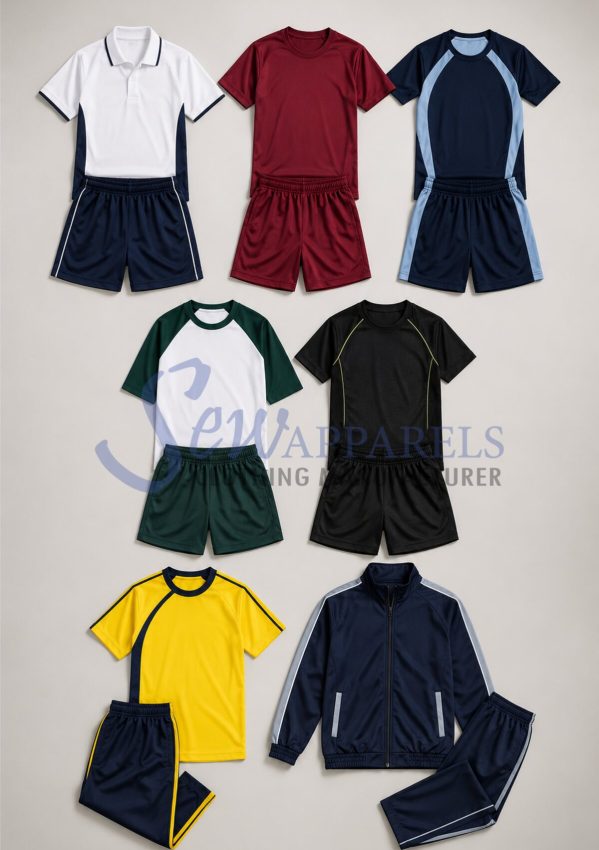
PE uniform examples reused from Sew Apparels’ product page for garment and colour context. This image does not demonstrate movement, opacity, stretch recovery or care-test results; approve those properties using identified samples and agreed evidence.
GUIDE 01
Movement Friendly Panel Design: PE Uniforms
Plan panel placement, stretch direction, seam positions and movement checks for PE uniform tops and bottoms using a measurable sample checklist.
Read the movement panel design guideGUIDE 02
Colour Blocking Construction: PE Uniforms
Specify panel alignment, contrast fabric shrinkage and seam positioning for PE uniforms with measurable pattern, wash and bulk-inspection controls.
Read the colour blocking construction guideGUIDE 03
Sublimation quotations: compare complete PE kit production routes
Align artwork, materials, sample scope and order quantities before comparing printed panels with cut-and-sewn colour designs. Use five checks and a route matrix to separate confirmed charges from exclusions and connect the chosen quotation with approved evidence.
Read the sublimation quotation comparison guideGUIDE 04
House colour MOQ: align school PE kit quantities and excess stock
Separate garment, fabric and trim minimums before dividing a PE kit order across school house colours. Use five checks and a scenario matrix to reconcile confirmed house-size demand, shared materials, excess stock ownership and supplier quotation assumptions.
Read the house colour MOQ planning guideGUIDE 05
Mesh snag review: distinguish catching from abrasion in PE panels
Map PE kit mesh panels against credible equipment contact before approving a sample. Use five checks to separate pulled loops from abrasion, retain material identity and agree a laboratory brief, correction sample and traceable approval record.
Read the mesh snag review guideGUIDE 06
Print colour changes: trace PE kit substrate and decoration evidence
Investigate pale PE kit prints that change shade on dark materials without diagnosing the cause from appearance alone. Use five evidence checks and a compatibility card to connect substrate identity, processing history, controlled comparisons, care evidence and exact-combination approval.
Read the print colour investigation guideHow to use PE Uniforms Buying Guides
A useful PE uniform brief begins with the activities students perform, the school dress code, the age and size range, and the expected laundering frequency. Define whether the set includes a top, shorts, trousers or layering piece; record each item separately before coordinating colours and trims. Translate comfort and durability claims into garment measurements, seam drawings, fabric specifications and acceptance checks. Record a fit-model profile and representative small, middle and large sizes.
A coordinated set should be assessed during running, stretching and sitting, not only while standing. Confirm which logo and colour placements are mandatory so design revisions do not break school identity. Use these PE uniforms buying guides to record the intended activity and the approval evidence required for each garment in the set.
Movement panels and range of motion
Movement-friendly PE uniforms need enough ease at the shoulders, armholes, seat and crotch without excess fabric that catches during activity. Define the panel shapes, seam placement and grain direction on the pattern. If stretch panels are used, specify their orientation and recovery after repeated extension. Trial reaching, jumping, squatting and running in the complete outfit, including the expected underlayer.
Check that hems stay in place, side seams do not twist and openings retain coverage. Compare the first sample with a laundered sample, because differential shrinkage between panels can alter both fit and appearance. Record the movements and tolerances in the approval sheet so production can repeat the assessment. The PE uniforms buying guides connect the panel map with this movement record so later pattern revisions can be reviewed against the same brief.
Fabric performance, opacity and recovery
Select PE uniform fabrics using stated fibre composition, finished weight, stretch, recovery, opacity, colourfastness, dimensional stability and care requirements. Evaluate the complete garment, not an isolated swatch: contrast panels, rib trims, waistbands and thread can respond differently to washing. Test comfort during exertion and drying time under the agreed use conditions. A lightweight fabric should still offer suitable coverage when stretched, while a heavier fabric must not restrict movement or retain excessive moisture.
Keep a sealed material standard with shade references and test results. Approve production-intent trims and decoration at the same time so sampling and bulk purchasing follow one controlled specification. Keep the PE uniforms buying guides alongside the material specification when asking which properties are confirmed and which still need sample evidence.
Fit, coverage and size grading for PE uniforms
Assess the top and bottom as a coordinated PE uniform set. Check shoulder and chest ease, sleeve opening, waist security, rise, seat room, leg opening and hem length through the same movement sequence used for development. Students should be able to run and stretch without a waistband slipping, a top riding up or a seam pulling at a stress point. State finished measurements for each garment, with tolerances and a size chart that the school or brand can understand.
Review representative graded sizes rather than assuming a good base-size sample guarantees every size. Repeat key measurements after the agreed wash process and record pattern changes with sample photographs and approval dates. Use the PE uniforms buying guides to keep body measurements, finished garment measurements and movement observations clearly separated in the approval record.
Seam construction, reinforcement and decoration
Plan PE uniform seams and decoration for repeated motion and school laundering. Identify stress points at the crotch, underarm, side seams and pocket openings, then specify seam type, stitch density, reinforcement and acceptable appearance. Colour-block panels need alignment marks and a defined tolerance so left and right sides match across sizes. Test whether contrast materials shrink or bleed at different rates before approving bulk production. Place printed or embroidered school marks where stretching and friction will not distort them, and record artwork dimensions from stable reference points. Inspect a washed sample for seam grin, puckering, thread breakage, panel distortion and logo damage. A construction sheet should let the factory reproduce the approved result, not rely on visual guesswork.
Laundering, durability and quality control
Confirm the school or brand care instructions before sealing the PE uniform sample. Define wash temperature, detergent conditions, drying method and the number of assessment cycles. Measure dimensional change, colour transfer, panel twisting, elastic recovery, logo condition and seam appearance before and after care. Approve the complete colour set under an agreed viewing condition, including shell fabrics, contrast panels, thread, rib and decoration.
Build a production inspection plan around measurable garment points and visible defects, then retain both pre-production and washed reference samples. Record batch and shade information so repeat orders can be checked against the same standard. Performance statements should reflect actual product tests and intended use rather than unsupported claims. These PE uniforms buying guides support a written care and inspection brief; they do not establish universal laboratory pass limits.
Low MOQ PE uniform manufacturer support for startup brands
A low MOQ PE uniform manufacturer can help a startup brand or growing schoolwear label validate a coordinated sports set before committing to a larger programme. Small MOQ development still needs a clear technical pack, fabric and trim approvals, a size set, care requirements, logo artwork and a sealed sample. We give startup brands a practical route to sampling when the brief limits unnecessary variations and defines clear approval stages.
Begin with one base silhouette and colourway, then test movement and laundering before extending the range. Confirm current commercial minimums, material availability and development timing for the selected PE uniform style directly with the manufacturer; avoid assuming one fixed minimum fits every fabric and decoration method. Sew Apparels’ PE uniform product page currently lists an MOQ of 1,000 pieces, sampling of 10–15 days and production of 20–45 days. Confirm the applicable garment set, design and colour allocation, material availability and milestones in a current quotation. These PE uniforms buying guides help startup brands prepare that discussion.
Documentation and approval route
The final PE uniform package should connect drawings for every garment in the set, measurement charts, grade rules, panel maps, seam details, bill of materials, colour references, logo artwork, labels, packaging, care method and quality plan. Give each file a version and date and identify who approves each sample stage. Maintain a change log for fabric, fit, colour-block and decoration decisions so later revisions cannot be confused with the sealed reference.
Costing should use the confirmed construction and material route. Before production, reconcile the purchase order with the approved samples and technical pack so quantity, size ratio, colours, labelling and delivery requirements describe one controlled product. Keep the PE uniforms buying guides with the dated development file so purchasing and quality teams can trace the decisions supporting each order.
Technical references for PE uniform development
Use ISO 8559-1:2017 for consistent anthropometric definitions that support clothing size and shape profiles, and ISO 18890:2018 for principal garment measurement points and agreed additional measurements. These references support clear body measurements, set proportions and graded-size evidence. They do not replace PE-uniform movement trials, laundering validation, sealed samples or buyer acceptance limits.
ISO anthropometric measurement definitions ISO garment measurement methodTurn your PE uniform decision into a product brief
Use these PE uniforms buying guides to prepare a PE uniform brief covering panel maps, fabric standards, top and bottom fit measurements, colour approval, care evidence, logo details and quantity route. Send the confirmed brief for focused costing and sample development. Keep each approval measurable so production can be inspected against the same sealed standard.
Review custom PE Uniforms manufacturing