
School pinafore zipper usability review helps uniform buyers turn a closure idea into a documented sample decision. A zipper that opens smoothly on a table may be difficult to reach when the garment is worn. The buyer therefore needs to assess access, opening and closing, fabric catching and interior contact in the intended dressing context, without assuming that one successful observation proves suitability for every wearer.
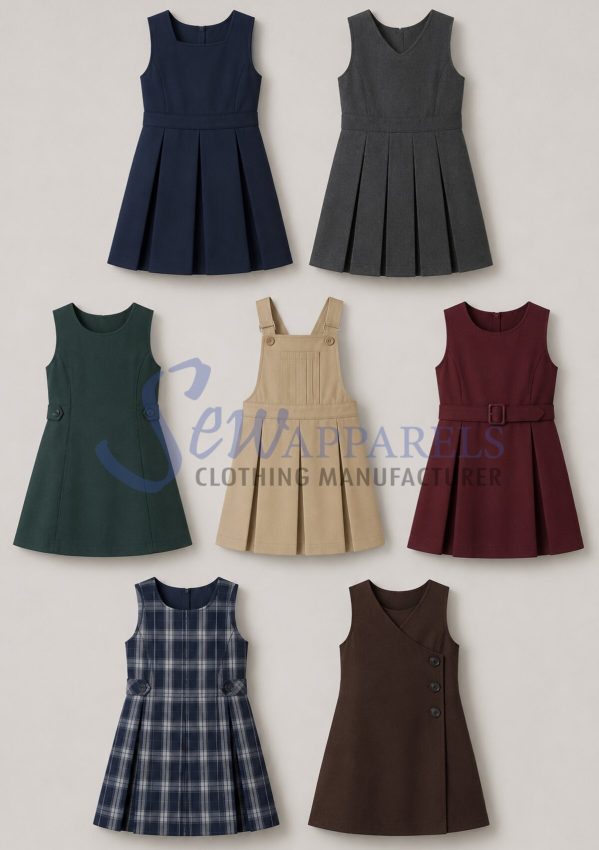
The practical output is a zipper usability observation sheet. It identifies the sample, records what happened and separates unresolved design questions from an approval decision. School pinafore zip opening access is one part of that record; operation, garment fit and the accompanying shirt can also affect the experience being reviewed.
This guide provides five critical checks for a product-specific development brief. It does not establish child-safety compliance, replace qualified component assessment or guarantee independent dressing. Start with technical review of the garment and use appropriate, approved participation arrangements for any wearer observations.
1. Define wearer age and the dressing context
A school pinafore zipper usability review should begin with the intended age and size range, the usual accompanying garments and whether dressing is expected to be independent or assisted. Describe the buyer’s actual requirement. Do not assume that every child of a stated age has the same reach, dexterity or experience with a zipper.
A school pinafores wearer age usability brief should identify the reviewed size and closure specification alongside those requirements. Record whether the sample represents the proposed production garment, an early prototype or an alternative under consideration. An early development sample can generate useful questions, but it should not silently become the approved reference.
For school pinafores zipper access dressing context, distinguish putting the garment on from making an adjustment while already wearing it. A zipper may serve an entry opening, a side seam or another proposed construction. Specify which task the observation is intended to address, and keep unrelated strap and waist-adjustment decisions separate.
Plan appropriate participation
A school pinafore child dressing sample must be suitable for the intended review before anyone is asked to wear it. Have the relevant team check the prototype and define an appropriate observation process. Obtain required permission, protect privacy and stop if there is discomfort, distress or an unsuitable sample condition. Do not ask a child to perform forced movements or hazardous experiments.
2. Compare access to the proposed zipper location
School pinafore zip placement tradeoff should be recorded against the actual garment rather than a general preference for front, side or back closures. Ask what the proposed location contributes to the design, how the user reaches it and what other garment details affect that task. Different placements are development scenarios subject to technical feasibility, not claims that every option is currently offered.
A school pinafores zipper location reach review can begin with garment inspection and appropriate technical handling. Identify the start and end of the opening, the pull location and the adjacent fabric. Record the shirt or other layer intended beneath the pinafore. A result obtained without the usual layer may not describe the planned uniform combination.
School pinafores back zip operation observation should distinguish reaching the pull from moving the slider through its travel. If assistance is needed, record the stage and the context instead of describing the wearer as incapable. The product question is whether the closure arrangement meets the defined use brief, and what change should be considered.
The school pinafore zipper usability review should also identify the garment size and fit state. An unsuitable sample size can confound a reach observation. If the sample does not represent the intended fit, retain the observation as provisional and arrange a suitable sample before drawing a purchasing conclusion.
Avoid an unsupported universal comparison
A comparison between two placements should preserve the relevant garment assumptions where feasible. Note differences in opening length, construction, material and fit. Do not declare one placement universally easier from a single informal demonstration, or carry one reviewed size’s result across the entire range without a justified review plan.
3. Observe opening and closing on an approved sample
School uniform pinafore zipper operation includes locating the pull, beginning the movement, moving the slider and reaching the intended opening or closed position. Record these stages separately. A summary such as difficult to use is less helpful than a description of the particular step that required adjustment or assistance.
A school pinafores pinafore opening sample trial should use a named sample and an agreed ordinary task. Identify whether the garment was on a form, handled by an adult reviewer or worn under approved arrangements. These situations provide different evidence. State the setting rather than presenting all observations as a wearer trial.
School pinafores independent dressing observation can record what assistance or instruction was provided and what happened afterward. Avoid prompting repeatedly until a desired result appears and then recording only that result. If the task changes between observations, note the change. A fair development record includes unsuccessful or unresolved stages.
A school pinafore zipper usability review can compare the original sample with a technically approved revision. Keep each revision’s specification and observations separate. If the revision changes the zipper supplier, installation or adjacent construction, describe those changes before attributing the outcome to a single design feature.
Do not turn observation into a mechanical rating
Ordinary handling observations do not establish a quantified operating-force rating, attachment strength or durability result. If one of those properties matters to the purchasing decision, ask a qualified specialist about an appropriate method and its scope. Do not invent a universal force limit or describe repeated informal operation as certified testing.
4. Check fabric catching and interior contact
School pinafores zipper fabric catching should be described by location, stage and the material involved. Record whether the adjacent shell, lining or accompanying garment entered the slider path during the agreed observation. Separate a visible catching event from a proposed explanation about installation or construction.
For a worksheet field labeled school pinafores pinafore closure interior contact, describe the closure’s inside surface and the contact reported or observed in the reviewed setting. Note the sample construction and underlying garment. Do not use a comfort comment as proof that the component meets applicable safety requirements.
If a sample catches or produces discomfort, stop the relevant observation and return it for technical review. Do not force the slider, deliberately trap material against a wearer or continue until damage occurs. Inspection of the garment off the wearer can help the team identify the next safe investigation step.
A school pinafore zipper usability review should record the unresolved question precisely. For example, the team may need to investigate clearance beside the zipper, installation alignment or an interior construction detail. These are questions for the actual sample; they are not a recommendation to add a particular guard or trim without checking feasibility and evidence.
5. Record feedback and refer component questions for review
School pinafores closure usability feedback should combine the task observation with the reviewed garment identity. Distinguish wearer comments, directly observed events and technical interpretation. Ask the development team to identify the proposed correction and what new evidence would support approval, rather than treating a reassuring comment as a closed issue.
The CPSC material-change testing guidance explains that changes to a children’s product’s design, manufacturing process or component source can affect compliance with applicable requirements. For a relevant US-market product, have the responsible compliance team review a proposed zipper or installation change and determine the testing and certification consequences. Usability observations do not replace that review.
School pinafores component safety evidence scope should therefore be a distinct section of the brief. Identify the market, intended product and changed components for qualified assessment. Avoid claiming that an existing report covers a replacement zipper or revised garment when the report’s identity and scope have not been checked.
The CPSC tracking-label guidance describes identifying information for children’s products and packaging, to the extent practicable, including responsible business, production location and date, and batch or similar information. Such traceability can support identification of affected production. A tracking label itself does not establish closure usability or certify safety performance.
Preserve the revision history
A school pinafores zipper technical review record should identify the original sample, proposed changes, responsible reviewer and approval outcome. Keep the relevant material and component references linked to each revision. Do not overwrite an earlier failure observation with a later successful sample result; the history explains what was changed and what was actually reviewed.
School pinafore zipper usability review: build the observation sheet
Use one entry for each sample and task. The following original worksheet structure is a purchasing aid rather than a standardized test. It makes the evidence understandable to a buyer or technical reviewer who was not present during the observation.
| Field | Required information | Observation / evidence reference | Action / reviewer |
|---|---|---|---|
| Sample identity: | style, revision, size, material, zipper specification and installation reference. | ||
| Use brief: | intended age range, accompanying garments, dressing task and expected assistance. | ||
| Access: | closure location, reach observation, fit limitations and steps requiring adjustment. | ||
| Operation: | opening and closing stages, instruction given, assistance and unresolved events. | ||
| Catching and contact: | location, material, task stage and any stop or referral decision. | ||
| Review outcome: | proposed correction, evidence needed, qualified reviewer and approval boundaries. |
Record an unresolved event without diagnosing it. For instance, an observed catching event at a named location should trigger inspection of that sample and a documented revision question. It does not, by itself, establish the cause, a component defect or the performance of every garment in a production order.
School pinafore zipper usability review: prepare the product brief
For custom school pinafore manufacturing, send the dressing context, closure proposal and sample observations through the school pinafores manufacturer page. Request confirmation of construction feasibility and the scope of a revised sample. Supplier availability, quotation terms and development timing need product-specific confirmation.
For private label school pinafore production, include approved sample identities, change-control requirements and evidence boundaries in the purchase documentation. The school pinafores buying guides connect closure decisions with related garment-development topics. A satisfactory zipper observation does not automatically approve pattern fit, strap adjustment or every material variant.
School pinafore zipper usability review: buyer questions
Does smooth operation on a table prove independent dressing?
No. It describes handling in that setting. The intended task also involves access, garment fit, accompanying layers and appropriate wearer feedback where participation is approved.
Can a buyer approve every size from one sample?
Approval should state the sizes and conditions represented. Agree an appropriate review plan with the development team rather than silently extending one observation to unreviewed variants.
What is the final decision record?
A traceable school pinafore zipper usability review ends with an identified sample, access and operation observations, catching and contact notes, and a technical review outcome. It supports a specific closure decision while keeping safety evidence, unresolved questions and approval limits visible.