
School shirt sleeve variant ordering starts with the school’s approved uniform options and the sizes families actually need. A total order quantity does not explain how many short-sleeve and long-sleeve shirts belong in each size. Buyers need that detail before comparing quotations, committing quantities or planning replenishment. An attractive unit price can be difficult to use if it assumes a sleeve split that does not match the approved purchasing plan.
This guide presents five checks for school shirt sleeve variant ordering and a size-by-sleeve order matrix. It separates confirmed demand from forecasts and shows where supplier inputs belong. The matrix is a purchasing control tool, not a prediction of sales or a statement that any particular configuration is currently available. Actual minimums, prices, materials and delivery arrangements require supplier confirmation.
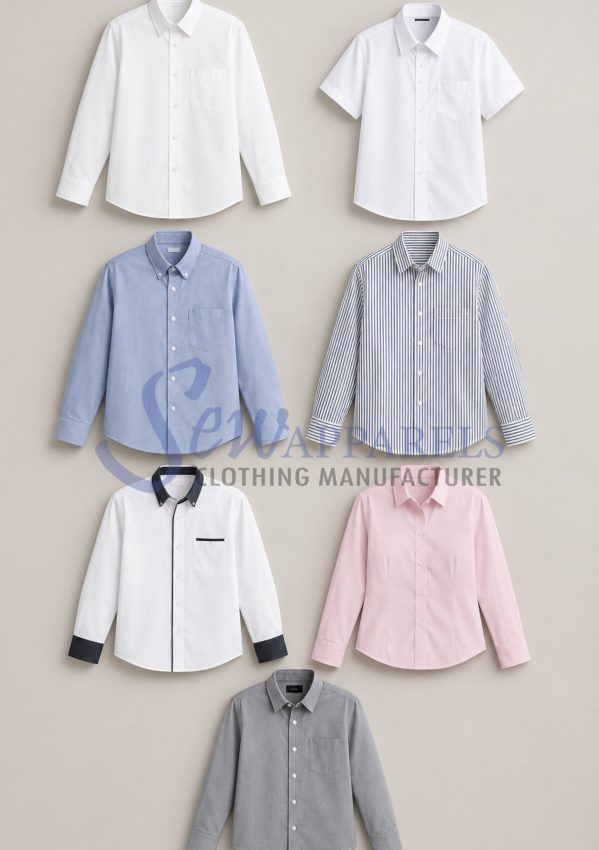
1. School Shirt Sleeve Variant Ordering: Record Approved Options
Before allocating quantities, establish which shirts the school permits. Record the approved short-sleeve and long-sleeve references, colour, fabric specification, fit range and any applicable wearer or term distinctions. If only one sleeve option is approved for a particular programme, a buyer should not add another option simply to create a more balanced order.
For school shirt sleeve variant ordering, approval means a documented product scope. Keep the reference sample or specification revision with the purchasing record. A long-sleeve shirt may also involve an approved cuff or fastening detail, so do not assume that changing sleeve length leaves every other specification unchanged.
A school shirt short long sleeve order should distinguish required uniform from optional choice. Confirm whether families select the sleeve themselves or whether the school assigns an option for particular activities or periods. These are different demand inputs and should not be combined without explanation.
Describe school shirt seasonal sleeve demand as an input supported by local ordering records or the school’s stated policy. Weather alone is not a reliable quantity instruction. A school may maintain one uniform option throughout the year, and family preferences can differ from a buyer’s assumptions about temperature.
Also record how changes are approved. If the school revises a sleeve option after quotation, identify the affected product references and quantities before requesting an updated price. Keep the earlier revision available as history, but make the current purchasing scope clear to everyone working on the order.
2. Separate confirmed orders from forecast demand
The second check for school shirt sleeve variant ordering is to label the source of every quantity. A paid or otherwise confirmed family order is different from a forecast for new enrolments. An allowance for exchanges is another input again. Each should have an owner, a date and an explanation rather than appearing as one unexplained total.
Use school shirt confirmed sleeve orders to identify committed demand by size and sleeve option. Record the collection cutoff and check that amended orders have replaced earlier versions. If a family changed a selection, retaining both records as active demand can inflate the purchasing requirement.
A school shirt long sleeve preorder list should show whether its entries are confirmed, provisional or awaiting a decision. Do not automatically treat every enquiry as a purchase. Agree how cancellations and late changes will be handled before using the list to place a supplier order.
Keep forecast quantities in a separate column with their evidence source. That source might be a documented enrolment input or an approved comparison with a previous programme. Explain material differences from the earlier programme, such as changed size coverage or a newly approved sleeve option. Historical demand can inform a scenario without guaranteeing that it will repeat.
For school shirt sleeve variant quantities, distinguish the proposed purchase from the underlying demand. A buyer may approve a stated buffer, but that buffer should be visible. A useful calculation is confirmed demand plus approved forecast plus a separately approved allowance, adjusted for usable stock already assigned to the same requirement. Check that the same demand is not counted in more than one column.
3. Map sizes to each sleeve variant
School shirt sleeve variant ordering becomes reviewable when the total is broken down by size. Two orders can contain the same number of garments and require very different sleeve assortments. The factory quotation and the buyer’s distribution plan should refer to the same matrix revision.
A school shirt size sleeve matrix uses one row for each approved size and separate columns for the sleeve options. Include the size system or measurement chart revision. Similar size labels from different suppliers do not necessarily describe the same fit, so quote comparisons should use the approved specification rather than label names alone.
Record the school shirt variant purchase breakdown before adding totals. Review each cell against the relevant confirmed and forecast inputs. Then check row totals, sleeve totals and the overall purchase quantity. These checks help identify an omitted size or a duplicated allowance without changing the underlying demand evidence.
When considering a school shirt mixed sleeve bulk order, make the arrangement explicit: which variants share a purchase order, which require separate lines, and how each size-and-sleeve combination will be identified for receipt. Combining lines administratively does not establish that supplier minimums can be pooled.
The GS1 GTIN Management Standard overview provides a framework for consistent trade-item identification. If your selling or distribution system uses GTINs, have the responsible identifier owner review the actual variant and packaging setup. Do not assume that one code can represent all sleeve options or invent allocation rules from a spreadsheet layout.
Keep the matrix’s identifier field separate from its quantity field. A product reference tells the receiving team what the line describes; the quantity tells them how many units are expected. If either field changes, identify which order and distribution records need an updated revision.
4. Request quotes on the actual sleeve split
The fourth check for school shirt sleeve variant ordering is to give suppliers the proposed size-by-sleeve matrix. A quotation based only on the collection total may conceal assumptions about materials, production grouping or size coverage. Ask the supplier to state which assumptions apply to each variant line.
A school uniform shirt sleeve mix quote should identify the approved specifications and the proposed quantity split together. If a supplier offers an alternative grouping, record it as an alternative scenario. Compare its effect on actual purchasing needs before accepting a revised assortment.
Ask what the school shirt short sleeve minimum applies to: a style, colour, sleeve variant, fabric commitment or another stated basis. Do not assume the answer from a previous order. Ask the equivalent question for the long-sleeve option and clarify whether any proposed combined arrangement is feasible.
For school shirt sleeve assortment costing, request a clear breakdown of relevant costs and inclusions. This can cover the garment lines, agreed labels or packaging, sampling scope and delivery basis. Request actual supplier values; a generic difference between sleeve lengths is not a substitute for a quotation on the specified shirts.
Use school shirt sleeve quote normalization to compare quotations on a common scope. Align currency, quantity matrix, size coverage, material revision, packaging and delivery assumptions. Separate an excluded cost from a lower price so the comparison does not reward a quotation that omits part of the requested work.
For US sales, the FTC’s textile labelling guidance discusses fibre content, origin and responsible-business identification for most covered textile products. Care labelling is separate. Ask the relevant team to review the actual label scope for the destination; this reference does not establish requirements for every market or verify a particular shirt’s compliance.
5. Approve a replenishment strategy using supplier inputs
Finish school shirt sleeve variant ordering by recording what happens after the initial purchase. A replenishment assumption can affect how much a buyer commits now, but it should come from current supplier inputs and the school’s distribution needs. Do not describe an unconfirmed reorder route as guaranteed availability.
A school shirt sleeve stock scenario should show the quantity proposed for immediate demand, any approved stock allowance and the conditions for a later purchase. Distinguish buyer-held stock from supplier-held stock. Ask who owns it, which variants it covers and what information is needed to release or replace it.
Request school shirt sleeve reorder terms for the actual product references. Ask about the applicable quantity basis, material continuity, quotation validity and the process for confirming a later order. A supplier’s response should be recorded as an input with its date and scope, not converted into a permanent promise.
For school shirt variant quantity approval, the buyer should sign off the matrix revision and the unresolved assumptions. If a replenishment condition is unknown, state that limitation in the purchasing decision. The approver can then evaluate the initial order with a clear view of the risk rather than relying on an invisible expectation.
When discussing custom school shirt manufacturing, share the approved options and the evidence behind the quantity split.
For private label school shirt production, include the label and packaging scope relevant to each variant. These details help make the quotation discussion specific without assuming that every requested configuration is offered.
School shirt sleeve variant ordering worksheet
Use the following record for each approved size-and-sleeve combination. It is an illustrative worksheet structure, not a completed Sew Apparels quotation. Add programme-specific fields where needed and keep the same revision across purchasing and receipt instructions.
- Product identity: approved school programme, sleeve option, colour and specification revision.
- Size: approved label and the controlling measurement chart.
- Confirmed demand: quantity, order cutoff and source record.
- Forecast: proposed quantity, evidence source, date and approving owner.
- Allowance and stock: separately approved buffer and usable stock assigned to this need.
- Proposed purchase: calculated quantity with a check for double counting.
- Supplier input: minimum basis, feasibility response and quotation revision.
- Replenishment: stated assumptions, open conditions and review date.
- Release decision: approved matrix revision, owner and unresolved actions.
Use one row per approved size in the matrix below. Enter buyer-approved purchase quantities after reconciling confirmed demand, forecasts, allowances and usable stock in the worksheet. The blank structure shows how to record the split; it does not supply demand figures or supplier minimums.
| Approved size | Short-sleeve purchase | Long-sleeve purchase | Source and revision |
|---|---|---|---|
| Size from the approved chart | Enter approved quantity | Enter approved quantity | Record controlling demand and approval references |
For example, a confirmed long-sleeve requirement in one size should remain visible even if a supplier proposes a larger short-sleeve quantity. Record the proposal separately, compare it with the school’s approved demand and resolve the affected line before release. An overall total that balances does not prove that each required variant is covered.
Common purchasing questions
Is there a standard short-to-long sleeve split?
No universal split is established by this worksheet. School shirt sleeve variant ordering should follow the school’s approved options, documented demand and confirmed supplier conditions.
Can sleeve variants share one minimum?
Only use a combined basis when the supplier confirms it for the actual specifications and quantities. A shared colour or fabric description does not establish pooling automatically.
Should forecasts be included in the first purchase?
The buyer can approve a forecast-based quantity when its evidence and assumptions are explicit. Keep it separate from confirmed demand so the purchasing decision remains reviewable.
Prepare a focused sleeve-order brief
Share the approved sleeve options, size matrix and quotation questions through the school shirt manufacturing page. Use the School Shirt Buying Guides for related development decisions.
A controlled school shirt sleeve variant ordering brief connects the school’s requirements with a supplier-reviewed purchase matrix. Keep quantities, evidence and open conditions visible so the final decision covers the required shirts rather than only a convenient collection total.
Use the white fabric opacity review when confirming material scope. A changed cloth specification should remain visible when comparing sleeve-variant quotations.