
School sweater neckline collar interface review asks whether the actual shirt collar and sweater opening work together in the intended uniform. A sweater that looks acceptable alone may present differently over a particular shirt. Buyers should approve the pair using identifiable samples, a confirmed size relationship and observations from relevant movement.
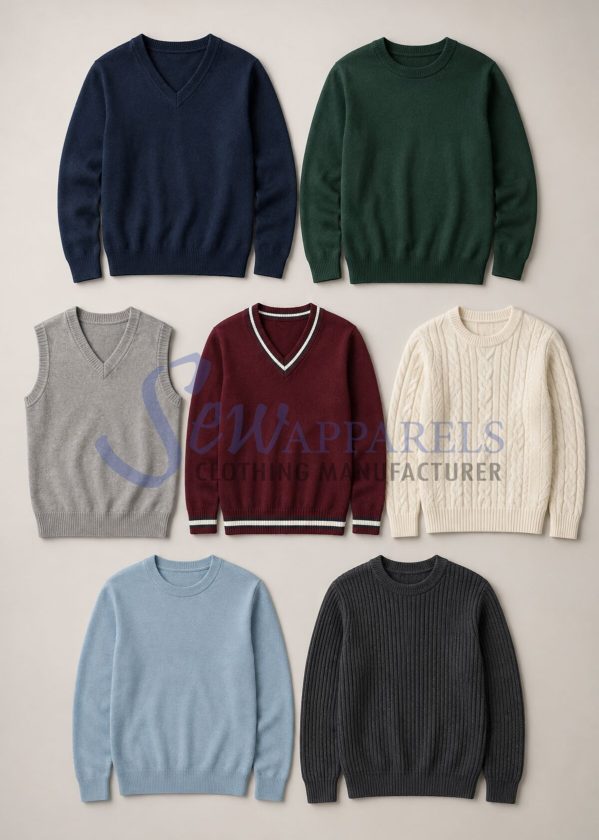
This guide uses five critical checks and a shirt/sweater interface chart. It connects neckline shape, collar presentation, size pairing and controlled revisions without inventing universal dimensions. The objective is a repeatable appearance and fit decision for the proposed uniform, not a promise that one neckline suits every school shirt.
Keep school sweater neckline collar interface assessment separate from school sweater knit gauge selection or yarn purchasing. Those decisions affect the sweater, but they cannot substitute for checking the approved shirt beneath it. Record the complete pairing so that an attractive photograph does not become the only evidence behind a bulk specification.
1. Identify the approved shirt and sweater models
Record the shirt style, sweater style, development versions, sizes, colours and intended wearing arrangement. Identify whether the school expects the shirt fastened in a particular way and whether another accessory is part of the approved uniform. Evaluate only the arrangement that the buyer has actually specified.
A school sweater shirt collar interface depends on the physical garments being reviewed. Use actual samples rather than replacing the shirt with a similar collar from another style. If the approved shirt is unavailable, mark the pairing as provisional and explain what remains to be checked before approval.
School sweater actual layer samples should carry references that match the working chart. Retain their material and construction information alongside the relevant measurements. If a neckline trim, shirt collar component or finishing detail was substituted, identify that departure so the team can interpret the observation correctly.
School sweater shirt neck compatibility should begin with the intended product relationship, not a general assertion about V-necks or crew necks. Confirm the proposed opening, shirt collar construction and intended presentation. Optional configurations remain development scenarios until their feasibility and sample evidence are confirmed.
For school sweater neckline collar interface review, keep the current approved pair as a reference when requesting alternatives. A new sweater sample should be compared with the same shirt version wherever practical. Changing both products without documenting the changes makes it harder to identify why the presentation differs.
2. Compare complete layered samples by size
Define which shirt and sweater sizes are intended to be worn together. Matching size labels does not prove that two garments have compatible dimensions or grading. Record actual measurement references and the buyer’s pairing decision rather than assuming that every item with the same label represents the same fit relationship.
A school knitwear neckline size pair should be listed as a separate row in the review chart. Include the model or fitting reference used, the garment versions and the starting arrangement. Where the buyer expects several size combinations, identify which combinations were checked and which remain unreviewed.
Use a school sweater neckline layered sample to observe how the shirt lies beneath the complete sweater. Check the neck opening, shoulder position and the surrounding garment fit together. A neckline observation is difficult to interpret if the sweater itself is being worn in an unintended size or the shirt is incorrectly positioned.
Record school sweater neckline fit observation in specific terms. State whether a collar point sits inside or outside the opening, whether the shirt gathers at a particular location and whether the opening appears asymmetric. Do not replace these details with a single comment such as poor fit.
During school sweater neckline collar interface review, compare the proposed size pairs under consistent conditions. Record how the shirt was arranged, which fastenings were closed and whether the wearer adjusted the collar. These details make the observation more repeatable without imposing a universal fitting procedure on every school programme.
3. Observe collar presentation during relevant movement
Agree a short movement sequence reflecting intended use, such as standing, sitting and normal arm movement where appropriate. Use the buyer’s fitting process and suitable participants. Record the starting state, movement and final state so that an adjustment made during the review is not mistaken for natural garment behavior.
School sweater layered neckline movement can reveal changes that a standing photograph misses. Note whether collar points move into the opening, whether the shirt gathers near the neck and whether the wearer needs to reposition the layers. Describe the observation without assigning a cause before the construction has been examined.
School sweater collar bunching review should identify the location and condition in which gathering occurs. Compare the shirt worn alone with the specified layered pair where this helps the investigation. A shirt collar that is already disturbed before the sweater is added needs a different explanation from one displaced only during layering.
For a proposed V-neck, school sweater V neck collar presentation should record the actual relationship between collar points, opening edges and the approved shirt position. This guide does not specify a preferred depth, width or visible proportion. The buyer’s appearance reference and intended uniform determine the acceptance criteria.
School sweater collar visible height should be recorded using the buyer’s agreed reference points and observation condition. Do not rely on a camera angle or an unlabelled image to establish a dimension. Where visual balance matters more than a single measurement, retain both the annotated photograph and the written decision.
School sweater neckline collar interface observations should distinguish a temporary displacement from a repeatable issue. Note whether the original position returns after movement and whether repositioning is required. A useful record explains what happened and when, while leaving the technical explanation open for a controlled sample comparison.
4. Separate neckline shape from broader fit problems
A school sweater neck shape comparison should use identified samples with the intended neckline changes recorded. Compare the opening and surrounding garment relationship while keeping other approved features controlled where practical. A new shape is not automatically better simply because it exposes more or less of the shirt.
Check whether the issue relates to the opening, the sweater’s overall position or the shirt’s own fit. Record the observations that support each hypothesis. Avoid solving every presentation concern by enlarging the neckline, because an uncontrolled change can affect the appearance and fit elsewhere.
Ask the supplier to identify the neckline construction used in the actual sample and any departures from the specification. If a revision is proposed, document the material reference, pattern or construction detail affected. Do not add a generic tolerance or claim that a particular trim will necessarily retain its shape.
For US-market product descriptions, the FTC textile and wool labeling guidance helps buyers review required product information and fiber representations. Keep material identity consistent with the approved garments when requesting a construction change. An appearance revision should not silently alter the product information basis.
School sweater neckline collar interface review should also record the garment condition. A freshly finished sample and a sample after the agreed care route may present differently. Evaluate the pair in the condition required by the approval brief rather than comparing unrelated states and attributing every change to the neckline.
The FTC care-labeling guidance explains the need for reliable evidence supporting care instructions and the importance of the whole garment. Confirm the care information for each actual item and the intended market. Do not assume that two products worn together share one care instruction or must be washed together.
5. Approve a traceable paired appearance reference
School shirt sweater pair approval should name both garment versions, the size pairing and the reviewed wearing arrangement. Retain the accepted photographs and written observations with the specification. A sweater-only approval and a paired approval answer different questions and should remain distinguishable in the record.
A school sweater collar appearance reference should show the accepted starting condition and, where relevant, the observations after movement. Include enough context to identify the garments and fitting arrangement. Keep the reference tied to the actual samples rather than treating a generic catalogue image as a production approval.
School sweater neck revision brief should state the observed issue, proposed correction and evidence required from the resample. Identify whether the shirt remains unchanged. If both garments are revised, name both changes and repeat the pairing review so the final decision reflects the proposed delivered products.
Repeat the relevant checks on a complete revised sweater worn with the approved shirt. A neckline component sample can inform development, but it cannot show every interaction created by the complete layered garments. Record the outcome by reviewed size pair and do not generalize an unreviewed combination as accepted.
Close school sweater neckline collar interface assessment with a named decision, approved sample references and open conditions. Distinguish approval for the reviewed development scope from inspection of bulk goods. The chart should show precisely what was accepted rather than implying certification or a guarantee of fit for every wearer.
School sweater neckline collar interface: review matrix
A school knitwear collar interface matrix connects the two products with the observation and proposed revision. Use a separate record for each reviewed size pair or configuration. The suggested fields below form an internal working record, not a standardized test or an independent certification.
| Information required | Size pair A | Size pair B |
|---|---|---|
| Pair record | Size pair A — not approved | Size pair B — not approved |
| Product identity shirt style and version, sweater style and version, material references. | — | — |
| Size pair actual garment sizes, measurement references and fitting arrangement. | — | — |
| Starting presentation collar point position, visible height and neckline relationship. | — | — |
| Movement observation agreed activity, displacement, gathering and any manual adjustment. | — | — |
| Condition sample finishing state and the relevant care history of each item. | — | — |
| Revision observed issue, technical hypothesis, proposed change and complete resample. | — | — |
| Approval accepted paired reference, reviewed scope, decision owner and open conditions. | — | — |
Separate observation from explanation. For example, a collar point moving inside the opening after sitting is an observation. A proposed explanation about opening shape remains a hypothesis until a controlled comparison supports it. This prevents the development team from treating an early impression as a permanent construction rule.
Buyer questions before final approval
Can the sweater be approved without the intended shirt?
For school sweater neckline collar interface planning, it can be reviewed for its own stated scope, but the specific collar relationship remains unverified. Identify that limitation and arrange the actual pair before closing the interface decision. A substitute shirt may support an exploratory trial, provided it is clearly marked as provisional.
Is one neckline shape universally preferable?
No universal preference is established here. Compare the intended school appearance, actual shirt collar and complete sweater fit. The accepted opening belongs in the product-specific reference rather than a general rule based on a neckline name.
Does one accepted size prove the entire pairing range?
It proves the reviewed combination and agreed conditions. Where other size pairs matter, identify how they will be reviewed. Preserve the relevant grading and sample evidence rather than assuming that all collar relationships scale identically.
Prepare a focused development enquiry
For custom school sweater manufacturing, send the actual shirt reference, proposed sweater neckline, size pair list and movement observations. Use the school sweater manufacturing page for the commercial enquiry, with a clear description of the review requested and the sample evidence available.
For private label school sweater production, include the paired appearance reference, revised specifications, intended market and remaining approval conditions. The school sweater buying guides connect the interface decision with the wider uniform plan. Complete school sweater neckline collar interface review with the actual approved pair and a documented buyer decision.