
School sweater shrinkage investigation should begin with the actual garment, material identity and care history. A sweater becoming smaller after laundering is an observation, not a complete explanation. Buyers need comparable measurements and surface records before deciding whether the problem relates to a material, construction, care instruction or an unconfirmed exposure.
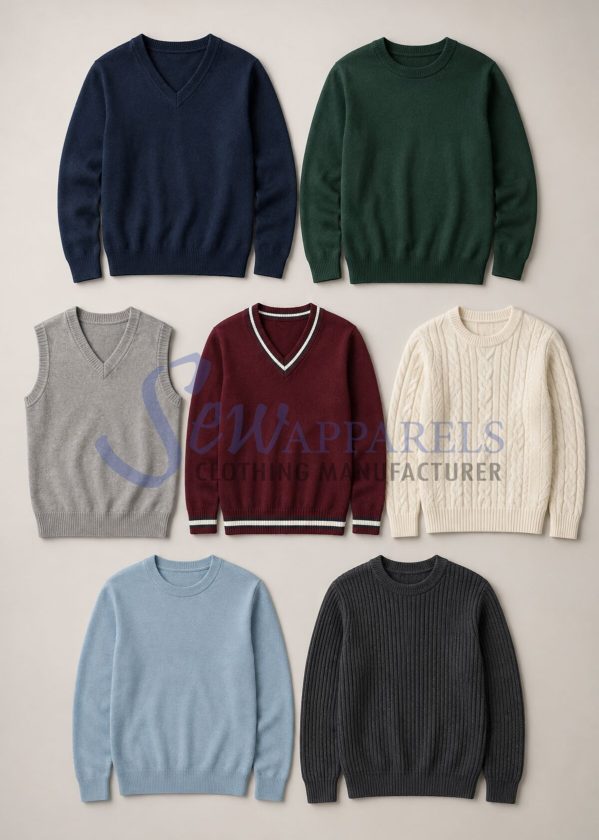
This guide uses five critical evidence checks and a care-change investigation sheet. It separates dimensional change from texture observations and routes unresolved mechanisms to qualified specialists. It does not diagnose felting from size loss alone, promise restoration or recommend an unverified treatment for an affected sweater.
Keep school sweater shrinkage investigation distinct from school sweater elbow durability design or snag classification. A care-related complaint needs its own sample references, actual exposure record and controlled follow-up. Combining unrelated issues into one general statement about quality can conceal the evidence needed for a useful supplier response.
1. Record composition and actual care exposure
Identify the style, sample or production reference, size, colour and material version. Retain the actual yarn information and declared composition rather than assuming that every school sweater contains wool or behaves like another knitwear item. If a component or material was substituted, record that fact separately.
School sweater fibre care compatibility must be reviewed for the complete proposed garment. The yarn name alone does not establish a suitable laundering route. Record the construction and relevant components, then ask which evidence supports the current instructions. A general recommendation from an unrelated product should not become this sweater’s care specification.
A school knitwear wash exposure record should describe what actually happened. Include the available washing method, programme, detergent, temperature information, drying route, cycle count and any later pressing or reshaping. Mark unknown details as unknown rather than reconstructing them from the care label.
Separate the instruction printed on the garment from the exposure reported by the person who cared for it. They may match, differ or be incompletely documented. Preserve both records without assuming fault. The investigation should establish the conditions as far as possible before assigning responsibility or proposing a revision.
For school sweater shrinkage investigation, record the sample’s condition when received and any handling after the complaint. Additional washing or attempts to restore its size can change the evidence. Retain the affected item and its records while agreeing any further examination with the supplier or specialist.
2. Measure change separately from surface observations
School sweater washed size change needs defined measurement points and a recorded observation condition. Identify the pre-care reference where available, the post-care dimensions and the method used to obtain them. An unlabelled comparison between different sizes or sample versions does not show the change in one garment.
A school sweater measured shrinkage record should retain both the original dimensions and the later dimensions. Where percentage change is calculated, use the same measurement basis and show the starting value. Record the direction and amount of change rather than presenting a single overall number that hides different changes at different points.
Keep school sweater shrinkage surface change observations in a separate part of the sheet. Describe visible or tactile changes in specific terms, such as a different apparent stitch definition or surface appearance. These descriptions help a specialist investigate, but they do not independently identify the mechanism.
School sweater after wash texture should be compared under consistent viewing conditions with an identified reference. Record photographs, the garment state and the areas examined. Do not treat lighting differences, a damp sample or a different finishing state as proof that the material has changed in a particular way.
School sweater dimensional change diagnosis requires more than a complaint photograph. Ask which measurements and material evidence support the explanation, and whether further examination is needed. This guide provides a record structure, not a technical diagnosis or a universal acceptance limit.
3. Compare retained and affected samples
School sweater retained sample comparison is strongest when the retained item matches the relevant material, construction and development or production version. Identify any differences in size, colour, lot or finishing. A similar-looking sweater from another order can provide background, but is not an equivalent control.
Compare the affected sample with the retained reference at the agreed measurement points and surface locations. Record which conditions are comparable and which are not. If no pre-care measurements exist, acknowledge that limitation; the approved specification can guide review but does not recreate the affected garment’s original dimensions.
School sweater laundering complaint evidence should connect the item, care history, measurements and observations in one traceable record. Include the source of each statement. A reported wash programme, a supplier’s technical explanation and an observed dimension have different evidential roles and should not be merged into a single unsupported conclusion.
The public scope of ISO 6330 domestic washing and drying procedures describes procedures used in textile testing and notes that procedure parameters can affect results. A complete care trial needs its washing and drying basis recorded. The standard’s public description does not provide a diagnosis of this sweater or a product-specific pass limit.
For school sweater shrinkage investigation, agree how any comparative trial will be conducted before exposing retained samples to care. Keep an appropriate reference and identify every trial item. A laboratory or supplier report should name the actual procedure, sample references and observations so the buyer can understand what was compared.
4. Ask specialists to distinguish plausible mechanisms
School sweater specialist assessment should begin with the actual composition, construction and available exposure record. Ask the assessor to distinguish the observations from possible explanations and to state the limitations of the evidence. Do not ask for confirmation of a diagnosis already assumed from the garment becoming smaller.
School sweater wool felting questions are relevant only when the material information and observations justify asking them. Shrinkage alone does not establish felting. Provide the complete records and ask what further assessment would be needed to support or reject that explanation, without presenting an unverified mechanism as fact.
A school sweater care damage investigation should consider the actual garment and evidence without prescribing a home treatment. Restoration attempts may alter the sample and are not guaranteed to recover the approved dimensions or appearance. Agree any investigative handling with the qualified reviewer before changing the affected item.
School knitwear wash failure review should clarify whether the available evidence represents the labeled procedure, another known exposure or an unknown process. If the conditions cannot be established, state that limitation. A controlled follow-up can answer a narrower technical question without claiming to reproduce an undocumented event exactly.
For school sweater shrinkage investigation, request a written explanation tied to the sample references and supporting observations. Record unresolved alternatives and recommended further work. A qualified assessment may narrow the cause, but a brief supplier assurance without supporting details should not be converted into a final technical conclusion.
5. Verify revisions on complete samples
If a material, construction or care revision is proposed, identify the change explicitly. Record which observed problem it is intended to address and what evidence will demonstrate improvement. Do not change several undocumented variables and then assume the preferred result proves which one caused the original issue.
A school sweater care correction sample should represent the complete revised garment. Identify its material references, construction version and instructions being evaluated. Repeat the agreed measurement and surface review using a documented care route, and retain the comparison evidence with the buyer’s decision.
School sweater care instruction evidence should support the actual proposed instructions and warnings. The FTC care-labeling guidance explains the need for a reasonable basis and evidence supporting care of the whole garment. For US-market review, consider all relevant components rather than assuming a yarn-only result approves the finished sweater.
Confirm the intended market and the scope of any revised care information. A buyer should not replace instructions solely to avoid a complaint if the new recommendation lacks supporting evidence. This guide does not provide a washing temperature, a drying treatment or an approved restoration method for the reader’s garment.
Close school sweater shrinkage investigation with the accepted sample version, reviewed conditions, evidence and remaining limitations. Distinguish a development revision from the disposition of affected stock. The technical review should inform the buyer’s decision without implying that every previous item has been restored or that future change is impossible.
School sweater shrinkage investigation: care-change sheet
Use one investigation sheet for the identified complaint and link it to the supporting records. The fields below are a suggested working structure, not a laboratory standard or an independent certification. Keeping observations and explanations separate helps the supplier respond to a specific question.
| Field | Information required | Actual observation / source | Hypothesis / open question | Owner / date / decision |
|---|---|---|---|---|
| Identity | style, size, colour, sample or production version and actual composition. | — | — | — |
| Exposure | reported wash and dry conditions, source of information and unknown details. | — | — | — |
| Dimensions | measurement points, original reference, later values and sample condition. | — | — | — |
| Surface | observed texture or stitch appearance changes, locations and photographs. | — | — | — |
| Comparison | retained sample identity, relevant differences and controlled trial records. | — | — | — |
| Assessment | qualified explanation, supporting evidence, limitations and further questions. | — | — | — |
| Revision | proposed material, construction or care change, complete resample and buyer decision. | — | — | — |
Assign an owner and date to each follow-up action. If a measurement or exposure detail is missing, keep it visible as an open question. This prevents a provisional complaint note from being treated later as a verified cause or an approved correction.
Questions buyers should resolve
Does smaller size prove that wool has felted?
No. Confirm the composition and request an evidence-based assessment of the observed dimensional and surface changes. The investigation may need a specialist to distinguish plausible mechanisms. Do not label a sample felted solely because it is smaller after care.
Can the sweater be restored by stretching or another treatment?
This guide makes no restoration promise. Preserve the affected sample and consult the relevant qualified reviewer before additional handling. A changed measurement after manipulation does not itself establish recovery of the approved construction, appearance or performance.
What if the actual wash conditions are unknown?
Mark them unknown and separate reported facts from assumptions. School sweater shrinkage investigation can still organize sample evidence and define controlled follow-up questions, but it should not claim that a later test exactly reproduced an undocumented exposure.
Prepare a traceable supplier enquiry
For custom school sweater manufacturing, provide the composition, garment reference, care information, measured changes and retained sample details. Use the school sweater manufacturing page for the commercial or development enquiry, with a clear explanation of what is known and what needs assessment.
For private label school sweater production, include the proposed revision, complete resample evidence, intended market and approval conditions. The school sweater buying guides connect the investigation with the wider product brief. Finish school sweater shrinkage investigation with a documented decision supported by the actual records rather than an assumed diagnosis or unverified care remedy.