
School tracksuit laundry turnaround evaluation should compare the jacket and trouser through a defined care routine, rather than assume that a two-piece set becomes ready at the same time. Fabric surfaces can appear dry while thicker construction areas still require attention. Buyers need component-specific observations tied to the actual garment, care route and drying environment.
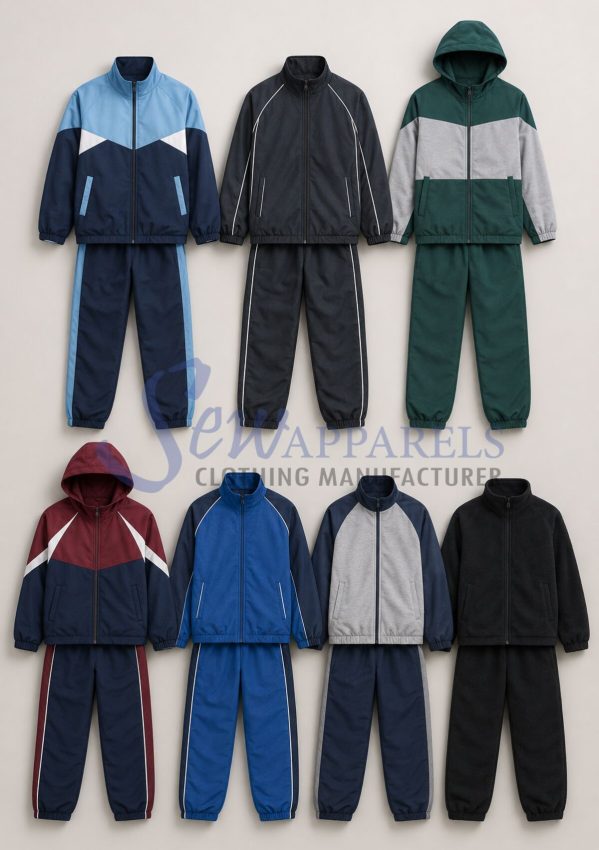
This guide uses five critical checks and an original component drying trial record. It helps teams distinguish wash completion, drying observation and agreed readiness. It does not provide a universal drying time or establish that every school tracksuit is suitable for a particular care method.
Keep school tracksuit laundry turnaround evaluation separate from ankle-opening selection. Open hems, rib cuffs and ankle zips are construction decisions; the current task is to observe the complete jacket and trouser under a realistic, documented care route. Retain the exact sample references so the evidence belongs to the product being considered.
1. Define the care routine and drying environment
Start with the proposed care instructions and the buyer’s actual use context. Identify the wash method, permitted drying route and any preparation required by the instructions. Resolve unapproved care proposals before conducting a comparison; a fast result from an unsuitable process cannot support a useful purchasing decision.
A school tracksuit care turnaround assessment should define its start and finish. Decide whether the programme is comparing drying after washing or the entire routine, including loading, washing, transfer and any permitted finishing. Keep these stages separate in the record so one component’s drying observation is not presented as the whole set’s turnaround.
For school tracksuits, the sports set drying environment needs a recorded description. Identify the drying location, arrangement, spacing and equipment or method actually used. Record relevant measured environmental information when available, along with the instrument or source. Do not substitute an assumed room condition for a measurement that was never taken.
The tracksuit care route timing should identify the event used to start each recorded interval. For example, removal from the washer and placement in the drying arrangement are different events. If a transfer delay occurs, retain it separately instead of quietly incorporating it into one component’s drying time.
The ISO 6330:2021 overview describes domestic washing and drying procedures for textile testing and notes that procedure parameters can affect results. When a formal test is required, agree the appropriate procedure with the testing team. An informal buyer trial should not be described as compliance with the standard without the required method and evidence.
School tracksuit laundry turnaround evaluation should therefore begin with a written trial brief. Name the garment references, care route, comparison question and conditions that will be recorded. Make the scope clear enough that a later reader can understand what the result does and does not represent.
2. Start both components from comparable conditions
Identify each jacket and trouser by style, size, material and sample version. Record whether the pieces belong to the same proposed set and whether their care requirements are compatible with the planned comparison. If one component has changed, retain its revised reference instead of treating the new sample as identical to the earlier one.
A school tracksuit jacket trouser drying comparison needs an agreed starting condition. Use the defined care and handling sequence for both components and record departures from it. Where the route calls for different treatment, report that difference openly; do not describe unlike procedures as a controlled comparison.
A controlled drying comparison for school tracksuits should specify how the pieces are placed and handled. Follow their applicable instructions and document the arrangement. Whether a jacket is hung, laid out or processed by an approved machine route can matter to the comparison, so the record must describe the actual method.
Record the load context where it is relevant to the procedure. A single garment trial and a routine with other items may not answer the same question. Keep any load, transfer or handling difference visible. Avoid assigning a result to normal household use when only a narrowly controlled arrangement was observed.
The jacket/trouser drying difference in school tracksuits should be interpreted through these starting conditions. If one piece entered the drying stage later, compare it from its own documented start rather than using a shared clock without explanation. Retain the original timing observations before calculating any comparison.
School tracksuit laundry turnaround evaluation becomes more useful when repeated trials are genuinely comparable. Agree the repetition plan in advance and identify each trial separately. Do not invent an average from one observation or remove inconvenient results without recording an authorised reason.
3. Observe thick seams and enclosed areas separately
Review the complete construction before deciding where to observe readiness. Identify overlapping layers, seams, waistbands, cuffs, pockets and any other relevant areas actually present in the samples. A generic checklist should be adapted to the garment; do not add a hood observation to a jacket that has no hood.
School sports set residual damp areas should have their own location fields. Describe the jacket and trouser zones clearly enough for another checker to find them. Use the same location names across trials, while keeping any construction differences visible in the record.
For school tracksuits, thick seam residual dampness needs an agreed observation method. Record whether the result came from a defined sensory assessment, a suitable measurement or another approved procedure. These methods have different limits; a casual touch assessment should not be reported as a quantified moisture result.
Hood and pocket enclosed drying areas, where present in school tracksuits, should be reviewed in their actual drying arrangement. Record whether the agreed method requires opening or repositioning a part and when that action occurs. Do not change the handling of one sample silently in order to make its result appear better.
Distinguish the broad fabric surface from the construction areas that govern the agreed readiness decision. A surface observation can be useful, but it should not stand for the entire component if relevant seams or enclosed zones remain unassessed. Record a zone as not observed when it was not checked.
School tracksuit laundry turnaround evaluation should connect each finding with its location, method and observation time. A conclusion such as still awaiting readiness is more informative when the record identifies which part of which garment caused that status.
4. Record component readiness using an agreed method
Define readiness before inspecting the results. The buyer and technical team should agree the criterion appropriate to the trial’s purpose and how it will be assessed. Drying observation is not automatically approval of appearance, dimensions, decoration, comfort or product safety after care.
Component readiness observation for school tracksuits should state the actual jacket and trouser findings independently. If a criterion is not met, record the relevant location and evidence. If a component has not been assessed, use not verified rather than allowing a blank entry to imply acceptance.
For school tracksuits, measured drying time must identify the start event, observation sequence and endpoint method. If checks occur at intervals, the record may establish when readiness was first observed rather than the exact moment it occurred. Describe that distinction instead of presenting an unobserved endpoint as a precise measurement.
School tracksuit drying trial records should retain the raw observations and the agreed decision. Note missing data, changes in conditions and interruptions. A result obtained under a changed arrangement can still be useful, but its limits belong alongside the finding rather than disappearing from the summary.
For a set-level conclusion, connect both component results with the stated requirement. If the programme requires a ready jacket and ready trouser, one component’s acceptance cannot establish readiness of the complete set. Explain the actual rule used without asserting that every buyer uses the same definition.
School tracksuit laundry turnaround evaluation should show the evidence behind any comparison. Report the number of completed trials and their conditions. A different outcome can prompt a construction or care review, but it does not by itself prove a universal advantage for one fabric or supplier.
5. Align care information with the approved trial
Review the trial alongside the proposed care information for the finished garments. Confirm that the observations relate to the instructions and construction under consideration. A change to material, trims or care route may require further review before earlier evidence is used for the revised product.
School sports care instructions for school tracksuits should reflect an approved, supported route. Where a buyer serves several markets, the responsible team should verify the applicable requirements rather than assume that one country’s guidance governs every sale.
The FTC care-label guidance explains the need for reliable support for care instructions and consideration of the finished garment’s components for covered products. It also distinguishes multi-piece products with shared instructions from pieces needing different care information. Confirm applicability for the intended US programme; a drying trial alone is not a complete labeling review.
Set drying claim evidence for school tracksuits should support the specific statement proposed. Retain the trial conditions, actual samples and observation method. Avoid a broad quick-dry claim or guaranteed overnight readiness based on a limited comparison in one environment.
A laundry turnaround trial brief for school tracksuits should identify any further work required before approval. Keep proposed construction changes separate from the accepted sample version. Reassess affected observations through an agreed route instead of transferring a favourable result automatically to a different garment.
School tracksuit laundry turnaround evaluation should close with a documented decision: what was observed, what was accepted for the defined purpose and what remains outside the evidence. This gives the buyer a usable record without converting a trial into an unsupported performance promise.
Build a component drying trial record
For school tracksuit laundry turnaround evaluation, use a worksheet with one identifiable entry for each component and trial. Include the jacket or trouser reference, size, version, care route, load context, drying arrangement, start event, environment, observation locations, method, actual observation times and readiness decision. Retain differences and interruptions in their own fields.
School tracksuit laundry turnaround evaluation connects three records: the original trial brief, the observations and the authorised conclusion. For example, a trouser surface and waistband can have separate findings while the jacket remains awaiting assessment. That is a scope description, not a claimed test result or an assumed drying time.
| Trial field | Jacket record | Trouser record | Evidence reference | Not observed / follow-up |
|---|---|---|---|---|
| Component reference, size and version | — | — | — | — |
| Care route and load context | — | — | — | — |
| Drying arrangement and environment | — | — | — | — |
| Start event and transfer delay | — | — | — | — |
| Observation locations and method | — | — | — | — |
| Actual observation times | — | — | — | — |
| Readiness criterion and decision | — | — | — | — |
| Differences, interruptions and reviewer | — | — | — | — |
Prepare the buyer’s next development decision
For custom school tracksuit manufacturing, send the proposed care route, garment construction and comparison question before defining the trial. Include the required records and decision ownership so the development brief addresses the buyer’s real laundry routine.
Private label school tracksuit production for startup brands can use the same evidence structure with a clearly scoped sample programme. Confirm sample availability, trial work and production conditions for the actual project; no fixed minimum, price or performance outcome is implied by this guide.
Use the school tracksuit buying guides to connect this review with related product decisions. School tracksuit laundry turnaround evaluation is complete for its agreed scope when the care route, component observations, readiness method and supported conclusion remain traceable to the actual samples.