
School tracksuit lining bagging review should investigate how the lining sits inside the complete jacket, including where excess material gathers or becomes visible. School sports jacket lining protrusion is an observation, not a diagnosis. Buyers need the shell and lining references, attachment details, sample size and care state before deciding what requires correction.
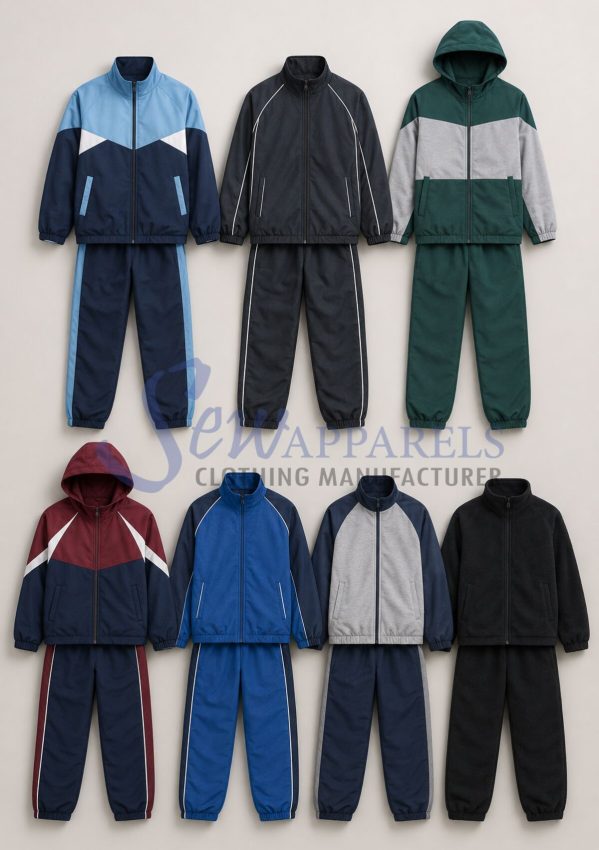
This guide uses five critical checks and an original lining balance record. It connects dimensions, attachment, movement allowance, care observations and the revised sample. It addresses lined-jacket assembly; it does not establish the best trouser ankle opening or the drying time of a two-piece set.
Begin school tracksuit lining bagging review with the actual construction. Confirm whether the proposed jacket has a lining and which parts are lined. Optional lining configurations are development scenarios subject to feasibility and approval, not a claim that every school tracksuit programme includes them.
1. Identify shell and lining reference dimensions
Record the jacket style, size, shell material, lining material and sample revision. Connect each component with its approved pattern and measurement references. If the records are missing or describe a different version, resolve the identity before attributing the observed appearance to a particular dimension.
School tracksuit lining reference measurements should define the points and method used. Identify the relevant shell and lining lengths or widths separately. Record how the finished jacket is positioned and which attachment or seam references are involved, so another checker can repeat the comparison without guessing.
School tracksuit shell lining balance is a relationship between the actual components and their intended construction. The pieces need not have identical dimensions at every point. Review the approved design and movement provision rather than treating any measured difference as an error.
A school tracksuit shell lining differential should identify what is being compared: pattern dimensions, cut component dimensions or finished garment measurements. These answer different questions. Keep them in separate fields and use a consistent measurement method within each comparison.
School tracksuit jacket lining bagging can appear at a hem, sleeve or another zone. Mark its location, appearance and the sample position in which it was observed. Avoid a broad note that the lining is too large when only one area has been assessed or the intended allowance remains unknown.
School tracksuit lining bagging review should preserve the baseline before alterations. Retain the original observations and relevant dimensions, along with the agreed comparison reference. A later correction is easier to assess when the team can explain what changed and which original finding it was intended to address.
2. Map attachment and free movement allowances
Identify the actual lining attachment points and the areas intended to move freely. Describe how the lining connects with the hem, sleeve opening, facing or other present construction features. Use the real sample and approved drawings; a generic attachment diagram cannot establish how this jacket was assembled.
School sports jacket lining attachment should connect each anchor with the relevant construction reference. Record whether the observed attachment matches the approved arrangement. If a detail is concealed, state how it was verified or mark it as unverified instead of assuming that an unseen anchor is correct.
School sports lining movement allowance needs an approved purpose and location. The technical team should define the provision appropriate to the construction and intended use. There is no universal allowance in this guide; do not remove all fullness merely because a flat sample appears neater.
School tracksuit lining hem visibility should be reviewed in agreed jacket positions, such as the defined presentation state and any relevant movement state. Record the position in the finding. Visibility that changes when the shell is repositioned deserves investigation rather than an immediate conclusion about lining length.
School tracksuit jacket lining distortion should be described separately from loose gathering. Note the direction, location and any relationship with the mapped attachments. These observations can guide the technical review, but appearance alone does not prove that a specific anchor or pattern feature caused the issue.
School tracksuit lining bagging review should link the attachment map with the dimension record. This helps the team distinguish a proposed dimension change from a proposed assembly change. Retain both possibilities as hypotheses until the investigation provides sufficient evidence for the correction brief.
3. Separate assembly imbalance from care changes
Observe the initial complete sample before the agreed care trial. Record its condition, measurements and lining appearance using the defined method. Do not compare an undocumented initial state with a later cared garment and assume that every visible difference arose during laundering.
School tracksuit lined jacket care should follow an approved route appropriate to the complete construction. Identify the washing, drying and other relevant treatment details, along with the actual number of completed care sequences. A route that was never agreed should not become the basis for acceptance merely because it produced a convenient result.
The ISO 6330:2021 overview describes domestic washing and drying procedures for textile testing and notes that procedure parameters can affect results. Agree any formal procedure with the testing team. A development observation should retain its actual method and should not be labeled a standard-compliant test without the supporting procedure and records.
A school tracksuit jacket lining investigation should compare the initial and cared states under a defined observation arrangement. Identify the same locations and measurement points in both states. If the sample handling or measurement method changes, disclose it before interpreting the difference.
Keep possible care-related dimensional changes separate from initial assembly observations. A lining already visible in the baseline does not establish a laundering cause. Conversely, a change after care needs investigation of the complete evidence rather than automatic attribution to the lining material alone.
School tracksuit lining bagging review should show which findings were present initially, which changed and which remain uncertain. Record the actual shell and lining information available at each state. Avoid diagnosing differential shrinkage where no appropriate dimensional evidence supports that conclusion.
4. Review complete jackets at size extremes
Select the sample sizes required by the programme’s review plan. Include the relevant smaller and larger sizes where needed to investigate grading and assembly balance. State the coverage accurately; findings from one jacket size do not establish that the entire range has been reviewed.
School tracksuit lining size extremes should be evaluated through complete jackets with identified versions. Compare the intended construction in each size, including the relevant shell and lining reference points. A proportional change should not be assumed merely because the outside garment size has increased.
A school jacket interior lining sample should retain its relationship with the complete shell. Inspecting a detached component can answer a component question, but it cannot reproduce every effect of finished assembly. Record the type of assessment and avoid treating the detached review as finished-jacket approval.
Use the agreed presentation and movement states consistently across the selected sizes. Describe where gathering, protrusion or distortion is observed and how it relates to the mapped construction. Keep wearer or personal details out of public records when they are unnecessary for the technical decision.
Distinguish a repeated observation from a range-wide conclusion. If one sampled size needs correction and another does not, preserve both findings. The technical team can then decide whether to review a size-specific construction, a grading relationship or a broader sample issue through the appropriate evidence.
School tracksuit lining bagging review should state any size that remains unverified. Sample coverage is part of the approval scope. It should not disappear from a summary that says the lining issue is solved when the revised construction has only been checked in one size.
5. Verify the correction with a new lined sample
Prepare the authorised correction before producing or modifying the next sample. Name the affected construction, dimension or attachment detail and identify the new revision. Retain the reason for the change without presenting an investigative hypothesis as an established cause.
A school tracksuit lining correction brief should link each proposed action with the original finding and its evidence. State who approves the change and what needs rechecking. A general instruction to shorten the lining is inadequate if the issue concerns attachment, positioning or a specific size relationship.
School tracksuit lined sample approval should assess the complete revised jacket against the agreed criteria. Check the affected lining locations, relevant dimensions, attachment and any care state included in the plan. Also identify whether the change creates another issue that requires technical review.
Use comparable conditions for the before-and-after assessment. Keep the old and new versions identifiable, including any intentional differences in the review route. If several changes were made together, avoid claiming that one change alone caused the improved appearance without evidence that separates their effects.
School tracksuit lining bagging review should finish with a scoped decision: accepted for the assessed construction and sizes, awaiting further evidence or requiring another correction. Retain unresolved findings and the evidence used for the actual acceptance rather than promising that lining bagging can never recur.
Build a lining balance record
For school tracksuit lining bagging review, use one identifiable record for each sample, size and assessment state. Include shell and lining references, measurement points, observed dimensions, attachment map, intended allowance, care route, visibility location, distortion finding, authorised correction and recheck result.
For example, the record can distinguish lining visible at a jacket hem in the initial presentation state from a later cared-state finding at the same location. It should then link the approved revision with the new complete sample. This illustrates a recording method; it is not a claimed factory test result or a universal correction.
The FTC care-label guidance explains that supported instructions for covered products must account for garment components, including linings and other details. Confirm applicability to the intended US programme. A lining appearance review does not replace the evidence needed for complete care information or establish compliance for every market.
| Review field | Initial complete sample | Cared-state observation | Revised complete sample | Evidence / decision |
|---|---|---|---|---|
| Sample, size and assessment state | — | — | — | — |
| Shell and lining references | — | — | — | — |
| Measurement points and observed dimensions | — | — | — | — |
| Attachment map and intended allowance | — | — | — | — |
| Care route and recorded conditions | — | — | — | — |
| Visibility location and distortion finding | — | — | — | — |
| Authorised correction and revision | — | — | — | — |
| Complete sample recheck and scoped decision | — | — | — | — |
Prepare a product-specific development brief
For custom school tracksuit manufacturing, share the affected sizes, shell and lining references, observed locations and care records before requesting a correction review. The brief should explain the decision required and the accepted sample route, rather than describe a generic lining problem without identifying the garment.
Private label school tracksuit production for startup brands can use the same evidence structure with a clearly scoped sample programme. Confirm actual materials, feasibility, review work and production terms for the project. This guide does not imply a fixed minimum, price, service turnaround or guaranteed correction outcome.
Use the school tracksuit buying guides for related product decisions. School tracksuit lining bagging review supports a clear approval when dimensions, attachments, care states, sample sizes and the corrected lined jacket remain connected in the final record.