
Scrub cap perspiration colourfastness testing helps a buyer ask a specific development question: could a coloured cap component change shade or transfer colour to another material under the agreed perspiration-test conditions? A dark shell, pale band and printed panel may each need identifiable evidence. A report marked satisfactory is useful only when its specimen, method and acceptance criteria match the material combination being purchased.
This guide explains how to prepare and review that evidence for ordinary apparel. It does not treat colourfastness as proof of dermatological safety, infection control or protective performance. Use scrub cap perspiration colourfastness testing alongside the approved cap specification and institutional requirements, where applicable. The buyer and laboratory should select the current method, sample preparation and limits before testing; no universal passing grade or clinical claim is implied here.
1. Identify every coloured component in the sample brief
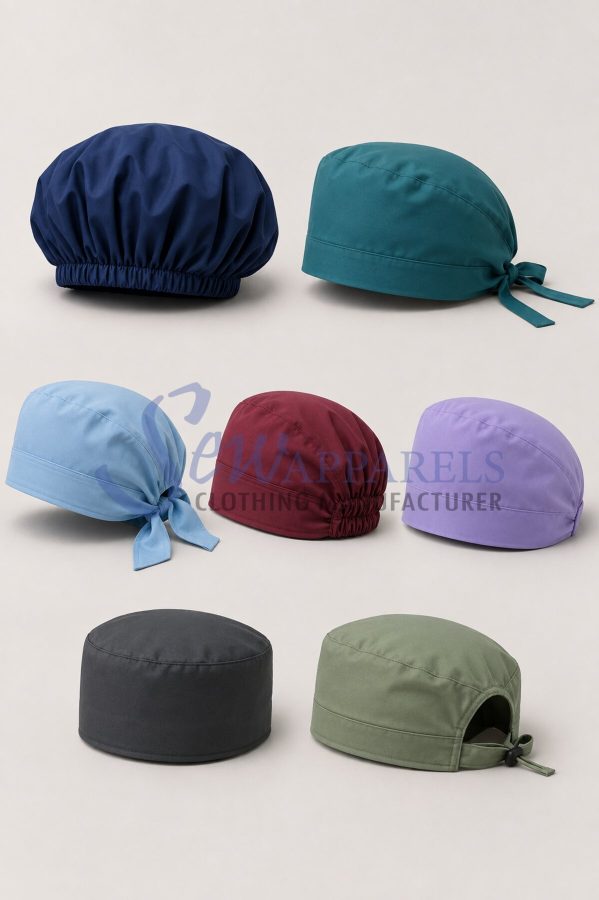
Start with the finished cap’s material map: shell, forehead band, ties, sewing thread, printed areas and any lining or trim. Record the fabric reference, colourway, supplier lot and treatment revision for each relevant part. A report for one shell fabric may not cover a separately sourced band or a later print treatment. Keep the assembled sample reference connected to the material references.
The first step in investigating scrub cap sweat colour transfer is to define where contact can occur. For example, a coloured shell may touch a pale band inside a seam, while ties may rest against another garment. These contact observations help frame the laboratory question. They do not replace the standard specimen preparation or authorize an improvised test to be described as a recognized method.
For scrub cap shell band dye compatibility, list each intended pairing rather than asking whether the shell is simply colourfast. A change of band colour or fibre may affect what the buyer wants investigated. Include photographs or a construction drawing that identifies contact areas, then ask the laboratory which test arrangement can address the question within a clearly stated scope.
Scrub cap band colourfastness evidence should refer to the band actually proposed for production. A generic swatch without a lot reference leaves uncertainty about the finished cap. Scrub cap perspiration colourfastness testing should make this uncertainty explicit before the sample is submitted, so the report is not later used to approve an unidentified component.
2. Confirm the relevant method and its actual scope
The AATCC TM15 public method summary describes acid-perspiration exposure and separate evaluation of specimen colour change and transfer to contacting materials. The laboratory should use the applicable current method text and identify its version. A public summary is a reference route, not a complete operating procedure.
Be precise when discussing scrub cap acid alkaline perspiration test scope. Do not assume that every named perspiration method covers both acid and alkaline conditions. AATCC’s public TM15 summary describes acid conditions and notes the removal of the earlier alkaline test. If the buyer requests a different exposure or method, have the laboratory identify it specifically instead of silently adding it to a TM15 claim.
Confirm whether the requested work uses the method as written, an agreed variation or a separate exploratory assessment. Ask the laboratory to record deviations and their implications for comparison. Keep the exact exposure parameters in the formal test brief and report. An article, seller’s checklist or casual damp-wipe demonstration should not supply invented standard temperatures, pressure, time or solution recipes.
Scrub cap perspiration colourfastness testing is most defensible when the buyer’s concern and the laboratory’s scope are aligned before samples arrive. If the available method cannot answer a particular finished-cap contact question, record that limitation and agree on complementary work. Avoid giving one result a broader meaning simply because it carries a recognized method number.
3. Make specimen identity and adjacent materials traceable
Use scrub cap lab specimen identification to connect the submission form, sample package and report. Record the article reference, lot, colourway, print or finishing revision and whether the specimen came from loose fabric or an assembled cap. Ask the laboratory how it will preserve identification where one submission includes several similar dark fabrics.
A scrub cap printed fabric staining trial needs an identified printed area and substrate. State whether the buyer is concerned about an all-over print, a placed decoration or the base fabric. A result for an unprinted base should not be presented as approval of a later decorated cap. Request clarification when the report’s description is too general to establish what was tested.
For scrub cap adjacent fabric staining, distinguish the method’s specified adjacent materials from actual cap components that the buyer may also wish to assess. Record which materials were used and how the results are reported. A finding on one adjacent material should not be generalized to every fabric that might touch the cap during wear.
Keep a retained, labelled comparison sample with the approval file where the parties agree to do so. Document sample selection and any prior care or treatment. Scrub cap perspiration colourfastness testing should not combine results from a fresh specimen and a previously laundered specimen without showing that difference. Preparation history can change the question the evidence answers.
4. Read colour change separately from staining
A scrub cap perspiration staining report should let the reviewer distinguish a change in the tested component from colour transferred to the contacting material. These are separate observations. A shell that retains its apparent shade does not automatically demonstrate that a pale adjacent component remains unstained. Review each reported endpoint against its own agreed criterion.
CottonWorks’ quality-testing resource describes colourfastness in terms of colour change and transfer and explains the role of controlled evaluation. Use this background to organize the report review. The actual grading procedure, scale and assessment conditions should come from the chosen method and laboratory report, not from an assumed meaning of a number.
For scrub cap colour change grading review, verify the reported scale, original specimen identification and assessment endpoint. Do not compare unlike grades as though they represent the same measurement. If the report supplies only an overall conclusion, request the detailed results needed to understand whether colour change, staining or another endpoint determined that conclusion.
Keep scrub cap perspiration report limitations beside the result. They may include an unidentified component, a scope variation or missing information about sample preparation. A laboratory result concerns the submitted specimen under stated conditions. It does not establish every wearer experience, every production lot or freedom from skin irritation. Scrub cap perspiration colourfastness testing should support a bounded approval rather than an unrestricted safety claim.
5. Compare colourways and treatments without hiding differences
Build a comparison sheet with one row for each submitted component, colourway and treatment revision. Use the same approved criteria where the comparison is intended to be direct. If methods or specimen preparation differ, flag those differences before ranking results. A strong-looking number from another scope is not automatically better evidence for the cap being ordered.
Scrub cap dark colourway approval should identify the exact dark shade and lot, not treat one dark sample as proof for every dark colour. Ask which additional colourways need evidence based on the buyer’s programme and the laboratory’s advice. Record the reason for any representative selection and the limits of the resulting approval.
Plan scrub cap treatment change retesting around meaningful changes such as a new dye route, print treatment, finishing revision or component source. The responsible parties should decide which checks must be repeated. Keep the earlier report as historical evidence but do not silently attach it to a changed material and present the approval as unchanged.
A scrub cap damp contact sample review can capture a buyer’s real development concern, such as visible marks at the shell-band junction. Label it as a supplementary observation if it is outside the agreed laboratory method. Record the sample, contact materials and conditions. Scrub cap perspiration colourfastness testing should keep exploratory observations and formal results distinguishable while allowing both to inform follow-up questions.
6. Record an approval decision that can be used in production
Create a scrub cap colourfastness acceptance sheet before release. Enter the buyer-approved criteria and their source; do not invent a universal minimum grade. Match every result to the submitted material reference, then identify approval, rejection or further investigation for each component. Record who can authorize a conditional decision and what remains unresolved.
The following report-review sheet supports scrub cap test evidence comparison. Its purpose is to expose missing connections, not to manufacture a passing conclusion.
| Review field | Record required |
|---|---|
| Sample identity | Cap style, component, colourway, lot and treatment revision |
| Test scope | Method/version, preparation, adjacent materials and deviations |
| Colour change | Reported result, scale and agreed acceptance criterion |
| Staining | Separate results for each reported contacting material |
| Decision | Approval status, evidence gaps, action owner and review date |
| Change control | Material changes that require an approval review |
Connect this sheet to the purchase specification and retained approval record. Ensure the production material matches the approved references before applying the decision to bulk output. If a lot is changed, resolve the evidence question before treating the previous approval as transferable. Keep the report and comments together so purchasing, development and inspection teams see the same limits.
Scrub cap perspiration colourfastness testing: prepare the sample request
The Scrub Caps Buying Guides connect this evidence review with the cap’s established fit and construction requirements. Use the tie-back design review for construction decisions and keep them separate from dye-transfer evidence: a well-fitting band can still need an identified colourfastness report, and a satisfactory colourfastness result does not approve the cap’s fit.
For custom scrub cap manufacturing, share the proposed colours, component map, sample references and buyer requirements to discuss a focused development brief. A private label scrub cap production file should retain the same report boundaries. Scrub cap perspiration colourfastness testing is valuable when its evidence can be traced to the actual approved materials and the decision remains clear when production changes.