
Scrub jacket snap versus zip closure decisions start with the institution’s actual use and laundry requirements. A closure that feels convenient on one sample may behave differently after repeated care, when the wearer uses gloves, or when a damaged component needs replacement. Compare identified hardware on representative jackets before approving a uniform order. The purpose of this scrub jacket snap versus zip closure review is a documented fastening decision, not a claim that either closure offers better infection protection.
This guide separates front fastening from the jacket fit and layering review. Establish body length, movement allowance and layering requirements through the wider scrub jackets buying guides, then use the six checks below to compare snaps and zips. Keep the sample identity, attachment construction and intended care process visible throughout the comparison.
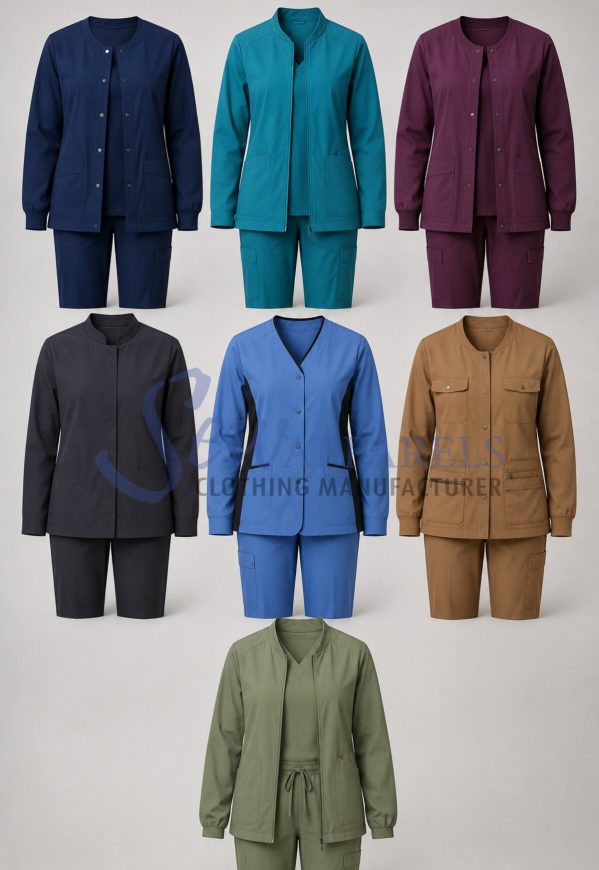
1. Start with scrub jacket snap versus zip closure requirements
A scrub jacket fastening institution requirements record should identify who uses the garment, how it is worn and which department approves it. Ask whether users fasten the whole front, leave part open, change layers during a shift or need to operate the closure with limited hand movement. Record these as practical requirements rather than assuming all clinical workplaces use jackets identically.
Clarify whether the jacket goes through a facility laundry, an external service or another permitted care arrangement. Obtain the institution’s current instructions and the proposed garment care specification. A domestic wash demonstration cannot stand in for an industrial process that uses different mechanical action, chemistry, drying or finishing conditions.
The buyer should also establish acceptable front appearance and replacement arrangements. Decide whether a visible zip, a covered zip or exposed snaps suits the uniform design. Request named sample variants with the same comparable fabric and construction wherever possible, so the evaluation does not accidentally compare an excellent jacket against a poorly built alternative.
2. Compare fastening operation on complete samples
For scrub jacket snap versus zip closure assessment, operate each front on a finished sample. Loose hardware demonstrations do not reveal how the attachment interacts with the fabric, placket, lining or wearer. A scrub jacket front fastening comparison should include opening, closing, alignment and comfortable access to the fastening positions.
During a scrub jacket snap operation trial, observe whether each snap engages consistently, whether the user can locate paired components and whether the fabric distorts during opening. Record a missed engagement separately from a component that releases unexpectedly. Do not convert a few successful operations into an unsupported durability rating.
For the zip sample, note whether the insertion pin and box align readily, the slider moves smoothly and the user can grasp the pull. Observe operation when the jacket is worn as intended, without deliberately forcing hardware. A scrub jacket fastening sample trial becomes useful when the same observations, sample conditions and users are recorded for both variants.
3. Review contact and front-edge appearance
A scrub jacket zip pull contact review considers where the pull rests when the front is fully or partly closed. Examine the neck area, facing, protective fabric coverage and any hard edge the wearer notices. Comfort observations should identify the garment arrangement and wearer feedback; they are not a substitute for a material safety assessment.
Evaluate scrub jacket closure front appearance with the jacket flat and worn. Look for placket twisting, uneven spacing, fabric puckering and a zip line that curves because the construction is mismatched. Photograph the relevant area with a sample reference and condition. A front that looks balanced before care should be compared with the same front after the agreed care trial.
Scrub jacket snap versus zip closure choices can involve different visual compromises. Snaps create discrete attachment points, while a zip joins the front along a continuous fastening line. Neither arrangement automatically guarantees a flatter edge. Fabric, reinforcement, sewing accuracy and component suitability all affect the finished result.
4. Check attachment and realistic repair provisions
A scrub warm up jacket snap attachment review should identify the snap system, backing arrangement and reinforcement around its installation. Ask the manufacturer to document the component reference and the intended attachment method. Inspect the sample for tearing, distortion or inconsistent engagement, and ask how attachment quality will be controlled during production.
A scrub jacket closure attachment check for a zip should cover tape support, stitching, alignment and finishing at the top and bottom. Record scrub jacket zipper component identity, including the supplier reference and relevant specification, rather than approving a general description such as “strong zipper.” A replacement from another source may differ in dimensions or operating behavior.
Discuss scrub jacket closure repair options before an order, not after a failure. A scrub jacket snap repair provision may require matching parts, installation equipment and access to a competent repairer. A zip replacement may involve removing stitching and restoring the front construction. Confirm which repairs are practical, who performs them and whether spare components are available; do not promise effortless replacement.
5. Compare both closures against the actual laundry process
Scrub jacket snap versus zip closure evaluation needs a care trial tied to the intended garment and component instructions. Ask the laundry operator and component supplier to resolve compatibility questions before testing. Define what will be observed, which samples are involved and how the care conditions will be recorded.
YKK’s published zipper use and care guidance illustrates why handling instructions matter: it cautions against forcing a jammed zip and describes care-related operating precautions. Use the instructions for the actual selected component and approved laundry process. The reference does not establish that a proposed jacket contains YKK hardware or that every zip tolerates the same treatment.
A scrub jacket zipper wash operation record should state the preparation agreed for the selected component, followed by observations after care and suitable cooling or conditioning. Check engagement, slider movement, tape appearance and attachment integrity. For snaps, compare engagement, release behavior, component appearance and the surrounding fabric using the same documented care history.
The CDC’s healthcare laundry and bedding guidance concerns facility laundry practice and material compatibility. It reinforces the need to obtain the institution’s requirements rather than invent a universal jacket wash recipe. This garment comparison does not select a disinfection protocol or establish clinical protection.
Scrub jacket fastening laundry evidence should connect each observation to a sample, process record and component identity. If the two variants receive different care, explain why and avoid claiming a like-for-like result. Where the intended process is not yet confirmed, keep the decision conditional and list the missing evidence.
6. Build a scrub jacket snap versus zip worksheet
The following scrub jacket snap versus zip worksheet organizes comparison without inventing a performance grade. Complete both columns from actual samples and supplier records. Leave an unanswered requirement visible instead of filling it with a generic claim about snaps or zips.
| Decision area | Snap sample record | Zip sample record |
|---|---|---|
| Institution and wearer use | Engagement positions, access and user observations | Alignment, slider access and user observations |
| Component and attachment | Snap reference, reinforcement and installation evidence | Zip reference, tape support and stitching evidence |
| Front appearance and contact | Spacing, distortion and contact observations | Front line, pull position and facing observations |
| Intended care compatibility | Supplier instructions and post-care engagement record | Supplier instructions and post-care operating record |
| Repair provision | Matching parts, equipment and confirmed repair route | Replacement availability and confirmed sewing repair route |
| Approval status | Accepted, conditional or revision required, with reason | Accepted, conditional or revision required, with reason |
Scrub jacket snap versus zip closure approval should follow the requirements established at the beginning. If both samples meet them, explain the preference using wearer operation, appearance, care evidence and repair practicality. If neither meets them, request a revision rather than choosing the less unsuitable sample simply to keep an order moving.
Turn the comparison into a controlled order brief
A scrub jacket complete closure approval record names the selected sample, component reference, attachment construction and care instructions. Include the observations supporting the choice and the person or department responsible for approval. Make clear which changes require a new review, such as switching hardware, altering the placket or changing the laundry arrangement.
For custom scrub jacket manufacturing, share the intended workplace use and laundry requirements alongside your closure comparison. Ask which sample options, component documents and attachment details can be reviewed for your proposed order. Confirm quantities, colours, pricing and feasibility through the quotation process; this guide does not establish a fixed minimum or an available hardware inventory.
A private label scrub jacket production brief should preserve the approved closure details through sampling and order confirmation. Keep artwork, labels and packing instructions in their relevant specifications, while retaining the fastening record as a clear decision document. Startup brands can use the same structured questions to reduce uncertainty before requesting a sample or quotation.
Frequently asked questions
Is one closure always better for scrub jackets?
No. Scrub jacket snap versus zip closure suitability depends on the specified use, finished construction, actual hardware and permitted care. A recorded comparison is more useful than a universal claim about convenience or cleanliness.
Can a successful wash trial guarantee long-term service?
No. It supports the conditions and observations documented for those samples. State the trial boundaries and keep unresolved care or durability questions open. Do not extend a limited comparison into a guaranteed service life.
What should the buyer send first?
Send the jacket design, wearer operation needs, institution care requirements and preferred front appearance. Request identified snap and zip samples, attachment information and a realistic repair route. Scrub jacket snap versus zip closure decisions become clearer when those records accompany the quotation request.