
A scrub set bulk packing specification connects an approved garment order with the way the receiving team will count, sort and issue it. Correct production quantities do not guarantee convenient delivery: a top-and-trouser set, a single top and an inner pack are different counting units. Define those units before packing instructions reach the supplier, then check a representative trial against the buyer’s receiving process.
This guide provides six critical checks for ordinary apparel packing. It covers the receiving route, paired or separate components, identification, handling boundaries, a packing trial and revision control. It does not establish sterile supply, protective garment performance or healthcare handling procedures. Any institution-specific clean-textile requirements must come from the responsible institution and laundry provider.
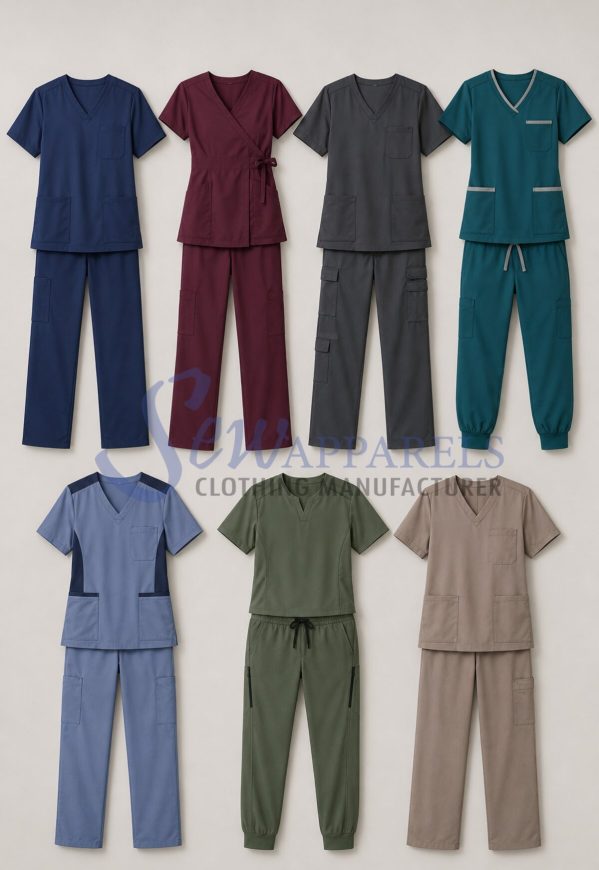
Why a scrub set bulk packing specification follows the order matrix
First confirm the approved styles, colours, sizes and quantities. A quantity matrix answers how many components are required; the packing specification answers how those components will be grouped, identified and delivered. Keep the two documents connected by order number and revision so a change in quantities triggers a review of affected packing instructions.
For example, a department may require medium tops with large trousers. The approved order can contain both quantities correctly while the packing team incorrectly pairs medium tops with medium trousers. Resolve the intended combinations in writing. Avoid relying on the word “set” unless the parties agree precisely what each set contains.
1. Identify the receiving route and responsible team
Begin the scrub set bulk packing specification with the destination and receiving owner. Will cartons go to a central store, distributor, laundry provider or individual department? Identify who checks delivery quantities and who distributes the garments. A scrub set institutional packing brief should describe that process rather than assuming every hospital or buyer works in the same way.
Ask the receiving team what information must be visible before a carton is opened and what details are needed at the inner-pack level. Confirm whether goods will remain in their delivery packs or be unpacked and processed before issue. Record any purchase-order references, delivery splits or appointment requirements through the buyer’s authorised logistics instructions.
Scrub uniform department delivery labels can help where the buyer assigns stock by department. Use approved department codes rather than employee names or private wearer information when those details are unnecessary. Confirm whether the label routes an entire carton or only a contained pack, and avoid mixing several destinations under one ambiguous outer description.
2. Choose paired sets or separately packed components
A scrub set bulk packing specification needs an explicit paired-set or separates decision. Define whether one unit contains a top and trousers, one component or another approved assortment. For paired sets, identify the top style and size alongside the trouser style and size. For separates, distinguish the component clearly on the unit and relevant packing records.
The scrub separates paired packing decision should follow the buyer’s actual issue arrangement. Paired sets may suit a programme with fixed combinations; separately packed tops and trousers may suit independent size allocation. Neither format is automatically better. Confirm the receiving team’s preference and the supplier’s ability to maintain the proposed combinations during packing.
Keep substitutions and shortages out of informal packing decisions. If the planned combination is unavailable, identify the affected quantity and request a documented buyer decision. Changing a trouser size to complete a set can alter the order even when the total garment count stays the same. The packing team should not have to infer an acceptable replacement.
3. Define unit, inner-pack and carton identification
Use the scrub set bulk packing specification to distinguish three levels: the sale or issue unit, the grouped inner pack and the shipping carton. Give each level a clear identity and counting rule. Scrub uniform inner pack identification should connect its contents to the outer carton and the approved assortment, rather than introducing a second unexplained product code.
Agree scrub garment unit label placement on a trial item. Show which information appears on temporary packing labels, which remains on the garment and which belongs only on shipping documents. Size, component identity, style and colour codes should be legible where the receiving team needs them. Confirm that temporary labels do not obscure the information the buyer must inspect.
FTC guidance explains U.S. textile and wool labeling requirements, including fibre content, origin and responsible-business identification for covered products. Care labeling falls under a separate rule. Treat this as destination-specific regulatory context, not permission to replace garment labeling with a warehouse sticker. Have the responsible importer or compliance team confirm the applicable requirements for the actual market and product.
Prepare a scrub set carton assortment sheet with carton ID, component or set codes, sizes, colours, units per inner pack and total carton contents. Scrub set mixed size carton control should make mixed assortments visible before dispatch. If mixed sizes are allowed, show the quantity of each size; if they are prohibited, state that instruction explicitly and confirm feasible packing arrangements.
4. Separate size verification from textile handling policy
Review identification and handling as separate parts of the scrub set bulk packing specification. Size verification checks whether the contents correspond to the order. Scrub garment clean delivery requirements concern the buyer’s defined handling route. Passing a size count does not demonstrate that a delivery meets a healthcare processing requirement.
CDC guidance discusses healthcare laundry and bedding practices. The receiving institution and its laundry provider should define applicable processing, storage and handling requirements. Do not interpret ordinary factory packing, a sealed bag or a tidy carton as evidence of sterility, infection prevention or approval for a particular clinical use.
Specify scrub set protective transport wrapping only for the agreed transport purpose. Describe the proposed material, closure and packing level, then ask the supplier to confirm the arrangement. Any special packaging claim needs its own evidence and applicable requirements. Distinguish protection from ordinary transport exposure from a verified sterile barrier or regulated protective system.
Include the buyer’s instructions for damaged wrapping, unclear labels and questionable deliveries in the receiving plan. Identify the person responsible for assessing the issue and the required reporting route. This article does not set institutional handling procedures; the packing document should refer to the buyer’s authorised procedure rather than inventing one.
5. Run a packing trial and receiving reconciliation
Test the scrub set bulk packing specification through a scrub set packing trial sample. Choose representative combinations, including any mixed top-and-trouser sizes and permitted mixed cartons. Ask the receiving owner to inspect the unit, inner-pack and carton information. A photograph can support the review, but it should identify the same trial and revision as the written records.
Use a scrub uniform receiving checklist to follow the actual unpacking sequence. Start with carton identity and expected contents, then check inner packs and units against the relevant assortment sheet. Confirm that labels remain understandable when items are removed from their outer packaging. Record confusing codes or counting assumptions before the packing format is approved.
Scrub uniform receiving count reconciliation should keep units consistent. For an illustrative trial, four paired units might contain four tops and four trousers; two inner packs could each contain two paired units. That is eight garment components, four sets and two inner packs. These are three descriptions of the same trial, not interchangeable quantities and not a proposed universal pack count.
If the receiving team records components rather than sets, include both counts in the agreed document. Compare the trial’s physical contents with the packing list and approved order. Resolve differences by identifying their cause, such as an incorrect combination, missing component or unclear unit definition, instead of changing the description merely to make totals agree.
6. Freeze the packing specification and change log
Release the scrub set bulk packing specification only after the responsible buyer and supplier confirm the agreed format. Scrub set packing revision approval should identify the document revision, trial reference, assortment rules and any remaining conditions. Record which order or delivery the approval covers; a trial for one programme should not automatically govern a different receiving route.
A scrub set carton marking proof lets the buyer review the proposed text and layout before bulk packing. Check component codes, quantities, destination references and any required logistics fields against the approved records. Confirm whether individual carton numbers and totals will be populated later, and identify who checks the final shipment-specific details.
Retain a scrub uniform packing acceptance record with the approver, date, accepted sample and released revision. If sizes, quantities, destinations or labeling change, record the affected packing fields and obtain approval for the revision. Tell the receiving team which version applies so it does not inspect a new delivery against superseded instructions.
A receiving-ready matrix for a scrub set bulk packing specification
The following matrix fields are an original planning tool for the buyer’s enquiry. They do not describe a confirmed factory capability or fixed carton capacity. Use only fields the parties can maintain, and add programme-specific requirements through the authorised receiving team.
| Record | Required information | Agreed format / counting unit | Document / trial reference | Owner / exception decision |
|---|---|---|---|---|
| Receiving identity: | order reference, delivery destination, department code and receiving owner. | |||
| Unit definition: | paired set or separate component, top and trouser codes, sizes and colour references. | |||
| Inner-pack rule: | pack ID, unit count, permitted assortment and visible identification. | |||
| Carton rule: | carton ID, inner-pack count, component or set quantities and assortment-sheet reference. | |||
| Acceptance evidence: | trial sample, label proof, receiving review, approval date and packing revision. |
Add space for exceptions rather than burying them in a free-text note. For example, identify whether an incomplete carton is permitted, how it is marked and who approves it. Confirm carton dimensions, transport constraints and shipment documentation with the relevant parties. Do not select a capacity or weight limit simply because another apparel order used it.
At dispatch and receiving, use the same definitions to investigate discrepancies. A missing inner pack, an incorrect unit pairing and a wrong outer label are different issues. Keep the carton and trial references available so the teams can identify the affected scope without treating every item in the shipment as incorrect.
Prepare your scrub packing specification enquiry
For custom scrub set manufacturing, send the approved component order sheet, intended receiving route and proposed packing matrix. Ask the supplier to confirm feasible grouping, identification, trial preparation and change-control arrangements. Obtain the quotation and schedule for any agreed additional packing work rather than assuming it is included.
For private label scrub set production, connect presentation requirements with the receiving process. Brand packaging may help the programme’s presentation, but the receiving team still needs clear component and quantity information. Review both needs together before approving a format that looks attractive but requires unnecessary sorting on arrival.
Share your receiving format and component order sheet through the Sew Apparels custom scrub sets service for a packing specification discussion. Use the related scrub buying guides to connect fabric, size allocation, quotation and reorder decisions with the same product brief. Release the agreed scrub set bulk packing specification alongside the order so production and receiving work from one confirmed instruction.