
Swim shorts assembled garment drying comparison should evaluate the finished short, not only the shell fabric. A lightweight outer panel may feel dry while the waistband, liner or pocket remains wet. Buyers need a defined starting condition, controlled drying environment and complete-garment endpoint before comparing samples or approving quick-dry wording.
This guide explains a buyer-defined comparison of production-intent swim shorts. It covers dry mass, retained water, component observations, time records and claim limits. It is not a reproduction of a licensed textile test method, and it does not establish a universal drying time. Agree the actual protocol with a qualified testing party when the results will support a formal performance claim.
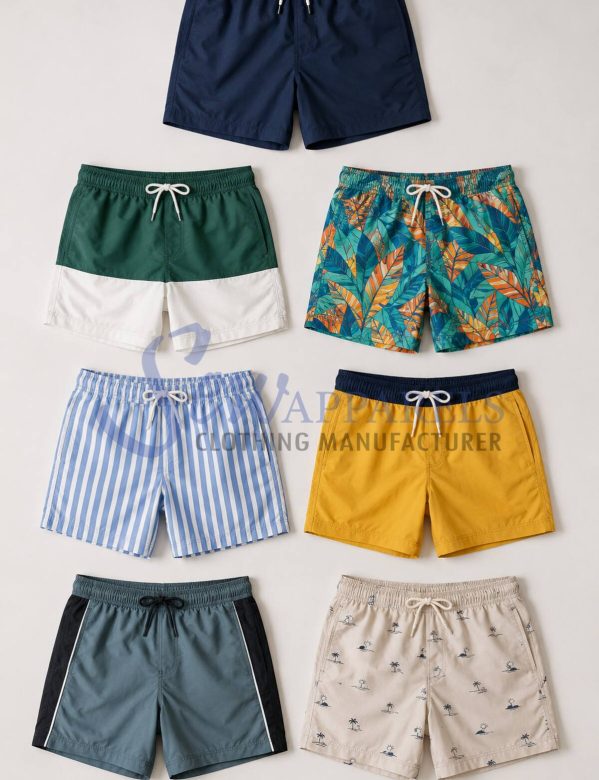
Why swim shorts assembled garment drying comparison needs a full sample
Record the complete construction: shell, mesh liner, waistband, elastic, drawcord, pocket bags, zippers, labels and other trims. Keep the sample size and revision identifiable. Two shorts with different liners or waistband builds are not simply two fabric candidates; they are different garment systems.
Describe the intended use and the question being asked. Is the buyer comparing two assembly options after immersion, or checking a proposed drying statement under defined conditions? Keep swim shorts finished garment dry down separate from a wearer’s comfort impression. A person may feel comfortable before the garment reaches its agreed drying endpoint.
1. Record dry garment mass and sample identity
Start swim shorts assembled garment drying comparison with a stable reference condition defined by the testing party. The dry garment mass record should include size, material references and construction revision. Use suitable weighing equipment and a consistent procedure. A casual reading taken in different environmental conditions can make the baseline unreliable.
Identify any differences in garment mass or components before comparing wet results. A lined trunk and an unlined board short may retain different amounts of water even when the shell is similar. Record those differences openly. For swim short fabric versus garment drying, do not present a design change as proof that one shell fabric alone dries faster.
Keep each sample’s own baseline with its time records. If the comparison includes repeated trials, distinguish trial number from sample number and retain the preparation history. Decide how the testing party will establish readiness for another trial rather than assuming the sample is fully reset because the shell feels dry.
2. Control wetting and initial water removal
For swim shorts assembled garment drying comparison, define how the garments are wetted and how initial excess water is removed. Record the water condition, exposure arrangement and the drainage or extraction step agreed for the assessment. Differences at this stage can influence the apparent drying result before the timed comparison begins.
Do not wring one sample strongly and leave the other dripping. If the protocol requires consistent wringing conditions or another extraction step, the testing party should define a reproducible condition that suits the garment. Avoid an uncontrolled twisting action that damages a liner, print or trim. Any departure from the agreed procedure belongs in the record.
Record the mass at the defined wet starting point. Subtracting the dry baseline from that reading gives an initial retained-water mass under the stated preparation. Keep the retained water comparison distinct from elapsed drying time. A garment can start with less water and reach an endpoint sooner without having the same underlying material drying behaviour as another sample.
Use both absolute and normalized information
Where appropriate, the testing party can report retained water in grams and relative to the dry garment mass. For example, an invented dry mass of 120 g and wet starting mass of 180 g gives 60 g retained water, equal to 50% of dry mass. These numbers illustrate the arithmetic only; they are not swim-short test results or acceptance limits.
3. Keep the drying environment and arrangement consistent
Swim shorts assembled garment drying comparison needs a controlled drying environment with a recorded arrangement. Identify temperature, humidity, airflow, hanging or laying arrangement and sample spacing as relevant to the selected protocol. Keep the garment orientation consistent, including pocket drainage and position and whether the liner is inside the shell or separately exposed.
Sunlight, a fan, a warm surface or an outdoor breeze can change a result. If such conditions are intentionally assessed, define them and keep the claim limited accordingly. Do not compare an outdoor sample on a sunny day with an indoor sample in still air and attribute the difference only to the fabric.
Record environmental changes during the trial. If a condition falls outside the agreed range, let the testing party decide whether the result remains usable. Do not silently remove the inconvenient trial from the comparison. A clear exception note is more useful than a precise-looking time based on inconsistent conditions.
4. Observe waistband, liner, pockets and trims
During swim shorts assembled garment drying comparison, map swim shorts water retention by component. Inspect the waistband casing, elastic assembly, drawcord channel, liner edges, pocket bags, zipper tape and seam intersections. Record swim short waistband drying time separately from whole-garment mass readings so wet waistband drying lag remains visible.
A shell can look dry while a folded waistband or enclosed pocket holds moisture. Record when each relevant area changes under the agreed observation procedure. Avoid repeatedly squeezing, rearranging or opening one garment if that action is not applied consistently to the others. Handling can alter the drying arrangement.
Record the shell liner drying difference separately. If a liner material or attachment changes, record the effect as an assembly question and reassess the complete sample. Similarly, a drainage feature may affect initial retained water while trim water retention affects a later drying stage. Keep those mechanisms separate rather than calling every improvement faster-drying fabric.
Do not remove trims or cut apart the production-intent garment during the main whole-short comparison. If component testing is needed, use separately identified specimens and report that work separately. The intact sample remains the evidence for the assembled product under the stated conditions.
5. Plot the dry-down record and define the endpoint
Use a time-and-mass table for swim shorts assembled garment drying comparison. Agree the observation intervals, weighing procedure and endpoint with the testing party before starting. Record each reading against the original dry mass and note any handling or environmental exception.
A sample dry down curve can show how the excess mass changes over time. Its shape helps the reviewer see whether a sample starts with more retained water or has a slower later stage. Do not reduce the comparison to one selected early reading when the waistband or liner remains wet near the end.
The complete garment drying endpoint must be explicit. It may involve a defined mass criterion or another agreed approach appropriate to the protocol, with localized observations reported alongside it. Do not invent a universal tolerance or declare absolute dryness simply because a final displayed mass resembles the baseline. Instrument resolution and the method’s limitations matter.
Repeatability also matters. Ask how many specimens or repeat trials are needed for the intended claim, and report variation where applicable. A single favourable trial does not establish consistency across sizes, production lots or different environments. Keep the raw record so the conclusion can be checked later.
6. Separate fabric methods from garment claims
AATCC’s moisture management testing overview distinguishes absorbency, wicking and different drying assessments. Its sample agenda identifies drying-time, airflow and heated-plate methods for textiles or fabric. These topics illustrate why the method name and endpoint matter; the overview is not a whole-swim-short certification or a substitute for a current licensed procedure.
SGS comfort and performance wear services describe general performance-claim support across fabrics, material systems and finished garments. The current public page does not identify a whole-swim-short drying procedure. Ask the provider to confirm the proposed drying assessment, its scope and the evidence it can deliver. This service listing does not mean that Sew Apparels or the chosen sample has received testing approval.
Close swim shorts assembled garment drying comparison with a qualified drying statement that matches the evidence. State which samples, construction and drying conditions were compared. Respect swatch result limitations: avoid extending a swatch result to the entire short or promising the same drying time in all weather, after every type of water exposure and across all sizes.
- Sample: garment revision, size, shell, liner, waistband, pockets and trims.
- Baseline: dry reference condition and dry garment mass.
- Wet start: wetting arrangement, initial water removal and retained-water reading.
- Environment: temperature, humidity, airflow, orientation and spacing.
- Results: time-and-mass record, component observations, endpoint and variation.
- Claim: supported comparison, limitations and approval owner.
Use the findings in the manufacturing brief
For custom swim shorts manufacturing, share the intended wet-use scenario, assembly options and required evidence during development. Private label swim shorts production should connect those requirements with the actual shell, liner and trim proposal, subject to factory confirmation of materials, construction and testing arrangements.
Use the existing Swim Shorts Buying Guides to coordinate dry-down findings with liner comfort and pocket drainage. Keep swim shorts assembled garment drying comparison and those related records tied to the same approved revision. A material substitution intended to improve drying still needs its relevant fit, coverage, seam and care checks.
Buyer questions before approving quick-dry wording
Can a fabric result represent the whole short?
It supports the tested fabric within its scope. The assembled short adds seams, layers, pockets and trims. Request garment evidence when the proposed claim refers to the finished product rather than the material alone.
Why compare retained water as well as drying time?
The wet starting load can differ. Recording it helps explain whether a shorter time follows lower initial water retention, a different drying pattern or both. Keep the two measures distinguishable in the report.
What makes the final comparison useful?
A traceable swim shorts assembled garment drying comparison identifies the samples, preparation, environment and complete-garment endpoint. It retains the time record and component findings, then limits the wording to what those observations support. That is stronger evidence than an unqualified quick-dry label.