
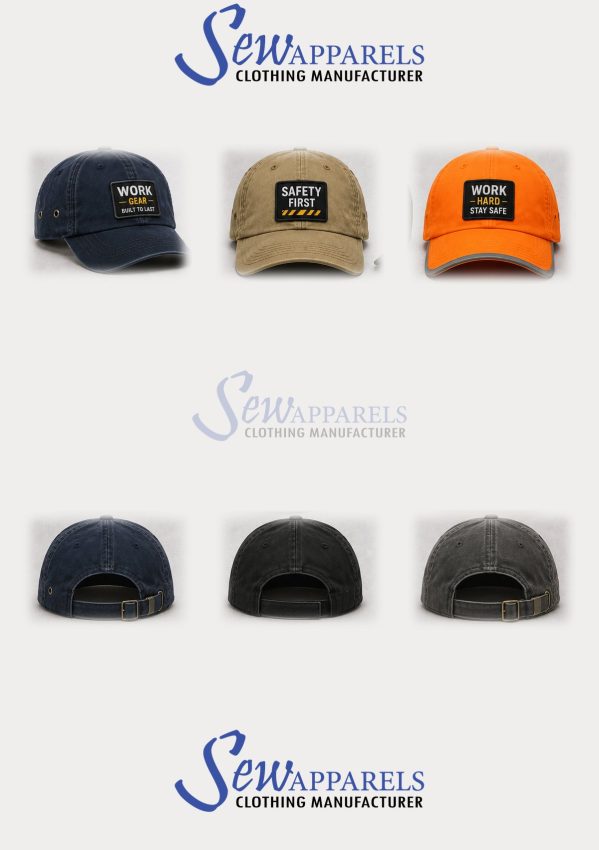
Work cap commercial laundry evaluation helps a uniform buyer decide whether a finished cap is compatible with the cleaning service that will actually handle it. Fabric appearance after one domestic wash does not answer every question about repeated commercial processing. The cap includes a visor, sweatband, closure, seams, branding and labels, all of which need to be considered together.
Start with the laundry operator’s proposed process and a representative finished sample. Then agree on the trial sequence, inspection points and acceptance responsibilities before the first bulk order. This guide covers six practical checks for recording cleaning exposure, evaluating component condition and deciding when a revised sample or replacement is needed. It does not prescribe a universal wash temperature, cycle count or hygiene outcome.
1. Define work cap commercial laundry evaluation around the intended service
Workwear cap wash service compatibility begins with a clear description of the cleaning route. Ask whether the service uses washing, bleaching where applicable, drying or another finishing process. Record the actual proposed route rather than assuming that all commercial laundries treat headwear the same way. The cap manufacturer’s care information and the operator’s equipment constraints should both be reviewed.
The work cap laundry service wash conditions record should identify the process supplied by the operator, including relevant machine, programme, chemistry and handling information. Ask the operator which details are needed to assess the cap and what restrictions apply. A buyer should not invent an aggressive process in an attempt to prove durability or select a milder trial that does not represent routine service.
Work cap commercial laundry evaluation also needs an intended use statement. A staff cap used in a relatively clean customer-facing setting may have different cleaning and replacement expectations from one exposed to heavier soil. Define the product and service scope without turning ordinary uniform headwear into a protective or hygienic certification claim.
Separate the responsibilities
The supplier can explain the cap’s materials and construction, the laundry operator can define the intended process, and the buyer can set appearance and usability requirements. Assign an approver for each part of the decision. One person signing a colour sample should not accidentally approve an unspecified laundry process or an unsupported sanitation claim.
2. Choose representative finished samples and trial records
A service trial sample record should identify the cap style, material batch or sample reference, colour, branding method and relevant trims. Include the visor construction, sweatband and back adjustment. A fabric swatch alone cannot reveal how an assembled cap behaves when components have different responses to cleaning and drying.
For work cap commercial laundry evaluation, keep an unprocessed reference and establish the agreed starting condition. Photograph the cap consistently, measure the agreed fit points and record any pre-existing marks. This creates a comparison basis for the review without implying that photographs are a substitute for measurement or a suitable technical test.
A staff cap repeated laundry trial should use a sequence agreed with the operator and buyer. Specify the inspection stages, identify who records each result and document any deviation. There is no universal number of cycles that automatically approves every cap. The chosen sequence needs to represent the intended use and the decision being made.
The ISO 15797 overview of industrial washing and finishing tests describes evaluation procedures for workwear and relevant appearance properties. Its public scope distinguishes these tests from operating instructions for industrial laundries and notes that actual-service testing can be appropriate when determining compatibility. Ask a competent laboratory about method suitability for the cap and use the complete applicable method for any formal test. Select washing and drying procedures for the material and intended use; every listed procedure is not automatically necessary.
Keep the actual trial identifiable
If several samples are processed, label them in a way that remains traceable throughout the trial. Record which sample entered which run and how it was dried or finished. A result without a reliable sample identity cannot be connected confidently to the specification later ordered. Preserve the records with the approval reference.
3. Review shape, fit and component condition after processing
Work cap commercial laundry evaluation should inspect the complete cap after the agreed conditioning or resting stage. Compare crown shape, fit measurements, visor presentation and seam appearance with the unprocessed reference. Record the inspection conditions so differences between reviewers do not create misleading conclusions.
Commercial drying exposure deserves particular attention in the trial brief. The operator should describe the proposed drying or finishing route and any restrictions relevant to the cap. Do not assume a visor support, closure or decoration is compatible merely because the fabric looks acceptable. Keep exposure records connected to the finished sample observations.
Employee cap cleaning durability includes continued usability as well as visible appearance. Check whether the adjustment still functions, the sweatband remains attached and the visor retains an acceptable condition. Record distortion, rough edges, loose components or seam changes clearly. Where a fault appears, identify the location and ask the supplier and operator to review its likely relationship to the process.
Distinguish a measured change from an acceptance decision. A reviewer can record that a fit point has changed, but the buyer needs an agreed limit or evaluation rule to decide whether it is acceptable. Establish these criteria before the trial where possible. Otherwise, a disappointing result can lead to an improvised threshold that another reviewer would not accept.
Evaluate the finished assortment
Different colours, logo methods or component alternatives may not behave identically. Agree which variants require their own evidence and document the rationale for any representative sample choice. Do not extend one successful trial to a materially different cap without review. A change in the supplied construction should trigger a check of the approval’s scope.
4. Check branding, label legibility and care communication
Work cap commercial laundry evaluation should include logo laundry durability using the actual decoration planned for production. Check the appearance and attachment against the agreed reference after the relevant stages. Record lifting, cracking, thread changes, staining or loss of definition where observed. The result should identify the decoration and cap construction tested.
Label legibility after cleaning is another practical inspection point. Confirm that the identifying and care information remains readable and attached as intended. A label that survives physically but becomes unreadable may no longer serve its purpose. Keep the label artwork, material reference and attachment details with the trial record.
The ISO 30023 overview of industrial laundry qualification symbols describes symbols communicating potential suitability for specified professional industrial laundering treatments. Refer the applicability and correct use of such markings to a qualified reviewer. A supplier should not add a qualification symbol to ordinary cap artwork simply because the cap passed an informal cleaning trial.
Employee cap care evidence should explain what has actually been evaluated. Separate ordinary care instructions from a claimed qualification for a particular service route. If the buyer intends professional cleaning, confirm that the service understands the approved restrictions. An internal issue sheet and the product label should not provide conflicting instructions.
Control branding changes
A change in logo size, decoration route or backing can alter the assembled product. Ask whether the relevant laundry checks must be repeated before accepting the revision. For private label work cap production, treat label and decoration approval as part of the finished specification rather than isolated artwork sign-offs. Keep the current approved version clearly identified.
5. Separate appearance approval from hygiene claims
Appearance versus hygiene claims must remain distinct. A cap that looks clean or retains its shape has not, through those observations alone, demonstrated a particular hygiene outcome. If the workplace requires a defined sanitation process or outcome, the responsible team and service provider need suitable evidence for that requirement.
Work cap commercial laundry evaluation should record laundry operator approval of the proposed product and process combination. Ask the operator to identify any unresolved handling restrictions or service limitations. Their acknowledgement should state what was reviewed, rather than relying on an informal assurance that the cap is “washable.”
For uniform laundry compatibility, confirm the cap is assessed as the item that will be supplied. A process used for shirts or trousers is not automatically appropriate for a cap with a shaped visor and different trims. The buyer should clarify whether headwear requires separate handling or a different approved route.
Keep unsuccessful results visible. If a trial requires another sample, record the reason and the corrective specification. Do not remove a failed variant from the report and describe the remaining result as approval of the whole assortment. The production release should identify only the combinations covered by the completed review.
Use precise approval language
An approval can state that the identified sample met the agreed appearance and usability criteria after the recorded service trial. It should not promise unlimited cleaning life or universal commercial laundry suitability. Limit the conclusion to the product, conditions and evidence reviewed, and make any unresolved requirement explicit.
6. Set replacement criteria and release the controlled specification
A work cap replacement condition checklist should cover the agreed signs of retirement, including damaged components, failed adjustment, unacceptable shape changes or unreadable required information. These examples support a buyer’s checklist; the final replacement condition criteria must reflect the organisation’s use and relevant responsibilities.
Work cap commercial laundry evaluation is more useful when each cap component retirement trigger has an owner and a response. Decide who inspects issued headwear, how a fault is reported and how replacements are approved. Do not set a fixed replacement interval from an unsupported general estimate. Actual use and cleaning records can inform future purchasing.
Use the Work Cap Buying Guides to connect laundry decisions with fit, branding and allocation planning. Keep those approvals linked through the same sample identity while retaining the separate evidence needed for each issue. A successful laundry trial does not automatically approve an unresolved fit or logo placement decision. Use the workplace cap fit design review to document the separate fit checks.
When discussing custom work cap manufacturing, send the service requirements and finished sample observations to the custom work cap manufacturer in Bangladesh. Ask for confirmation of any proposed material or component revision and the checks needed before release. Startup programmes can use this same approach, with minimum quantities and development terms confirmed directly in the quotation.
Final laundry approval checklist
- The actual service route and relevant restrictions are recorded.
- Finished sample identities and unprocessed references are traceable.
- Trial stages and process deviations are documented.
- Shape, fit, branding, labels and components have agreed inspection criteria.
- Appearance conclusions are separated from hygiene claims.
- The approved specification and replacement criteria have named owners.
Work cap commercial laundry evaluation is complete when the purchase decision can be traced to a finished sample, an identified process and agreed results. Retain that evidence with the order and review it whenever materials, decoration or the laundry service change.