
Work cap versus protective headwear procurement starts with a clear statement of intended use. A fabric cap ordered for uniform identification, branding or everyday comfort should not acquire a protective claim simply because employees wear it at work. When a job involves head injury hazards, the purchasing brief needs a separate safety review and equipment selection process.
This guide helps uniform buyers define that boundary before requesting samples or quotations. It covers six scope checks: intended purpose, hazard review, product evidence, supplier communication, claim control and final release. The examples distinguish ordinary cap development from protective equipment purchasing. The responsible employer and safety specialist must assess the actual workplace and applicable requirements; a general product brief cannot replace that assessment.
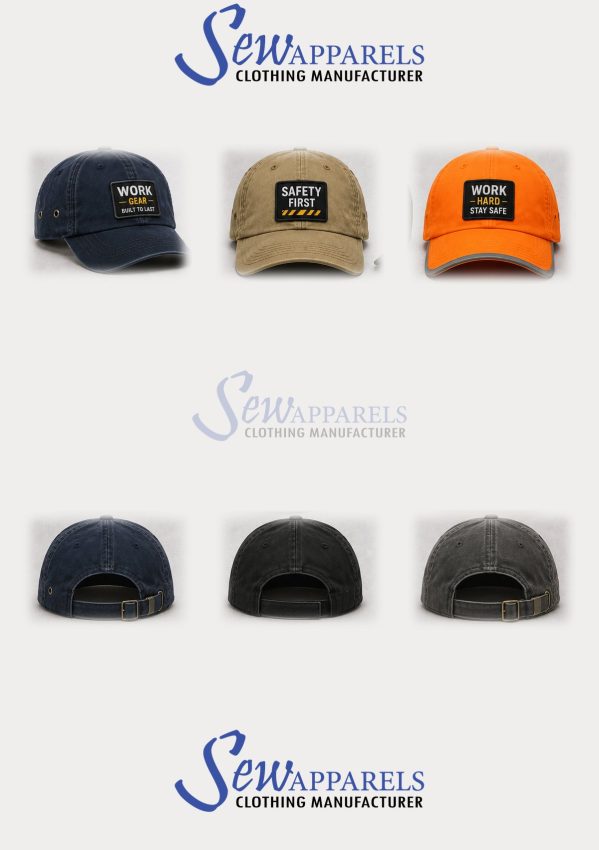
1. Define work cap versus protective headwear procurement by intended use
Write a headwear intended use record before selecting fabrics, trims or logo positions. State who will wear the cap, where it will be used and why it is being issued. A uniform identification purpose might involve matching company colours or distinguishing a customer-facing team. These are valid product requirements, but they do not establish protection from impact or electrical hazards.
For work cap versus protective headwear procurement, avoid ambiguous descriptions such as “safety cap” when the enquiry concerns an ordinary textile cap. The term may cause different teams to assume different functions. Describe the product accurately and record any protective requirement as an unresolved safety specification requiring specialist review.
Separate the operational role from the product function. Warehouse staff, service technicians and reception teams can all wear branded headwear, yet their work environments may differ substantially. A job title alone does not determine the appropriate equipment. The buyer should seek a defined use statement from the workplace owner rather than inferring requirements from the department name.
Prepare an ordinary cap limitation statement
A uniform cap limitation statement should make the enquiry boundary understandable. For example, the brief can identify the item as ordinary textile headwear for uniform appearance, with no protective helmet claim included. The wording must accurately reflect the product being sourced. If the workplace requires protection, refer the requirement for review instead of relying on a limitation statement to excuse an unsuitable purchase.
2. Refer the hazard-defined brief to the responsible specialist
A work cap hazard assessment brief should identify the location and task requiring review, along with the person responsible for equipment selection. The uniform buyer can collect this information but should not convert a clothing sample into approved protective equipment through a visual inspection. Keep safety decisions separate from preferences about colour, crown shape or embroidery.
For a U.S. workplace example, OSHA 1910.132 on general PPE requirements addresses hazard assessment, appropriate equipment selection and fit, communication and training. The rule also specifies a written certification of the hazard assessment. Its requirements should be considered in their applicable context; buyers operating elsewhere need the relevant local requirements and competent advice.
Work cap versus protective headwear procurement becomes clearer when the hazard-defined headwear brief names the decision owner. Ask that owner whether the enquiry is for an ordinary uniform item, protective equipment or two separate products. Record the outcome and its date. An unanswered question should remain open rather than being treated as permission to issue the ordinary cap for every task.
Use a referral record when information is incomplete. List the missing task description, hazard information or equipment specification, identify who will resolve it, and keep the relevant purchase line on review. Other uniform decisions can be prepared, but the unresolved protective requirement should not disappear from the release checklist.
Keep the review tied to the workplace
An approval for one environment may not answer another site’s question. Identify the location and activity covered by the review. If the task, equipment or operating conditions change, return the scope to the responsible team. Do not treat a previous cap order as evidence that the current workplace requirement has been assessed.
3. Review product evidence without assuming equivalence
A uniform cap versus safety helmet comparison should distinguish appearance from function. Fabric weight, stiff front panels and a firm visor may influence the look and feel of a cap. None of those features by itself establishes protective helmet performance. The staff headwear PPE evidence review and PPE purchasing specialist review must concern the specific equipment proposed for the assessed hazards.
The OSHA 1910.135 head protection requirements address helmets for potential head injury from falling objects and helmets designed to reduce electrical shock hazards near relevant exposed conductors. The provision also identifies criteria for head protection. It does not mean an ordinary branded fabric cap provides these functions.
Work cap versus protective headwear procurement therefore needs separate falling object protection evidence where that hazard is relevant. Refer protective helmet documentation to the safety or PPE purchasing specialist for assessment against the specified requirement. Do not accept a photograph, generic catalogue statement or unrelated material test as proof that the offered model meets the required protection.
An electrical hazard headwear referral deserves the same distinction. The ordinary cap supplier should not be asked to certify suitability merely because a cap has no obvious metal component. Product construction alone is not a substitute for the required protective equipment evidence. The qualified decision owner should select and review the appropriate equipment for the actual hazard.
Identify the exact offered product
For any claimed protective item, record the manufacturer, model, relevant specification and documentation provided. Confirm that the documents relate to the item offered rather than a different product in the supplier’s range. Keep the scope of every claim visible. Purchasing should be able to connect the approved requirement, reviewed documentation and order line without guessing.
4. Keep ordinary cap development in its own quotation scope
Work cap versus protective headwear procurement should produce a quotation that accurately reflects what the supplier is being asked to make. For ordinary cap development, specify the fabric, crown, visor, sweatband, closure, fit reference and branding. Use the department colour allocation review for the uniform quantity split. Identify the quantities, colour split and packaging requirements separately. These details support manufacturing review without implying a protective certification.
Buyers discussing custom work cap manufacturing can provide a clear uniform brief and ask the supplier to confirm material and construction feasibility. For private label work cap production, include label artwork and any approved wording. Do not insert a safety claim into a label or packaging draft unless it belongs to the correctly reviewed product and is supported by the appropriate evidence.
If the programme also needs protective headwear, maintain distinct purchase lines and review responsibilities. Separate specifications make it easier to compare quotations and prevent a low-priced ordinary cap from appearing interchangeable with a protective item. A mixed enquiry should state which supplier is responding to which scope.
Discuss decoration only within the approved product route. A logo on an ordinary cap is a normal development detail; decoration on protective equipment needs review under the equipment manufacturer’s instructions and the responsible specialist’s decision. Do not transfer embroidery, drilling, adhesive or attachment assumptions from one product to another.
Confirm the commercial assumptions
Ask the ordinary cap supplier to confirm minimum quantities, sampling arrangements and any construction alternatives in writing. Startup brands can prepare the same focused brief even when their proposed quantities are smaller. A public guide should not invent an order minimum or promise a protective capability that has not been offered and verified.
5. Remove unverified safety claims from the product record
Work cap versus protective headwear procurement includes a claim-control check before artwork, packaging and product descriptions are approved. Search the working documents for language suggesting impact protection, electrical protection or protective helmet equivalence. Ordinary work cap protective claim limits should be visible to marketing, purchasing and anyone preparing the supplier brief.
Unverified safety claim removal is a practical documentation task for ordinary cap protective claims. If a draft calls the ordinary cap protective without evidence, correct that wording and record why. Do not simply replace one unsupported phrase with another vague assurance. Describe the ordinary product features accurately while retaining an explicit referral for any genuine protective need.
Review claims in quotation notes as well as artwork. A sales sentence can be repeated in an order acknowledgement, internal issue sheet or online product listing. One approved description should travel with the product scope so different teams do not create conflicting versions. Keep the ordinary cap’s purpose consistent throughout the record.
US workplace headwear scope should be labelled when OSHA is used as a reference. A buyer should not imply that a short summary establishes compliance in every jurisdiction. The referenced provisions explain the distinction relevant to this guide; the actual employer’s review must address the rules and circumstances that apply to its own operation.
Check the sample review language
Comments such as “comfortable,” “good coverage” or “strong front panel” should remain observations about the ordinary cap sample. They must not be turned into protective performance conclusions. A fit review can approve uniform proportions while the PPE decision remains separate. Label the approval record so each team understands exactly what has been accepted.
6. Release the order with a documented scope decision
The final work cap versus protective headwear procurement decision should identify the approved ordinary product scope, any separately reviewed protective requirements and the responsible approvers. Purchasing should confirm that the order, artwork and sample record agree. If a protective question remains unresolved, route it back to the specialist instead of treating the ordinary cap approval as a complete answer.
Use the Work Cap Buying Guides to organise ordinary fit, branding and allocation questions. Those guides support a uniform brief; they do not certify protective equipment. Keep related development records together while preserving the separate safety decision and its applicable scope.
For an ordinary uniform enquiry, share the approved brief with the custom work cap manufacturer in Bangladesh. State the intended textile cap specification and request confirmation of the proposed construction and commercial terms. Refer protective helmet sourcing to the appropriate qualified route when the workplace assessment requires it.
Final scope checklist
- The intended use record identifies the actual task and location.
- The ordinary uniform purpose is clear and contains no unsupported protective claim.
- Hazard questions have a named safety or PPE purchasing specialist.
- Protective evidence, when required, matches the specific offered equipment.
- Quotation lines, artwork and sample approvals describe the same scope.
- Unresolved safety decisions remain visible before order release.
Work cap versus protective headwear procurement is complete when the buyer can show what is being purchased, what it is intended to do and who approved that decision. Clear boundaries help the supplier quote accurately and help the workplace avoid confusing ordinary branded headwear with reviewed protective equipment.