
Work cargo shorts repair access planning belongs in product development, before a damaged pocket or failed seam forces the buyer to improvise. A garment can appear straightforward from the outside while its pocketing, reinforcement and layered seams make a particular repair difficult. The useful question is not whether shorts can be repaired in principle, but which repair routes are feasible for the approved construction.
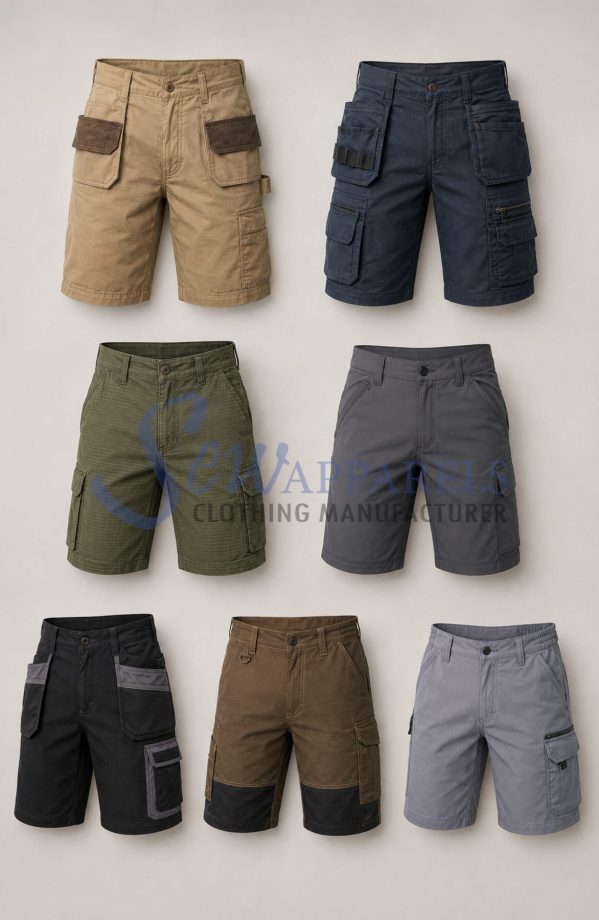
This guide helps uniform buyers specify access, replacement components, sample checks and authorization decisions. It does not promise a repair service, spare-parts stock or a fixed service life from Sew Apparels. Confirm those arrangements separately. Some damage may require replacement rather than repair, particularly where the remaining material cannot support the proposed work.
Work Cargo Shorts Repair Access Planning: 6 Easy Checks
Use these checks to distinguish an intended repair route from an untested suggestion. Review the actual sample, map the components, identify replacement information and agree how a repaired garment will be assessed. Keep original construction requirements visible so a convenient repair does not silently change fit, pocket function or an approved site restriction.
1. Define the likely repair need
A work cargo shorts uniform repair failure map should record the location and nature of observed damage. Separate a pocket bag hole from damaged shell fabric, a detached trim from a failed seam and a cosmetic mark from a functional problem. These conditions may need different responses and different levels of authorization.
For work cargo shorts repair access planning, use actual returned-garment information where available. A few observations do not establish a failure rate for an entire product. Record the sample or garment reference, care history if known and the condition when inspected. Avoid assuming the cause from the location alone.
WRAP’s clothing durability and longevity resource places longer garment use within the design discussion. Repair access can be considered as part of that development objective. However, this article does not quantify environmental savings or guarantee that a particular repair will extend useful life by a stated amount.
2. Map access through the actual construction
Cargo work shorts repair seam access should be evaluated on the approved sample. Identify which seam or opening gives access to the damaged area and which neighbouring components would be disturbed. Do not rely solely on a flat sketch when pocket layers or reinforcement conceal the route.
Work cargo shorts inside seam repair route documentation should name the location, relevant layers and the proposed opening and closure sequence. Ask a qualified garment technician or repair provider to assess feasibility. A development brief should describe the intended outcome without inventing a universal stitch setting or an instruction suitable for every fabric.
In work cargo shorts repair access planning, preserve the relationship between access and construction performance. Coats’ garment design guidance discusses assessing seams and making recommendations about strength or elongation during development. It supports reviewing the seam requirement alongside accessibility; it does not prove a repair method or confirm that an unspecified Sew Apparels garment uses Coats products.
3. Review pocket bag replacement separately
A work shorts replaceable pocket bag needs more than a matching colour. Consider the attachment points, dimensions, opening, connection to the shell and the intended pocket function. A replacement should be assessed against the approved design rather than selected because it is the nearest material available.
Work cargo shorts pocket bag repair access may be restricted by a reinforced opening, waistband connection or surrounding layers. Record whether replacement requires disturbing those areas and how they would be restored. If the original shell or attachment area is too damaged, a new pocket bag alone may not provide a satisfactory outcome.
A work cargo shorts replacement pocketing specification should identify the approved material reference and relevant characteristics confirmed for the order. Keep dimensions and attachment details traceable to the style revision. Do not present an unverified substitute as equivalent because it appears similar on the workbench.
4. Identify service components and availability
Work cargo shorts repair access planning should distinguish component identity from component availability. A detailed part reference helps a buyer ask the correct question; it does not mean the manufacturer has a replacement on hand. Confirm any agreed supply arrangement, quantities and responsibilities in the purchasing documentation.
A work cargo shorts repairable component register can list pocketing, closure parts, thread references and other items relevant to the approved repair routes. Mark each item as confirmed, proposed or unavailable rather than assuming all parts are interchangeable. Note any design revision that changes the reference.
Work cargo shorts service component identity should remain linked to the original bill of materials and approved sample. If a component is discontinued, request a reviewed alternative instead of silently changing the repair. Confirm whether the substitute affects operation, appearance, care or any material restriction.
5. Evaluate an approved repair sample
A work cargo shorts approved repair sample demonstrates one defined repair on an identifiable garment or development sample. Record its starting condition, the work performed and the inspection outcome. The purpose is to make the route reviewable, not to establish that every future damaged garment can be repaired the same way.
For work cargo shorts repair access planning, inspect pocket operation, garment dimensions, closure function and the repaired area as relevant. Compare against agreed requirements. A tidy surface appearance alone may not show whether a concealed attachment has been restored or whether another area was unintentionally caught in the work.
A work cargo shorts sample repair care check should follow an agreed care preparation consistent with confirmed product information. Record the preparation and resulting observations. Do not claim wash durability from one informal observation or introduce a new care instruction without confirming its suitability for the whole garment.
6. Define authorization and rejection decisions
Work cargo shorts damaged short repair authorization should specify who decides whether a garment can proceed, needs further assessment or should be replaced. Consider the remaining material and the role of the damaged area. Keep the garment out of circulation until the applicable review has been completed.
Work cargo shorts repair access planning does not authorize modifications to protective clothing or override a site clothing requirement. If a garment carries a specific protective claim, use the manufacturer’s relevant instructions and the required specialist assessment. An ordinary uniform repair process should not be presented as proof of retained protection.
A work cargo shorts repair inspection decision should reference the actual garment, repair performed, criteria reviewed and decision owner. Record any limitation or follow-up. Do not use a generic “repaired” label to conceal an unresolved problem with fit, pocket attachment or surrounding fabric condition.
Prepare a Work Cargo Shorts Repair Access Planning Brief
A work cargo shorts service parts brief should bring together construction references, intended repair routes and confirmed supply arrangements. It helps development and purchasing teams ask specific questions before approving an order. Keep proposed options separate from commitments that the supplier has actually confirmed.
- Style identity: garment, revision and relevant sample reference.
- Repair location: damaged component and neighbouring construction.
- Access route: opening, affected layers and restoration requirements.
- Replacement: component reference, approved substitute and availability status.
- Assessment: sample checks, care preparation and acceptance owner.
- Limits: conditions requiring further review or replacement.
These fields keep work cargo shorts repair access planning connected to a real construction. Avoid phrases such as “easy to repair” unless the route has been reviewed and the statement is properly scoped. Access may be practical for one pocket arrangement and difficult for another within the same product family.
Separate Cosmetic Patches from Functional Repair
Work cargo shorts cosmetic patch approval should identify whether the patch addresses appearance, provides an agreed construction repair or does both. Covering a visible hole does not automatically restore the original function. The underlying condition and the proposed attachment need to be reviewed.
Agree patch material, size, location and appearance with the relevant buyer before use. Check whether it changes pocket access, comfort or the intended uniform presentation. A patch acceptable on one work area’s uniform may conflict with another site’s appearance or clothing requirements.
Cargo shorts repairability inspection should consider the garment around the damage, not only the damaged spot. If adjacent fabric is extensively worn, there may be insufficient material to support the proposed repair. Record that concern and refer it to the decision owner rather than treating every repair request as automatically feasible.
Connect Development to the Supplier Discussion
When discussing work cargo shorts manufacturing requirements, include access and component questions in the technical brief. For custom work cargo shorts manufacturing, ask which proposed routes can be demonstrated on the actual sample and what information is needed to assess them.
Private label work cargo shorts production should retain approved component and construction references through revisions. Confirm actual repair support, component supply or sample evaluation arrangements separately if they are required. This guide does not establish a guaranteed service package, price, turnaround time or parts inventory.
Example: Pocket Bag Damage and Shell Damage
Consider two fictional returned garments. Garment A has damage limited to a pocket bag, with the attachment area awaiting inspection. Garment B has damage extending into the surrounding shell. The records should describe these differences rather than assigning the same repair instruction to both.
Work cargo shorts repair access planning helps the reviewer ask whether A has a feasible replacement route and whether B needs a different assessment or replacement decision. This example gives no actual Sew Apparels repair result. It illustrates why the damage boundary and remaining material condition matter before authorization.
Questions Before Approving the Repair Route
Does accessible stitching mean a garment is repairable?
Not by itself. Review the damaged material, affected layers, component identity and the ability to restore the agreed function. Access is one part of the decision.
Can any similar pocketing be used?
Use the approved reference or a reviewed substitute. Appearance alone cannot establish equivalent dimensions, function, care behaviour or compatibility with the surrounding construction.
Should all repaired garments return to use?
Only after the required inspection and authorization. Retain unresolved items for review and follow the applicable site or protective-clothing requirements where relevant.
Keep Repair Decisions Traceable
Use the Work Cargo Shorts Buying Guides to connect repair access with pocket, trim and fabric decisions. Preserve the approved construction, record the actual repair and make the inspection decision traceable. A clear route supports orderly evaluation; it does not remove the need to assess each damaged garment.
Where a repair changes a closure, rivet or cover, include the work cargo shorts exposed metal review in the approval check. Retain the original site restriction and confirm the revised component identity. Restoring pocket function does not by itself establish that a substituted trim meets the workplace brief.