
Work cargo trousers shrinkage by panel needs a more detailed review than one finished inseam measurement. Shell fabric, pocketing, reinforcement and other sewn components can respond differently to the agreed washing and drying process. A garment may remain close to its overall size specification while a pocket opening becomes distorted or a reinforced area changes shape.
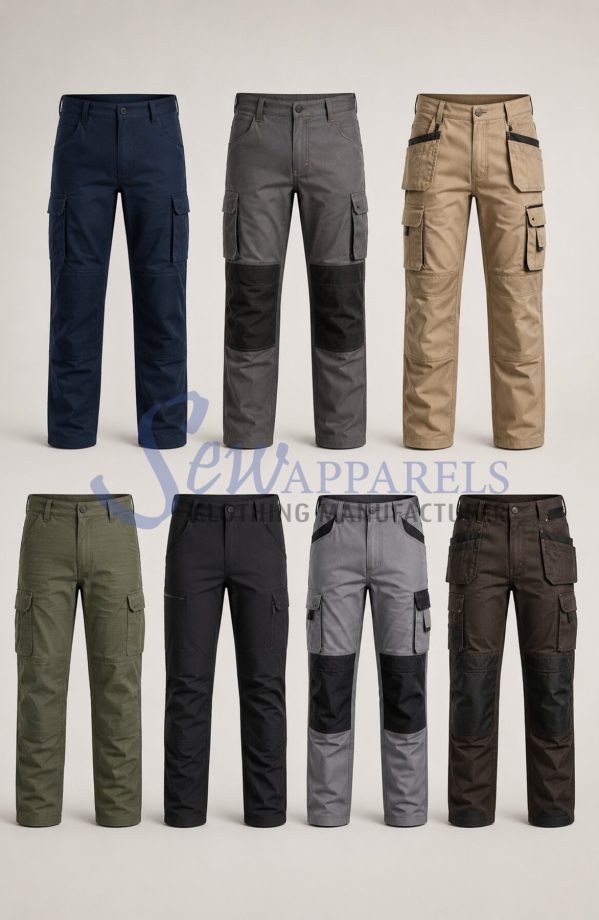
This guide helps buyers plan component mapping, comparable evidence and a finished-sample review. It does not provide test results for a Sew Apparels style or promise a universal shrinkage allowance. Agree the relevant method, care route and acceptance criteria for the actual order, then keep the evidence connected to the materials and construction that were evaluated.
Work Cargo Trousers Shrinkage By Panel: 6 Easy Checks
Start with the component list and baseline sample. Define where measurements will be taken, how care conditions will be recorded and what appearance changes need review. Treat measured dimensional change and visible distortion as related but separate observations.
1. Map the materials and panel directions
For work cargo trousers shrinkage by panel, identify shell panels, pocket bags, pocket faces, knee reinforcements, waistband components and any other contrasting material. Record fabric reference, finish, lot where available and cut direction. Two areas with a similar colour are not necessarily the same material, and a small reinforcement can influence the appearance of the larger area around it.
A work cargo trousers seam puckering component map should show which materials meet at each affected seam. Mark pocket edges, layered intersections and reinforcement boundaries, then connect the labels to the bill of materials. Include thread and relevant construction references in the record without assuming that any one component is responsible for a problem.
Cargo trouser mixed panel shrinkage should be considered before approving the pairing. Ask what evidence exists for each material and what remains untested in the assembled garment. A fabric report for the shell does not establish work cargo trousers shell pocketing compatibility, nor does an unwashed sample show the final response of a mixed assembly.
2. Define one traceable care and measurement plan
The public abstract of ISO 5077:2007 describes determining dimensional change in textile fabrics, garments and other articles after specified washing and drying procedures. It provides a method reference, not a universal acceptance limit. Obtain appropriate technical guidance for the actual test and retain the reported conditions alongside results.
For work cargo trousers shrinkage by panel, define the baseline measurement locations before the trial. Record direction, measurement points and sample identity so the same locations can be reviewed afterward. Avoid comparing an unspecified supplier percentage with a finished-garment result measured using a different care route or reference length.
A work cargo trousers home wash reference sample should be linked to the intended home-care instructions and the agreed evaluation conditions. If industrial laundering is part of the brief, work cargo trousers industrial wash panel behavior requires evidence relevant to that route. Do not relabel a home-wash observation as an industrial-wash result.
Keep washing, drying and any subsequent handling visible in the file. Note the number of cycles actually evaluated, the state in which measurements were taken and any departure from the agreed procedure. Do not quietly stretch or press a sample back into shape and then report it as though it had not been altered.
3. Compare component changes with the assembled garment
Cargo trousers differential dimensional change means that the relevant areas do not necessarily change by the same amount or in the same direction. Where measurements are available, compare them on a consistent basis. Keep length and width observations distinct, and record whether the evidence comes from separate materials, a sewn trial assembly or the finished garment.
In work cargo trousers shrinkage by panel assessment, review local areas alongside the main garment dimensions. Work cargo trousers whole leg dimensional change can help describe overall length or proportion, but it does not explain every pocket-edge or reinforcement effect. Retain both levels of evidence rather than replacing the component review with a single garment average.
Work cargo trousers mixed material wash response should include the relevant combinations. Consider what happens where a pocket face, shell and reinforcement are sewn together, not just how three loose pieces behave individually. Agree an appropriate work cargo trousers multi panel wash trial with the team and document which combinations it actually covers.
Inspect attachment boundaries and access after care. Can the pocket still be used as intended? Has a panel edge become uneven or a reinforced area changed its relationship to a nearby seam? Describe the location and observation before assigning a cause. A visible change can justify investigation even when the main garment dimensions meet the agreed limits.
4. Investigate distortion without diagnosing it from appearance alone
Coats’ seam-puckering bulletin identifies several contributing mechanisms, including tension, fabric structure, feeding and different dimensional responses during treatment or washing. Its discussion supports investigating the assembly rather than automatically blaming the thread. The reference does not establish the cause in a particular Sew Apparels garment.
For work cargo trousers shrinkage by panel, separate work trouser pocket puckering after wash from the conclusion that a specific panel shrank excessively. Review baseline appearance, care conditions, material references and construction information. Ask the technical team what further examination or controlled sample comparison is needed before choosing a correction.
Work cargo trousers pocket panel distortion should be documented in a repeatable way. Keep before-and-after photographs with the relevant measurements and sample identifiers. Record whether the change is localized to a seam, spread across a panel or associated with a layered area. A photograph alone cannot quantify the dimensional response of every component.
Review work cargo trousers reinforcement fabric care interaction when distortion follows a reinforcement boundary. Consider the pairing and assembly, then evaluate any proposed material or construction change in a revised sample. Avoid prescribing one thread, stitch density or sewing adjustment as a guaranteed solution without the relevant investigation and review.
5. Set criteria before judging the evidence
A work cargo trouser wash distortion record should distinguish numerical results, appearance observations and the approval decision. Agree which locations matter to fit or pocket function, how appearance will be compared and who accepts deviations. Writing criteria after seeing the result can hide an unresolved problem rather than resolve it.
For work cargo trousers shrinkage by panel, a stated dimensional tolerance belongs to the defined measurement and procedure. It should not be copied from an unrelated style or treated as a promise for every fabric pairing. Keep the specification, evidence and decision aligned so an accepted local difference is not mistaken for permission to change the whole assembly.
Work cargo trousers differential shrinkage evidence should identify its coverage and limitations. A result from one sample or material lot does not automatically represent every shade, size and later substitution. Decide what additional coverage is needed for the actual assortment and record any areas that remain provisional.
When an observation falls outside the agreed requirements, name the issue and the next review action. A revised pairing, pattern or construction may be proposed, but it needs its own evidence. Keep rejected, provisional and accepted sample versions distinct so production is not working from conflicting instructions.
6. Release the accepted component pairing
For work cargo trousers shrinkage by panel, final release should name the approved material combination, construction revision and care evidence. A work cargo trousers component pairing approval is stronger when the sample, drawing, reports and accepted differences can all be traced to the same arrangement. Include the date and decision owner.
When requesting custom work cargo trousers manufacturing, provide the proposed shell, pocketing and reinforcement references together with the intended care route. Ask which development samples and evaluation costs are included in the quotation and what further work is required. This guide does not promise a particular test service, result or fixed allowance.
For private label work cargo trousers production, keep future substitutions subject to review. A changed pocketing or reinforcement can affect an otherwise unchanged shell-and-pattern combination. Confirm the relevant sample, testing, minimum quantity and delivery terms for the actual order rather than assuming that an earlier approval covers a new material reference.
Work Cargo Trousers Shrinkage By Panel Evidence Checklist
- Map materials, references, directions and layered intersections.
- Identify the baseline sample and repeatable measurement locations.
- Record the actual washing, drying and handling conditions.
- Compare local component evidence with overall garment dimensions.
- Keep distortion observations separate from an unverified diagnosis.
- Release only the material pairing and revision covered by approval.
A Practical Sample Review Example
Imagine two fictional trouser samples with the same shell but different pocketing. After the agreed care trial, their main length measurements are similar, while one sample shows a more distorted pocket edge. The buyer records the location, checks the material and construction references and requests further investigation. The observation does not prove that the pocketing alone caused the change.
The team reviews a revised assembly using the same documented comparison conditions. It then records which requirements were met and what differences were accepted. This example illustrates a review process, not an actual Sew Apparels result or a guarantee that one material choice prevents distortion.
Frequently Asked Questions
Is shell-fabric shrinkage enough to approve the trousers?
It is relevant evidence, but it does not establish how all sewn components behave together. Review the combinations and finished sample needed for the actual construction.
Does puckering always mean differential shrinkage?
No. Other material and sewing factors can contribute. Keep the observation in the file and investigate before assigning the cause or choosing a correction.
Can a care result be reused for a substitute material?
Confirm its coverage first. Identify the change and decide what revised evidence or sample review is required instead of automatically carrying the earlier approval forward.
Keep the Wash Review Connected to Development
Use the Work Cargo Trousers Buying Guides alongside fit, pocket and material-substitution decisions. A work cargo trousers shrinkage by panel record keeps local observations, garment measurements and accepted component identities together. Return to that record when a material, care instruction or construction changes so the next approval rests on the actual configuration.
Record any proposed component change in the work cargo trousers fabric substitution review. Identify the original and revised materials, the care evidence available and the sample requiring approval. Keep a changed pocketing or reinforcement traceable even when the outer shell and main dimensions remain unchanged.