
Work chino trouser hangtag attachment should be approved on the finished garment, not decided only from an artwork file. A tag carries useful product information, but its attachment can also affect the fabric, a sewn label, a belt loop or the way the trousers sit inside their packaging. Buyers need a clear sample showing where the tag goes and what happens when it is removed.
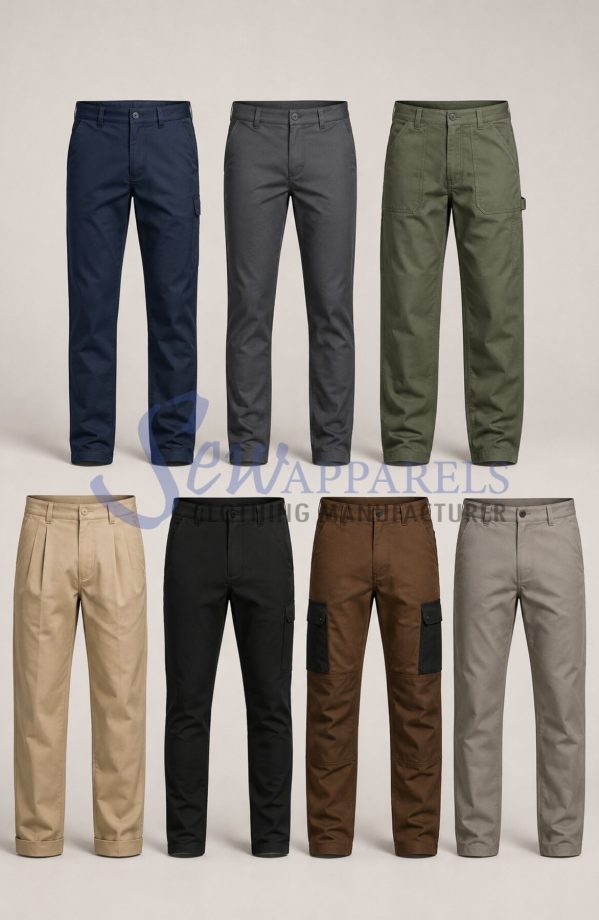
The practical objective is a readable, correctly identified tag attached by an agreed method without an unacceptable mark or damaged component. This guide sets out six checks for location, fastener selection, sample review and packing approval. It does not claim that one fastener works without damage on every chino fabric or that a named fastening brand is used in every Sew Apparels order.
For the garment brief, use our work chino trousers manufacturing page. Discuss tagging and packing requirements alongside the actual garment sample, and confirm the available method before treating it as part of the approved order.
1. Define work chino trouser hangtag attachment in the packing brief
Start with the purpose of the tag. A retail price ticket, brand hangtag and internal uniform allocation card may need different information and presentation. Identify which tags are required and who approves their content. The attachment review should use the intended combination rather than a substitute card with a different size or weight.
A uniform trouser tag specification should identify the tag artwork version, attachment method, position and the relevant garment reference. Include any retailer instruction that affects accessibility or placement. An instruction such as “attach as usual” leaves too much room for different operators to make different choices.
Work trouser retailer tag requirements should be obtained from the actual buyer or retailer. Record the current instruction rather than assuming that a previous customer’s packing arrangement applies. If the instruction conflicts with the proposed garment attachment point, resolve that issue during sampling.
In work chino trouser hangtag attachment, keep a removable uniform trouser information tag distinct from the garment’s permanent labels. The hangtag approval does not establish that mandatory garment information is complete. If label requirements need a separate compliance review, keep that review within its appropriate market and order scope.
2. Choose and show the exact attachment location
For work chino trouser hangtag attachment, location should be visible on the sample or a clear reference image. Identify the exact part of the garment and show how the tag hangs. A general instruction to place it “at the waist” does not distinguish a label, belt loop, seam or exposed fabric panel.
Work chino hangtag location affects both appearance and access. Check whether the tag covers important product information, catches inside the packing arrangement or pulls against a component. Consider the garment’s folded presentation as well as how the tag sits when the trousers are opened for inspection.
Record trouser tag attachment points separately if more than one is being considered. Each point needs its own sample observation; approval at one location should not silently authorize puncturing a different panel. Keep the chosen point clear enough for the packing team to follow consistently.
Avery Dennison’s general apparel fastening guidance describes selection factors including fabric delicacy, hanging distance and required fastener strength. It also discusses different application locations. This manufacturer’s guidance supports an application-specific decision; it is not proof that every label, seam or fabric location is suitable on your actual trousers.
If a looped or tied arrangement is proposed instead of a fabric-piercing method, review the actual component it uses. A loop can still pull, rub or sit poorly. Do not replace one assumption with another: confirm the complete attachment on the sample.
3. Match the fastener and application method to the garment
Work chino trouser hangtag attachment needs a matched system: the fastener, tool where applicable, tag and garment location. Confirm compatibility through the relevant supplier information and the sample trial. A fastener description alone does not define how it will be applied to a particular garment.
A work chino packaging tag method should record the actual fastener identity and the approved application. Where a needle-based tool is involved, use the tool manufacturer’s instructions and an appropriately trained operator. This article is a development checklist rather than an operating manual for handling tagging equipment.
The Avery Dennison Fine Fabric fastening systems overview describes products designed to reduce damage risk when tagging delicate garments. The distinction is useful when discussing suitable systems. A reduced-risk design does not guarantee a mark-free result on every material, and suitability still needs confirmation on the chosen sample.
For uniform trouser tag attachment, review how the selected length and arrangement allow the tag to sit. A tag that hangs too far can catch during handling, while an overly restrictive arrangement may make information difficult to read. Agree a practical presentation rather than inventing a universal fastener length.
Do not make a brand substitution automatically after approval. If the fastener or application changes, check whether the original sample still represents the new arrangement. The buyer should know which method has actually been accepted for the order.
4. Inspect the garment before and after tag removal
A work chino trouser hangtag attachment trial should include a baseline observation before application. Identify any existing mark or irregularity so that it is not later attributed to the tag. Review the actual material and component used in the approval sample.
For chino trouser tag puncture marks, document the attachment area with the tag fitted and again after removal by the agreed method. Look for visible openings, displaced yarns, pulled threads, distortion or damage to the attached component. Record what is observed without claiming an underlying cause from a photograph alone.
A chino trouser tag removal observation should specify how the sample was handled. Do not approve removal by force simply because the fastener eventually comes away. Follow the relevant instructions and check that the garment and any permanent label remain intact after the intended removal.
Work chinos tag marking review should use an agreed viewing basis and buyer acceptance reference. If visibility changes with lighting or garment position, record that context. Avoid claiming that a tiny mark is acceptable to every buyer or that it will disappear after care without evidence.
Chino hangtag garment damage is a reason to review the attachment choice before releasing the packing instruction. Consider a revised location or matched fastening system and repeat the relevant sample check. Keep the changed version identifiable so the final approval does not refer to an earlier unsuccessful arrangement.
5. Check readability and presentation in the actual pack
Work chino trouser hangtag attachment should be reviewed in the proposed folded or hanging presentation. A tag can look good on an open garment and become hidden, bent or caught when packed. Use the intended packaging arrangement for the approval comparison.
Chino garment retail tag access means the required information can be reached and read in the agreed presentation. Check the visible faces, tag orientation and access to any required code or identifier. If scanning is required, validate the actual printed item through the buyer’s relevant process rather than assuming that a digital proof establishes scan performance.
Work chino hangtag proof should therefore include two distinct approvals: information and physical application. An artwork approval confirms the accepted content version; it does not establish attachment quality. A correctly attached blank tag does not establish that the final printed information is correct.
A work trouser hangtag sample should show the full tag set, approved attachment and actual garment version. If several tags are stacked, confirm their order and whether the arrangement remains usable. Do not quietly omit a required ticket to make the sample presentation look cleaner.
A fictional comparison illustrates the gap. Sample A uses the approved printed card but attaches it at a different garment point. Sample B uses the approved attachment but an old artwork version. Neither is a complete approval sample. Combine the current information and accepted physical arrangement, then review that finished version.
6. Release one clear instruction and control changes
A work chino trouser hangtag attachment approval should end with a specific packing instruction. Include the tag version, fastener identity, attachment point and approved sample reference. Keep rejected trial versions separate so the team can distinguish development alternatives from the current release.
Chino retail presentation approval should connect to the order’s garment identity. Check that style, size and other relevant ticket information match the actual product allocation. A good attachment method does not prevent a wrong tag from being fitted to the right garment.
For custom work chino trousers manufacturing, supply the buyer’s tagging requirement with the development brief. Ask what sample work, tag sourcing and attachment tasks are included in the proposed scope. Do not assume that printing, fasteners and application are automatically included in a garment quotation.
For private label work chino trousers production, keep the artwork and packing approval versions aligned. If the buyer revises a ticket, fastener or location, confirm whether another physical sample review is needed. Changes to the garment material or component can also affect whether the accepted attachment remains representative.
Agree how any issue discovered during packing will be recorded and resolved. The useful instruction tells the responsible team which sample to follow and where to raise a discrepancy. It should not encourage an operator to choose a different location merely to keep the packing line moving.
Final sample checklist
Before releasing work chino trouser hangtag attachment, verify these points against the actual finished sample and order information.
- The current tag information and buyer requirements are identified.
- The exact attachment point and matched fastener method are shown.
- The garment baseline and post-removal condition have been reviewed.
- The tag remains readable and usable in the intended packaging.
- The garment allocation and tag identity match.
- The packing instruction identifies the accepted version and change process.
Keep the work chino trouser hangtag attachment result with the garment’s other development and packing decisions. Related topics are collected in our work chino trousers buying guides. A clear sample and a controlled instruction help the buyer approve the actual tagged product rather than separate pieces that have never been reviewed together.
Where labels identify different supplied lengths, connect the tag check to the work chino trousers finished inseam order options matrix. Match the actual garment, current ticket and allocation before packing. Correct physical attachment cannot resolve an incorrect size or length identifier.