
A football kit colour clash approval review should examine complete match combinations rather than separate shirt swatches. A home shirt that looks different from an away shirt on a screen can still leave unanswered questions about shorts, socks, goalkeeper clothing or visible base layers. Buyers need an approved combination record before they release the final production specification.
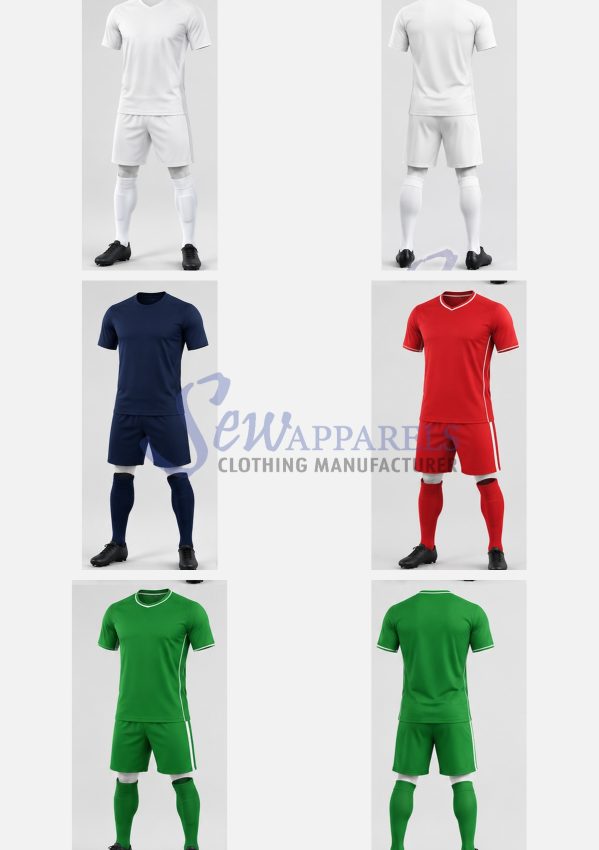
For custom football uniform manufacturing, colour selection is both a design decision and a competition-specific approval task. This guide gives clubs and sourcing teams six checks for association football kits. It does not grant competition approval, prescribe universal contrast measurements or assume that a supplier’s colour reference replaces the organiser’s current requirements.
Why Football Kit Colour Clash Approval Starts with Scope
Define the association football scope: competition, team level and season, before reviewing the artwork. This article concerns association football; do not automatically apply its discussion to futsal, another sport or every local tournament. Ask the responsible organiser which equipment rules and approval procedure govern the intended use, including any relevant modifications or additional requirements.
Keep football kit colour clash approval linked to a dated specification. Record the proposed shirt, shorts and socks together with each goalkeeper option and visible underlayers. A colour name such as navy or red is not a complete manufacturing reference. The production file also needs an approved physical standard, material identity and artwork version.
1. Verify the Competition and Season
Competition season verification should be the first entry in the approval file. Identify the governing authority, rule edition and submission deadline, then confirm the requirements with the club or organiser. Record which person is authorised to obtain equipment decisions. A previous season’s accepted design may help explain the history, but it is not automatic permission for a revised kit.
Use IFAB Law 4 (2026/27) on players’ equipment as the association-football starting reference. It requires distinguishable colours for the teams and match officials, with goalkeeper distinction addressed separately. The same law includes specific visible underlayer colour provisions. Check the applicable edition and competition instructions before treating a proposed combination as ready for match use.
The practical review file should distinguish the source rule from the club’s implementation decision. Add the actual organiser response, accepted artwork or required amendment when available. Avoid writing “approved” on a factory sample merely because its colours look acceptable to the development team. Appearance review and competition acceptance are different records.
2. Compare Home and Alternate Kits as Complete Sets
For football kit colour clash approval, prepare home alternate kit combinations using the exact proposed components. Lay out each shirt, shorts and socks option in a controlled comparison. Include front and back views, dominant panels, sleeve treatments, stripes and large contrasting zones. Do not compare only the chest area while ignoring a back panel that changes the kit’s overall appearance.
Football home away kit contrast should be assessed against the organiser’s method and requirements. If formal measurements or physical submissions are required, follow that process with the responsible authority. A screenshot, digital mock-up or designer’s opinion can support preparation; none should be described as an official contrast measurement without the required procedure.
The 2026 UEFA Equipment Regulations, Article 9 provide a competition-specific example: first and second outfield attires must clearly contrast, goalkeeper alternatives must also contrast, and approved components may need to be combined to resolve a clash. These UEFA provisions should not be presented as automatic requirements for every domestic or community competition.
3. Include Goalkeepers and Match Officials
A goalkeeper kit colour combination review belongs alongside the outfield combinations, not in a separate late-stage conversation. List each proposed goalkeeper shirt, shorts and socks set. Ask the club to identify the alternatives required by its competition. Compare those options with its own outfield choices and the opponent combinations supplied for the relevant approval process.
Document goalkeeper outfield distinction and any official uniform colour conflict as separate checks. The team may not control the match officials’ clothing, so obtain guidance through the organiser’s procedure. Do not invent a referee colour for the production plan or assume that every conflict will be resolved by the other participant changing.
A football kit colour clash approval register should make the responsible decision visible. Record whether a combination is submitted, accepted, conditionally accepted or awaiting clarification. If an authority requires a different pairing, revise the garment references together. Keep the superseded version identifiable so production and the team kit manager cannot select it by mistake.
4. Match Visible Underlayers to the Applicable Rules
Football undershirt colour compliance should follow the actual sleeve design. Under current IFAB wording, the underlayer can use the sleeve’s main colour as a single colour, or reproduce its pattern and colours precisely. A plain body-colour undershirt is therefore not automatically appropriate when the sleeve has a different main colour. Confirm the intended combination before ordering base layers.
For football shorts tights colour matching rules, IFAB specifies the shorts’ main colour or lowest-section colour and requires teammates to use the same underlayer colour. Keep the undershorts team colour rule connected to the approved shorts version. Review contrasting hems and panels rather than relying on a general team colour description.
In a football kit colour clash approval file, record the undershirt sleeve colour rule and shorts/tights decision with marked drawings and exact component references. These practical records help purchasing source the intended options. Ask the relevant authority to resolve an uncertain design instead of broadening the rule through an informal interpretation.
5. Build a Permitted Combination Register
A permitted combination register should connect every accepted outfit to its approval evidence. Use a simple identifier for the outfield shirt, shorts and socks, another for goalkeeper options and a linked entry for underlayers. Include the organiser response or approved submission reference. The register should be usable by production, packing and the club’s matchday staff.
Complete kit contrast review is easier when each comparison has a fixed scope. Record the two outfield combinations, goalkeeper options and any officials’ information used in the decision. Identify exclusions or outstanding questions. A register should not suggest that one accepted home-away comparison establishes compatibility with every possible opponent kit.
- Combination identity: shirt, shorts, socks and relevant underlayers.
- Design control: garment code, colour standard and artwork revision.
- Competition context: authority, season and applicable rule edition.
- Evidence: submitted sample, drawing or approval reference.
- Decision: accepted pairing, qualifications and unresolved items.
- Change control: revision owner and reassessment trigger.
For private label football uniform production, this register should accompany the technical package. Do not use it to replace the measurement chart, bill of materials or print layout. It is the controlled link between the garment specification and the combinations the buyer intends to use. Keep its version consistent with the final sample approval.
6. Prepare a Clash Contingency and Release Decision
A football kit colour clash approval plan should include a clash contingency kit that the club can actually supply. Identify approved alternative pieces, available quantities and size coverage. Confirm which substitutions the competition permits. An attractive third option in a catalogue is not a usable contingency if it has no approval evidence or cannot be delivered in the required sizes.
Keep the competition approval record together with the manufacturing release decision. If an organiser requests a change, identify the affected panels, colours, underlayers and packing instructions. Assess the revision before bulk cutting or printing. When production has already started, reconcile the committed quantities and obtain a clear commercial decision on any replacement work.
Matchday acceptance remains with the appropriate authority. Do not promise that a factory-approved colour set will eliminate every clash or override a referee’s decision. A practical contingency reduces uncertainty by giving the club documented options; it does not remove the need to follow the applicable selection and inspection process.
Example: Turn a Colour Concern into a Controlled Revision
Consider an illustrative club selecting a dark home shirt and a light alternate shirt, but pairing both with the same shorts and socks. The development team should compare the complete outfits and ask the organiser whether those combinations meet its requirements. Different shirts alone do not answer every component-level question. This scenario is a planning example, not a ruling on a real team.
If a different sock pairing is accepted, assign it a combination code and update the register. Check goalkeeper alternatives and the underlayer references against the revised set. Then reconcile quantities so packing does not accidentally produce the old pairing. The useful output is one documented combination, not a collection of conflicting emails and mock-ups.
Repeat the relevant review when a fabric finish, colour, panel layout or major artwork revision changes the accepted appearance. Ask the responsible authority which changes require resubmission. Keep the old approval and the new request traceable. Avoid assuming that a colour described with the same commercial name necessarily matches the approved physical reference.
Buyer Questions Before Bulk Production
Does away kit mean it is automatically clash-free?
No. Treat home and away names as collection labels, then verify the intended complete combinations. The competing kits and applicable approval process determine the review context. A design can be distinct from its own home kit while still requiring another pairing for a particular match.
Can we approve colours from a phone photograph?
Use photographs to communicate design intent, with their limitations clearly stated. Ask the organiser and supplier which physical references or formal submissions are required. Record those requirements before bulk approval. Do not turn a convenient image exchange into an unsupported statement that official contrast assessment has been completed.
Should the supplier choose the underlayer colour?
The supplier can work from a controlled specification, but the buyer should confirm the competition decision and intended garment pairing. Identify the approved reference instead of asking production to infer it from a club badge. Resolve uncertainty before sourcing so a later clarification does not leave unused base-layer inventory.
Send a Complete Football Uniform Specification
For football kit colour clash approval, share the competition, season, complete outfield alternatives, goalkeeper options, sleeve and shorts details, underlayer plan and approval contacts. Add quantities, size ratios and required delivery windows. State which combinations are already accepted and which remain proposals. This gives development teams a clear route without assigning them authority they do not hold.
Use the football uniforms manufacturing page to prepare your enquiry, and the Football Uniforms Buying Guides to connect colour selection with construction and artwork decisions. Keep the production specification aligned with the accepted combination register.
Close football kit colour clash approval with a dated record of the approved pieces, applicable competition evidence and contingency route. The value is a shared instruction that purchasing, sampling, production and the kit manager can follow. Reopen the relevant approval when a controlled component changes, rather than allowing an old acceptance to cover an unreviewed revision.
If approval requires a revision after production starts, use the late kit artwork change review to reconcile affected quantities, costs and conditional dates.