
Patient gown identification label placement needs a complete garment map before artwork is released. Required textile disclosures, care information, size markers and institution-owned identifiers serve different purposes. Putting them into one crowded label can make receiving harder, conceal information or introduce avoidable contact at a neckline, seam or closure.
Use five checks to decide which information belongs at each approved position, who controls its wording and how the finished sample will be reviewed. This is a garment development guide, not a patient identification procedure. Sample artwork should contain garment and institutional references only; personal patient details are unnecessary for approving an apparel label layout.
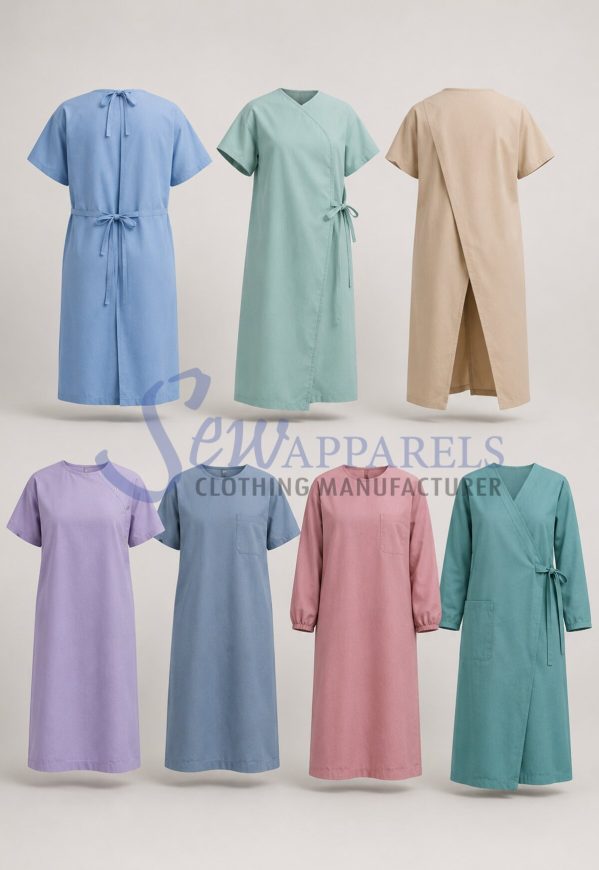
1. Separate information duties in patient gown identification label placement
Start with an information register. Give each proposed item a purpose, content owner, intended reader and approval reference. The register might distinguish required textile disclosures from the institution’s garment ownership mark, supplier style reference, size code and laundry routing identifier. Do not assume that a department code can replace a disclosure required for the destination market.
The FTC’s textile and wool labeling guide explains U.S. requirements for covered products, including fibre content, origin and responsible business identity. It also addresses legibility, accessibility and placement. For covered garments with a neck, its country-of-origin placement rules deserve specific review. Care labeling is governed by a separate rule. Check applicability and destination obligations before approving artwork; these U.S. provisions are not a universal label specification.
Build a patient gown information hierarchy that makes the intended function clear. A receiving size marker may need quick visibility, while a care label needs accessible instructions for the relevant reader. An institutional inventory code has another job. Decide what must be read together and what should remain visually distinct instead of asking the factory to arrange competing text at its discretion.
For patient gown identification label placement, distinguish a garment identifier from a wearer identifier. The development record should identify a style, size, lot or institution-approved ownership reference without naming a patient. A sewn label does not certify an electronic tracking system, establish clinical suitability or replace the institution’s own identification policies.
A patient gown institution identifier map should state the institution-approved wording and who may authorise a change. If several departments use the same base gown, determine whether the garment identifier remains common or needs an approved variant. Record that choice explicitly; colour, abbreviated text and department codes should not acquire meanings that the receiving team has never approved.
2. Map each position on the complete garment
Draw front, back and relevant inside views with a consistent orientation. Mark each label by a unique reference and connect it to the information register. Describe its location from a named construction point, such as an approved seam intersection, rather than an informal instruction to place it near the neck or somewhere inside.
The patient gown ownership label location should be checked on the assembled gown in its normal closed condition. A mark visible on a flat panel may disappear beneath an overlap, facing or tie after assembly. Confirm whether visibility is needed when worn, folded, received or processed; these are separate review conditions, not interchangeable photographs.
Define the patient gown care label position against both destination requirements and practical access. Show which face carries the information, how it can be unfolded and what seam captures it. Do not hide required content under an inaccessible attachment. If a specific legally required position applies, let the applicable requirement control rather than choosing a visually convenient alternative.
Patient gown size marker placement should use the institution-approved size code and remain consistent with the garment’s approved size allocation. Check that a receiving worker can distinguish the marker from a supplier style number. If letter, numeric or colour references are combined, supply the approved legend with the sample instead of expecting the reader to infer a conversion.
Patient gown identification label placement should also account for back closures and access openings. Keep the position map separate from closure engineering, but review them together on the actual gown. Label attachment must not accidentally secure an opening, obscure an operating instruction or alter an approved overlap. Record any necessary change as a controlled garment revision.
For patient gown identification label placement, give every measurement a viewing direction. State whether the gown is flat, assembled, closed or folded during inspection. A coordinate measured from an unfinished panel edge can differ from a finished seam reference; keep that distinction visible in the drawing and inspection instruction.
3. Review readability, access and wearer contact
Patient gown textile label readability depends on the complete text, contrast, type size, print quality and available label area. Review the actual label material and production-intent artwork, not an enlarged screen image. Check all required language versions and the reverse face where applicable. A clear main heading does not compensate for unreadable supporting information.
Run a patient gown label skin contact review in the intended garment configuration. Observe label edges, folded corners, attachment bulk and contact at the neck, side seam or other chosen location. Record the size, posture, underlayer and closure condition used for the assessment. This is a practical sample observation, not a claim that a particular material is clinically non-irritating.
For patient gown inner label access, show how the intended reader finds and opens the label without disturbing an unrelated closure. A label captured at both ends may conceal its reverse face; a folded label may present different text depending on how it lies. Confirm the attachment and information arrangement together rather than approving the artwork and sewing method separately.
Patient gown receiving label visibility should be checked in the agreed receiving and packing condition. If gowns arrive folded, an inner marker may require unfolding before it can be read. Determine whether the receiving process accepts that step or needs a separate institution-approved pack identifier. Packaging information should be coordinated with the garment label, not silently used as its substitute.
During patient gown identification label placement review, use a reader task rather than an aesthetic preference alone. Ask the reviewer to locate the approved size, ownership reference and care information in the defined sequence. Record confusion or repeated searching as an observation that requires resolution; do not invent a universal time limit or declare usability from a photograph.
4. Validate attachment with the approved care route
Patient gown sewn label attachment needs a finished construction instruction: label reference, fold type, insertion depth, stitch route and captured seam. Show which edge is free and how the label sits after finishing. Inspect the seam area for unwanted bulk, exposed edges and distorted text. Any measured tolerance should come from the agreed specification, not an assumed industry allowance.
A patient gown heat transfer identifier trial is a separate development option, not an automatic upgrade. Identify the actual substrate, garment fabric, artwork and application conditions proposed by the supplier. Assess the resulting appearance and attachment under the agreed validation plan. Do not claim universal wash resistance, skin compatibility or suitability for every processing system.
The CDC’s institutional laundry guidance provides context for healthcare textile handling and processing. It reinforces why garment care and the institution’s handling arrangements need coordinated review. It does not supply a label endurance test, approve a tracking device or justify a made-up number of wash cycles for this gown.
Make the patient gown laundry identifier distinction explicit. A routing or ownership mark is different from care instructions and from required textile disclosures. Ask the institution’s responsible team which identifier must remain readable at which stage. If an electronic component is proposed, its separate system compatibility and evidence requirements need their own approval; ordinary label review does not establish those claims.
Patient gown identification label placement validation should compare the approved new sample with the sample after the agreed care evaluation. Record readability, edge condition, attachment, distortion and access at the same position. Preserve the care process reference and observed result. Do not turn an unevaluated label into a durability claim simply because its first sample looks neat.
5. Release one controlled label map
Use the following approval-sheet fields for each label. Separate observations from acceptance decisions so an unresolved concern cannot disappear into a general sample approval.
- Reference and purpose: label ID, information type, intended reader and content owner.
- Artwork: approved text, language, file revision, size code and required disclosure review.
- Position: inside or outside face, orientation, named measuring points and approved dimensions.
- Construction: material reference, fold, free edges, attachment route and relevant seam details.
- Visibility and contact: receiving condition, reverse-face access, wearer-contact observation and closure interaction.
- Care validation: agreed process reference, sample identity, observed condition and decision owner.
- Release: approved version, remaining questions, sign-off and change-control responsibility.
The patient gown identification approval sheet should link these fields to the actual sample photographs and garment revision. Use photographs showing the full position and a closer view of the text, with a clear inside or outside orientation. An isolated label image cannot prove that its approved position remains accessible on the assembled gown.
Keep a patient gown label artwork version reference on the development record. If a buyer corrects a business name, destination wording or institution code, update the artwork, position map and relevant packing instruction together. Quarantine obsolete instructions through the agreed document process so one correction does not leave several apparently approved files in circulation.
A patient gown label placement sample should represent the intended production materials and relevant size variation. Review whether the approved position changes through grading or a length variant. Where it does, document the rule and confirm it on the appropriate sample. Do not copy a base-size location across every variant without examining the resulting access and contact.
Complete patient gown identification label placement with a release decision for each item: approved, revise or awaiting specified evidence. Name the person responsible for unresolved content and the condition needed for approval. Retain the earlier version and the change reason so the next sample can be assessed against a clear instruction instead of personal recollection.
Before releasing patient gown identification label placement, compare the information register with every label shown on the sample. Confirm that each approved item is present once in its designated position, unless an intentional repetition is documented. Remove unintended competing artwork through a controlled revision rather than informally editing the approved file.
Prepare an enquiry with approved label information
For custom patient gown manufacturing, send the garment specification, label map, artwork references and receiving requirements as one coordinated enquiry. Ask the supplier to identify any unresolved material or attachment detail before quotation or sampling. The buyer remains responsible for obtaining the appropriate destination and institutional content approvals.
For private label patient gown production, distinguish brand presentation from required disclosures and institution ownership marks. Ask for a sample that shows their interaction on the assembled gown. Keep the enquiry free of personal patient data and avoid presenting an ordinary garment label as a protective certification or a validated tracking system.
The patient gown product enquiry page supports the garment supply discussion. The patient gowns buying guides connect this label map with related development decisions. Use the agreed garment and artwork versions for both the enquiry and sample review.
A successful patient gown identification label placement record explains which information goes where, why it belongs there and who approved it. The result is a readable, accessible and traceable garment instruction with documented care observations. It supports receiving and production coordination without replacing the institution’s procedures or claiming performance that has not been verified.