
Performance cap quick dry claim evidence should connect the statement a brand wants to make with the sample, conditions and result used to support it. A fabric described as moisture managing does not automatically establish how quickly the assembled cap dries.
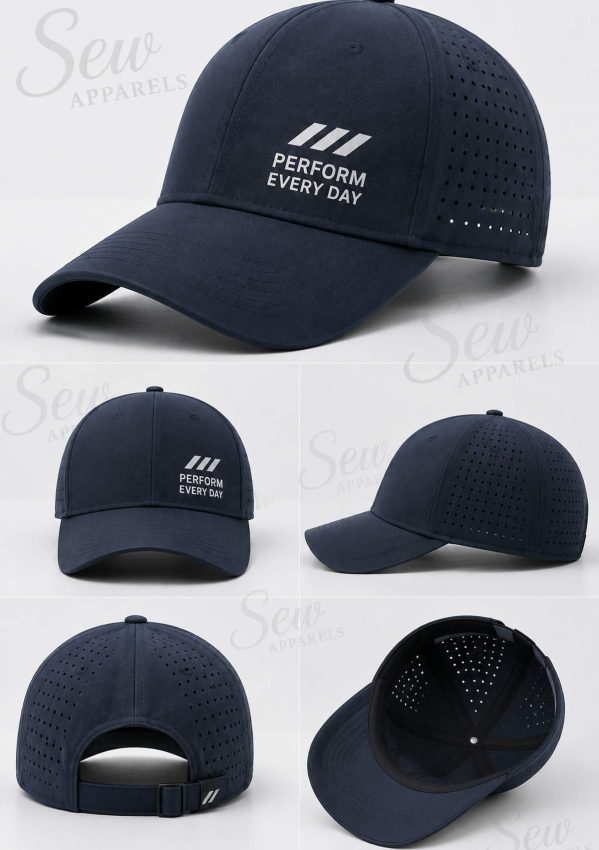
The sweatband, seams, reinforcement, visor and decoration can behave differently from a flat swatch. Buyers need to understand what was evaluated before turning a supplier’s description into product copy.
This guide helps teams organise a drying evidence brief for custom performance cap manufacturing. It does not set a universal passing time or state that a Sew Apparels cap achieves a particular result. Agree the intended claim, suitable evaluation and acceptance criteria for the actual product. Keep standardised fabric testing distinct from any additional whole-cap comparison designed with the laboratory or supplier.
Performance Cap Quick Dry Claim Evidence: 6 Critical Checks
1. Define the proposed claim
Write the proposed claim before selecting the test. Does it refer to the crown fabric, the sweatband or the finished cap? Is the wording a general description or a comparison with another product? A quick dry hat claim comparison needs an identified reference and a clear definition of what is being compared. Avoid leaving those decisions until after the team sees a favourable result.
Describe the intended use without pretending a laboratory result reproduces every outdoor condition. A running cap may become wet from perspiration, rain or washing, and these are different scenarios. Decide which situation the development evaluation addresses. Record the sample condition and the reason the selected assessment is useful for that decision, rather than promising the same drying time during every activity.
The public scope of AATCC TM201 describes fabric drying-rate evaluation under defined heated-plate conditions. It is relevant to a fabric evidence discussion, but it should not be presented as a complete cap test merely because fabric was cut from a product. Ask the laboratory to identify the method, edition and specimen it actually evaluates.
Your performance cap quick dry claim evidence brief should separate the proposed wording, the available material report and any missing finished-product evidence. This gives the sourcing team a practical question to resolve. A report can be useful even when its scope is narrower than the final claim, provided the limitation remains visible and the wording is reviewed accordingly.
2. Identify the fabric and the complete assembly
Use a sample identifier tied to the approved bill of materials. Record the crown fabric, finish, sweatband, seam construction, reinforcement, visor materials and decoration. A finished running cap drying assessment should describe the cap actually evaluated. A clean reference without the intended embroidery backing or sweatband is a different assembly and needs to be identified as such.
Keep a swatch versus assembly comparison in the development record. The swatch may help compare material options, while the assembled cap reveals where moisture remains in the construction. Do not merge those observations into one result. Ask whether the supplier’s report covers an unfinished material, a finished fabric or a component taken from the actual cap.
Review the ventilation layout alongside the evidence. The performance cap buying guides can help buyers document openings and surrounding layers. The performance caps perforated panel design should match the tested assembly; visible openings alone do not prove a drying claim. Record whether lining, backing or reinforcement changes the evaluated panel arrangement and whether the physical sample matches the approved drawing.
A performance cap quick dry claim evidence file should preserve material references and construction revisions. If the sample changes after evaluation, identify whether the evidence still applies. A lighter sweatband or different backing may look like a small adjustment, but the buyer should not assume an earlier result describes the revised assembly without reviewing that change.
3. Control wetting, mass and the drying endpoint
For a supplemental performance cap drying rate trial, agree a cap wet mass drying protocol before starting. Identify the conditioned whole cap dry mass, the wetting approach and how excess water is handled. These details should be developed with the evaluator for the intended comparison. Do not copy a partial online method description and label an improvised procedure as compliance with that standard.
The controlled water load should have a documented basis. Adding the same amount of water to two different caps and wetting each to its absorbent capacity answer different questions. Decide which approach suits the claim, then apply it consistently. Record the actual wet mass or exposure details so differences in starting water do not disappear from the comparison.
AATCC also publishes TM200 for drying rate at absorbent capacity using an air-flow method. Its existence illustrates why method selection matters: different drying assessments can use different conditions and starting states. Ask the laboratory which approach is suitable, and use the full authorised method when a standardised result is required.
Make a drying endpoint agreement before reviewing the result. The chosen endpoint could involve a defined mass condition or another documented criterion appropriate to the protocol. It should not change between samples simply because one feels dry sooner. The performance cap quick dry claim evidence record must explain what completion means and how the evaluator determined it.
4. Record the environment and compare equivalent samples
Maintain a drying environment record including the conditions relevant to the agreed procedure. Temperature, humidity, air movement, sample position and any applied heat can influence the comparison. Use the laboratory’s reporting requirements for standardised testing. For a buyer development trial, document the agreed conditions honestly rather than implying the result represents every climate or wearer.
An equivalent cap comparison should identify the reference product and its construction. If the buyer compares a light unlined cap with a heavier lined style, explain that difference. A useful comparison can include different designs, but the conclusion must describe what was compared. It should not attribute the entire difference to one fibre or finish when several components changed.
Include an appropriate number of samples or repeated observations agreed with the evaluator. A single convenient specimen can hide variation between samples. Retain individual results and note unusual handling or measurement problems. Do not publish only the most favourable observation while treating it as representative of the complete production specification.
The performance cap quick dry claim evidence brief should identify who prepares, evaluates and reviews the samples. Keep the process consistent across the candidate and reference. If the evaluator changes positioning, wetting or air movement, record it and decide whether the comparison remains useful. Clear conditions make a modest result more credible than an impressive number without a traceable procedure.
5. Review sweatband behaviour and wash-conditioned evidence
Observe wet sweatband drying lag separately from the crown appearance. A panel can look dry while a thicker internal component retains moisture. Record where moisture remains in the complete cap and how that relates to the proposed wording. A claim about the crown fabric should not silently become a claim that every part of the cap reaches the same endpoint together.
Keep evaporation versus wicking clear in the discussion. Moisture spreading along a material and moisture leaving that material are different observations. A supplier’s wicking result does not automatically establish a drying time. Ask which property was measured and describe it accurately when comparing reports or discussing the intended benefit of the construction.
Consider wash durability of the drying claim where the product’s intended use and care instructions make it relevant. Agree the conditioning programme with the evaluator rather than inventing a universal number of washes. Compare like-for-like sample states, and record changes in materials, finish or construction. A new sample result should not be assumed to describe every later care condition.
For private label performance cap production, connect the evidence sample with the approved care information and material specification. If the care route or finish changes, review whether another evaluation is needed. The performance cap quick dry claim evidence file should retain the condition of each sample so a reader can distinguish new-product evidence from evidence after the agreed treatment.
6. Interpret the report before approving wording
Drying report interpretation starts with the method, sample identification, conditions, starting state, endpoint and individual results. Read those details before using a headline value. Ask the evaluator to explain limitations or deviations. A result without a clear specimen reference cannot reliably support the claim for an approved bulk specification.
Quick dry wording approval should identify exactly what the evidence supports. If only the fabric was evaluated, describe that scope. If a comparison is supported under specified conditions, keep the comparator and conditions available in the evidence record. Avoid replacing a defined result with broader promises about comfort, temperature regulation or all-weather performance that were not evaluated.
The performance cap quick dry claim evidence review should have a named decision owner. Keep sourcing, product development and marketing comments in one approval record. Record the final wording, evidence references and any qualification required. If a gap remains, resolve it before releasing the claim rather than asking the production team to justify it after the copy is published.
Low MOQ Planning for Startup Brands
Startup brands preparing a low MOQ performance cap order should define the intended claim before choosing the final fabric. Confirm available materials, minimum quantities and sampling terms directly, then agree who commissions and reviews the evidence. Keep the performance cap quick dry claim evidence brief focused on the actual launch specification.
A small run does not make a fabric report representative of every assembled cap. A modest, properly qualified claim is more useful than an unsupported promise; preserve the approved sample and review the evidence when the sweatband, backing, finish or care instructions change.
Buyer evidence checklist
Start with the proposed statement and identify the actual fabric and assembled sample. Agree the evaluation, wetting basis, environment, endpoint and comparison. Review component behaviour and any required wash-conditioned evidence. Retain the complete report and approved wording with the product specification. This sequence makes the result useful for a buying decision without overstating its scope.
Share the intended use and evidence questions through the custom performance cap manufacturer page when discussing sampling. Ask which materials and evaluation routes can be considered for the actual project. A clear performance cap quick dry claim evidence brief helps both teams identify what must be confirmed before the final product claim is approved.