
School polo retail pack quantity decisions should compare a defined sales unit with a documented buying scenario. Selling one polo and selling a fixed pack are different offers, even when the garments share the same specification. A larger pack does not automatically create stronger demand, lower total cost or a better stock position.
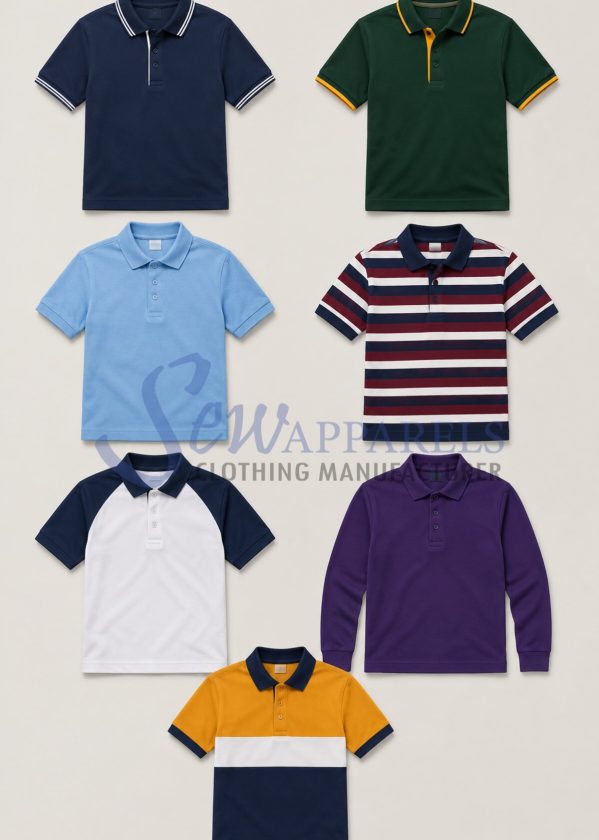
This guide explains five critical checks for buyers considering single units, twin packs or another fixed arrangement. Its practical tool is a single-versus-multipack decision matrix. The matrix records contents, buyer-provided demand, supplier packaging charges, identifiers and stock exposure without claiming a guaranteed sales uplift.
Begin school polo retail pack quantity decisions with the intended channel and the actual garment brief. Keep the number of retail packs separate from the number of polos inside them. Then ask suppliers to quote the same contents and allocation before deciding which proposal is ready for commercial approval.
1. Document the channel and the source of demand
Identify whether the proposed offer will be sold through a school shop, a uniform retailer or an online channel. Record the channel’s requirements for listing, stock handling, returns and pack presentation. Do not assume that a pack accepted by one retailer will work unchanged in another channel.
A school polo single versus twin pack comparison needs a demand basis. Ask the buyer for dated sales records, confirmed orders or a clearly identified planning assumption. Historical garment sales do not necessarily show demand for a new fixed pack. Record that limitation instead of converting old unit sales into a confident bundle forecast.
Use the worksheet field “school polo shirts polo pack demand input” to name the source, period, size breakdown and uncertainty. Distinguish a committed order from an estimate. The team can then compare scenarios using the same evidence without treating a supplier’s suggested pack format as proof of customer preference.
School polo shirts retail polo quantity comparison should show both retail units and garment units. For example, a proposed twin pack contains two polos per sales unit. This describes the conversion between units; it does not establish how many packs customers will purchase. Use the buyer’s actual scenario quantities for the order calculation.
School polo retail pack quantity decisions should also identify the decision owner and review date. If the channel has not accepted the proposed format, record channel approval as pending. This prevents packaging development from being mistaken for permission to release a retail offer.
2. Freeze the pack contents and size allocation
Define the exact contents before requesting prices. State the style reference, school emblem if applicable, colour, size and number of garments in each retail unit. Confirm whether every pack contains identical polos or an explicitly fixed combination. Keep alternatives as separate versions so the supplier can price each one accurately.
The “school polo shirts retail bundle fixed contents” field should describe what the customer receives. A phrase such as “two school polos” is incomplete if the offer could contain different colours or sizes. The approved pack specification should leave no scope for substitutions without a documented change review.
For “school polo shirts single garment sales unit,” record the corresponding single-item specification and its sales identifier. That creates a fair baseline. A multipack using a different garment, emblem or quality requirement should not be presented as a packaging-only alternative to the single polo.
School polo retail pack sku planning needs a clear record for each approved configuration. A retailer’s internal stock keeping unit and a GS1 identifier are not interchangeable terms. Identify who maintains the item master and how the pack links to the garments and outer packing used for receiving and fulfilment.
School polo retail pack quantity decisions become harder when size allocation is unclear. Confirm whether each pack uses one size throughout or a specified mixed-size arrangement. If a mixed option is proposed, request channel acceptance and supplier feasibility rather than assuming it is currently offered or commercially attractive.
Keep retail packs separate from shipping cartons
A carton containing several retail units is a logistics arrangement, not necessarily the customer-facing pack. Record garments per retail unit, retail units per carton and the planned carton allocation separately. Ask the supplier to confirm the actual arrangement before calculating handling or freight assumptions.
3. Separate garment cost from added packaging scope
Request a school polo shirts single versus multipack quotation against the same garment specification and documented quantity scenarios. Ask whether the offer includes materials, folding, pack assembly, identifier application and inspection. If the supplier provides one combined figure, request a scope explanation instead of inventing its cost components.
School polo multipack price comparison inputs should include quotation date, currency, stated quantity basis and the explicitly included delivery scope. Compare equivalent terms. A price per garment and a price per completed twin pack cannot be compared directly without identifying what each figure contains.
The “school polo shirts polo twin pack cost assumptions” entry should distinguish confirmed supplier inputs from buyer assumptions. Do not assume that placing two garments in one retail pack halves handling cost or guarantees a lower garment price. The supplier must price the actual material and assembly proposal.
For “school polo shirts school polo packaging charge,” record the named packing material, artwork version and quoted activity. Ask what changes if the printed sleeve, bag or label is revised. Treat alternative packaging as a development scenario until the supplier confirms availability, suitability and terms.
School polo bundle quantity costing should reconcile total garments with total sales units. Calculate the garment requirement from the approved pack contents, then compare it with the purchase-order allocation. Do not add an arbitrary production allowance or claim a minimum order without supplier agreement.
School polo retail pack quantity decisions should state whether freight, taxes or channel fees are inside or outside the comparison. Mark unresolved items as pending. A partial factory quotation is useful, but it should not be described as a complete retail margin or landed-cost calculation.
4. Review identifiers and access to garment information
The GS1 GTIN Management Standard addresses fixed assortments sold together as one trade item. Its predefined-assortment rule requires a new GTIN when an included trade item is changed, added or replaced. Have the identifier owner review the actual pack and relevant packaging levels; do not reuse an existing code simply because the polo style name is unchanged.
Use “school polo shirts polo bundle identifier change” to record the review, responsible owner and resulting item reference. A fixed combination, a change in quantity and a shipping-case change may raise different identifier questions. Request the applicable GS1 and trading-partner review instead of treating every configuration as the same type of assortment.
The “school polo shirts school polo bundle label access” field records whether the customer can obtain the garment information at the point of sale. The FTC’s Care Labeling Rule guidance explains that additional care information is needed on packaging or a hang-tag when packaging prevents access. For a US-market offer, review the actual presentation and care arrangement, rather than assuming a sealed pack makes each garment’s information accessible.
Review the pack artwork against the approved garment contents. Check count statements, size identification, colour descriptions and care information for consistency. Do not copy claims from a different polo specification. If garments have different care requirements, ask the responsible reviewer to confirm an appropriate arrangement.
School polo retail pack quantity decisions should record identifier and artwork approval before assembly is released. A supplier’s ability to print a barcode does not establish that the number is correctly assigned or that the retailer’s item data is ready. These decisions belong in the same controlled pack record.
5. Compare stock exposure without assuming sales uplift
A fixed pack commits garments to a particular combination. Document how that allocation affects the buyer’s proposed stock position. If a customer needs one replacement polo, a twin pack may be a different offer; whether it suits that customer requires channel evidence, not a general claim that multipacks always sell better.
Use “school polo shirts pack stock exposure scenario” to show what remains under the buyer’s stated sales assumptions. Mark the scenario as illustrative when demand is unconfirmed. Do not turn a planning exercise into a prediction or invent a sell-through percentage to justify the selected pack.
The “school polo shirts multipack commercial decision” field should record the selected scenario, reasons, open conditions and review owner. School polo retail pack quantity decisions can remain conditional on channel approval, a packing sample or a revised quote. Make those conditions visible before ordering materials or assigning garments to packs.
For custom school polo shirt manufacturing, submit the controlled garment and pack brief through the school polo manufacturing page. Include the buyer’s proposed quantities and confirmed contents. The enquiry should ask for product-specific feasibility and quotation, rather than presenting an unverified packing route as a standing factory offer.
For private label school polo shirt production, keep pack artwork, item identifiers and garment approvals connected. Confirm who can authorize a content change or substitution. A packaging decision should not silently alter the school emblem, garment specification or information already approved for the order.
School polo retail pack quantity decisions worksheet
Build a comparison matrix with a separate response for the single-item proposal and each fixed pack. Use the same garment reference and date wherever the proposals are intended to be comparable. Leave supplier prices and buyer demand fields blank until the responsible party confirms them.
| Required record | Single-item proposal | Fixed-pack proposal |
|---|---|---|
| Channel: intended seller, acceptance status, listing requirements and demand source. | ||
| Contents: garment references, colour and size combination, garments per retail unit and permitted changes. | ||
| Quantity: proposed retail units, total garment requirement and allocation by approved configuration. | ||
| Quotation: garment scope, packaging material, assembly, inspection, currency and stated exclusions. | ||
| Identification: item-master owner, GTIN review, artwork version and packaging-level references. | ||
| Exposure: buyer-entered demand scenario, remaining stock assumptions and approved commercial decision. |
For each scenario, total polos equal retail units multiplied by the confirmed polos per retail unit. Compare costs only after using the same currency and documenting the scope included; this conversion does not predict demand.
For an illustrative comparison, start with the same proposed number of garments and show how each pack format converts that quantity into retail units. Next record the buyer’s independently supplied demand scenario for each offer. Equal garment quantities do not mean equal expected sales, so keep conversion arithmetic separate from the demand judgement.
School polo retail pack quantity decisions should be revisited when contents, quantities or channel requirements change. Retain the old proposal for traceability, but identify the current approved version. Ask the supplier and identifier owner to confirm the consequences before substituting a garment or changing a printed count statement.
Questions before releasing a retail pack
Is a twin pack always cheaper?
No guaranteed saving should be assumed. Compare confirmed quotations covering equivalent garments and explicit packing scope. A lower figure per garment can still leave other costs or approval activities unresolved.
Can existing single-polo identifiers be used for the pack?
Have the identifier owner review the new sales unit and the applicable GS1 rules. Do not assign or reuse numbers from appearance alone. Confirm the retailer’s item-master requirements alongside the pack specification.
What should the buyer send first?
Send channel information, exact contents, size allocation and proposed quantity scenarios. Connect the decision with the school polo buying guides and retain the confirmed quote and packing sample. Complete school polo retail pack quantity decisions with documented approvals instead of a promise that a larger pack will increase sales.