
Visor retail packaging return deformation deserves attention before a retail pack is approved. An open-crown visor can leave production with an acceptable brim curve and band shape, yet arrive with a pressure mark, twisted edge or flattened profile. The cause may be a display clip, a tight hangtag attachment, an unsuitable support or the way a customer repacks the product for return.
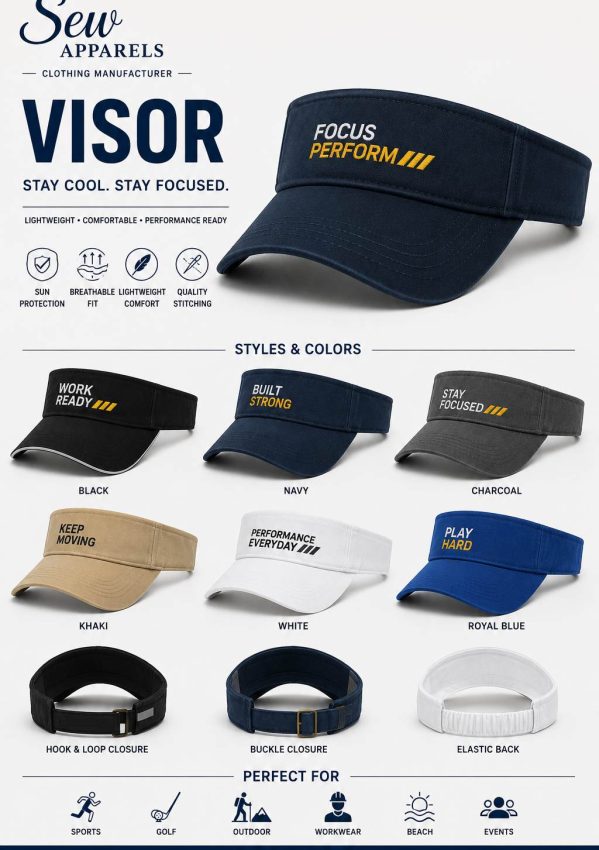
This visor retail packaging return deformation guide covers six practical checks: establish the starting shape, inspect retail contact points, compare packing supports, review the delivery route, evaluate customer repacking, and record unpacking recovery. These checks help buyers separate product construction issues from package-related damage. They are development recommendations, not a complete standardized transport test or a guarantee that every shipment will remain unchanged.
Visor retail packaging return deformation: six packing checks
A retail pack may hold a visor attractively on a display fixture while offering little protection inside a parcel. Conversely, a protective shipping arrangement may occupy too much space for a store rack. Plan outbound versus return protection as two connected decisions. Record which components remain with the customer and which protective components are discarded after delivery.
The open crown makes the relationship between band, brim and support especially important. A support that pushes on one brim corner can change the apparent symmetry without crushing the whole package. Use the visor curvature checks to define the approved brim reference. Before changing the pattern or stiffener, compare the unpacked article with an untouched reference. Visor return parcel deformation should be traced to observable contact and handling conditions rather than attributed automatically to the sewing process.
1. Establish the starting shape and inspection method
Begin visor retail packaging return deformation work with samples from the intended construction. Identify fabric, brim insert, band, closure, decoration and size. Photograph each sample from consistent front, side and top viewpoints on the same surface. Record visible marks before packing so an existing feature is not later counted as transit damage.
For an open crown visor retail pack trial, agree on the features that matter commercially: brim symmetry, band alignment, trim appearance, label condition and usable adjustment. Define how the buyer will inspect these features. A description such as “shape acceptable against approved reference” needs an accompanying reference and clear viewing conditions; otherwise different inspectors may reach different conclusions.
Keep one unexposed control sample and label each trial unit. Record sample quantity and package revision, including any differences between trials. A small development comparison can identify promising arrangements, but it does not establish a reliable damage rate for a large order. Expand the evaluation when construction variation, delivery routes or the commercial risk justify it.
2. Inspect hangtags, clips and display contact points
Check visor hangtag pressure damage at the attachment point and wherever the tag rests against fabric. A tight loop may pull a band edge inward; a hard tag corner may leave a localized impression. Inspect attachment tension, exposed fastener ends and whether the tag swings into the decorated area. Evaluate the actual retail arrangement rather than only the loose tag.
Include retail clip contact marks in the review. Examine clip jaws, contact width, surface condition and placement. A clip that holds securely may still concentrate pressure on a visible panel or binding. Compare an alternative location or protective interface, then check whether it introduces slipping, extra bulk or a new impression elsewhere.
For hangtag display pressure, document how the product hangs and what carries its weight. Conduct a display dwell trial for an agreed period that reflects the planned display use. Record the period and conditions rather than assuming that a short demonstration represents weeks in a store. Inspect promptly after removal and again at the agreed follow-up time.
3. Compare supports without forcing the approved brim curve
A packing support comparison should change one major variable at a time. Compare the current arrangement with an alternative insert, orientation or separation method. Use the same visor construction and similar handling. If support material, carton dimensions and packing quantity all change together, the result may be useful operationally but cannot identify which change caused the improvement.
Look for concentrated loads at the brim tips, band ends and closure. A support should not require an operator to flatten an approved curve merely to close the pack. Check whether adjacent units press into one another and whether decoration contacts a rough insert. Photograph the packed position before closing the container so the arrangement can be repeated.
Record ease of packing as well as appearance. If a protective arrangement requires precise positioning that operators cannot maintain at the intended pace, it may be unreliable in production. Write clear orientation instructions and inspect trial packs made by more than one operator. Include insert movement and closure interference in the visor packaging contact mark inspection.
4. Match the transport review to the actual route
Visor retail packaging return deformation can occur even when a retail sleeve looks intact. Review the complete product-and-package combination, including the outer parcel. Map the expected route: bulk delivery to a retailer, individual customer delivery, or both. Describe packing quantity, container type and any transfers between warehouse, store and customer.
FedEx packing guidance discusses limiting movement with cushioning and using protective outer boxes for items vulnerable to handling. Apply that general principle through a visor-specific trial. Added material should support the product without creating pressure against its brim or band. Generic guidance does not establish a universal cushion thickness or approved packing method for your particular visor.
For formal transport evaluation, select the procedure with a qualified packaging laboratory. The ISTA test procedure overview distinguishes screening approaches from transport simulation. Route, package configuration and test purpose affect the choice. An informal return parcel compression check is not equivalent to completing an ISTA procedure, and a development observation should not be described as certification.
5. Evaluate realistic customer repacking
Outbound packing is performed under controlled instructions; customer returns may use a different box, orientation or closure position. Include customer repacking directions in the development brief. Make the instructions short and practical: retain useful supports, avoid deliberately folding the brim, and place the visor without trapping the closure beneath a hard edge.
Ask a trial participant to repack using the supplied directions without coaching through every movement. Observe where the instructions are unclear and whether the original pack can be closed again. Record missing components and obvious alternatives a customer may choose. The purpose is to improve the return arrangement, not assume that every buyer will preserve every component.
Keep visibly different return scenarios separate in the record. For example, compare the retained original support with a documented arrangement without that support. Do not combine the outcomes into a single claim about protection. Where a return scenario leaves the product vulnerable, consider simpler reusable support or clearer directions before increasing packaging material indiscriminately.
6. Record recovery and approve the complete package
Inspect visor retail packaging return deformation immediately after unpacking and at agreed follow-up points. Define the unpacking recovery period in the trial plan rather than selecting a convenient time after seeing the result. Keep the product in the same agreed condition between observations; steaming, bending or wearing it changes what the evaluation represents.
Separate a temporary impression from a persistent crease, distorted brim or damaged decoration. Record photographs, inspection findings and any handling used to restore shape. Do not promise recovery within a universal number of hours. If customer intervention is necessary, evaluate whether the instructions are appropriate and whether the restored appearance meets the buyer’s approved reference.
Complete product package approval with the selected insert, tag attachment, packing orientation, outer container and instructions. Retain a reference pack and its revision details. Link the package approval to the product specification so a later change in brim construction, decoration placement or order quantity triggers a review of the relevant packing conditions.
Build a cost comparison around the approved arrangement
For a pack bulk quotation, specify dimensions, materials, quantity per pack, assembly steps and any reusable components. Compare a pack format cost scenario using the same assumptions. Unit material cost alone can hide differences in packing labor, storage space, outer carton quantity and shipment volume. Ask for itemized assumptions rather than an unsupported promise of overall savings.
Startup brands can begin with a focused sample comparison and expand it when the preferred arrangement is clear. For visor retail packaging return deformation, keep product quality and packaging decisions connected: a cheaper insert is not a saving if it damages the approved appearance. Likewise, extra material that provides no demonstrated benefit adds cost without resolving the actual contact point. Record why the selected arrangement is appropriate for the intended route and retail format.
Buyer questions before final approval
Should every returned visor be treated as a packaging failure?
No. Compare its condition with the starting reference and examine the returned pack. Manufacturing variation, customer use and repacking may contribute differently. A visor retail packaging return deformation record helps investigate the evidence without making a conclusion solely from the appearance of one returned unit.
Can one pack cover store display and parcel returns?
Possibly, if the complete arrangement meets both needs in the agreed evaluation. Check display attachment, shipping support and repeat closure independently. A pack that looks attractive on a rack still needs appropriate protection for its delivery and return conditions.
What should a buyer send for development?
Provide the approved visor reference, retail presentation, expected shipping route, packing quantity and photographs of any existing damage. Include budget assumptions and customer return practices. These details give the sample team a specific problem to review instead of a broad request for stronger packaging.
Visor retail packaging return deformation: production brief
Use the Visor Buying Guides to connect packing decisions with fit, closure and other product development checks. Keep the selected package revision alongside the approved visor specification, and identify which changes require another sample review.
For custom visor manufacturing or private label visor production, share your route, display requirements and sample concerns with the Sew Apparels visor team. Startup brands can discuss the development scope and quotation requirements before commitment. A clear visor retail packaging return deformation brief supports a repeatable packing decision grounded in observed samples rather than an unverified protection claim.
Low MOQ packing decisions for startup brands
Confirm the proposed package materials and purchase increments before choosing the first production quantity. A startup brand can compare a small set of labelled packing samples, but should distinguish development quantities from the supplier’s minimum order for printed sleeves, inserts or hangtags. Visor retail packaging return deformation remains a product-and-package approval issue even when the first launch is small.
Keep the accepted packing reference and written orientation instructions available for the production team. If a lower-cost insert or a different box is proposed, review the contact points and return scenario again before replacing the approved format. Record any price benefit separately from the sample decision so an assumed saving does not conceal a new deformation risk.