
Work chino shorts wash crease appearance needs a clear review basis before a buyer approves an easy-care uniform. A freshly pressed sample can look different from the same short after washing, drying and ordinary handling. The useful question is which appearance the order actually requires, under which care conditions, and whether the finished garment supports that requirement.
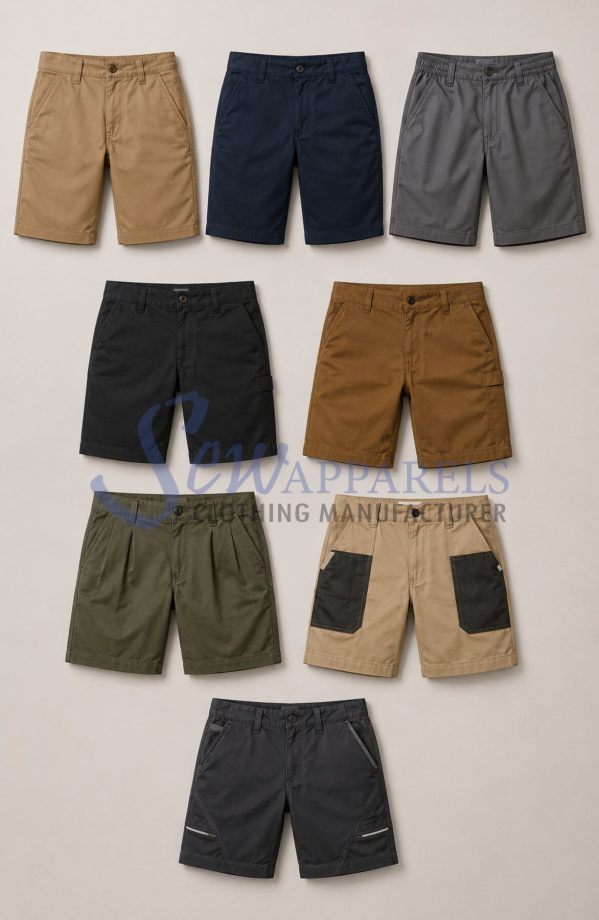
Keep surface wrinkles, seam puckering and an intentional pressed crease separate. They can occur together, but they are different observations. This guide explains how to build a practical sample record, compare like-for-like evidence and agree a presentation reference without assuming that every visible crease means a fabric fault.
For product development, use our work chino shorts manufacturing page. This review belongs before final appearance approval; it does not replace a complete test method or establish a particular performance result for Sew Apparels.
1. Define work chino shorts wash crease appearance before comparing samples
Start with the intended use. A restaurant uniform, workshop short and customer-facing retail uniform may have different presentation expectations. Ask whether the buyer wants an acceptable unpressed garment, a garment that can be improved by permitted ironing, or retention of a deliberately pressed crease. Write that expectation before reviewing photographs.
Work chino shorts washed presentation approval should identify the sample, material version, care instructions and assessment condition. Record whether the short is new, washed once or evaluated after an agreed series of cycles. A clean reference label prevents people from comparing an untouched approval sample against a repeatedly washed development sample.
Separate work chino shorts crease location observation from the overall impression. Note front panels, back panels, waistband, hems and pocket areas individually. Describe what is visible rather than assigning a cause immediately. A fold created during storage, for example, should not automatically become evidence of poor wash performance.
Agree who reviews the sample and how differences will be resolved. A buyer-approved reference is useful, but the acceptance basis should also state whether a formal assessment is required. Do not invent a universal pass grade: the appropriate criterion depends on the agreed specification and the method used.
2. Separate fabric wrinkles, seam puckering and pressed creases
A work chino shorts wash crease appearance record becomes more useful when observations have consistent names. Broad folds across a panel describe fabric presentation. Small repeated ripples beside a sewn line describe a seam observation. An intentional crease has its own location and expected retention. These should not collapse into a single comment saying “too wrinkled.”
For work chino shorts seam versus fabric wrinkles, inspect both the area beside the stitching and the surrounding panel. Record whether the effect follows the seam, spreads across the fabric or appears only at a component junction. This location map supports investigation, although appearance alone cannot establish the underlying cause.
Work chino shorts wash puckering can be recorded alongside uniform chino shorts seam appearance. Avoid treating those phrases as identical conclusions. Ask the development team to compare the garment construction, component materials and care history before deciding what to change. A photograph is an observation, not a complete diagnosis.
If the buyer requires a work chino shorts washed seam puckering grade, agree an appropriate assessment and reference system. A casual phone photograph should not be presented as a formal grade. Keep the actual assessed result, method edition and sample identity together so the approval refers to evidence that can be understood later.
3. Keep washing and drying conditions comparable
When checking work chino shorts wash crease appearance, care conditions belong beside every result. Record the procedure used, number of cycles, drying route and relevant handling. A supplier’s sample and a buyer’s sample may look different because their preparation differs, even when they came from the same production material.
Use a work chino shorts line dry appearance comparison only for samples prepared on a comparable basis. Likewise, a work chino shorts tumble dry creasing evaluation should record the actual drying condition used. Keep the two routes distinct; neither should be described as representing every possible domestic or commercial care situation.
The public abstract for ISO 15487:2018 on apparel appearance after domestic washing and drying describes assessment of finished textile products, including fabric and seam smoothness and retention of pressed-in creases. It also covers other appearance attributes. This summary establishes the scope; applying the method requires the full applicable procedure.
For seam-specific evidence, the public scope of AATCC TM88B on seam smoothness after home laundering concerns washable fabrics prepared under specified washing and drying options. It evaluates seams as supplied rather than prescribing how to sew them. Obtain the complete method and appropriate assessment resources when formal testing is part of the order.
These references do not supply a buyer’s acceptance limit by themselves. Agree which evidence is needed and who will provide it. Also distinguish domestic-care evidence from any separate industrial-laundry requirement. Do not extend a result to a different care system without an appropriate basis.
4. Record unpressed presentation before any pressing trial
For work chino shorts wash crease appearance, keep the first assessment separate from an improvement step. Work chino shorts unpressed garment presentation is relevant when the buyer expects easy daily care. If the garment is ironed before anyone records that condition, the original observation can no longer be judged from the final photograph.
A work chino shorts finished short pressing trial can then document a separate question: how does permitted pressing affect presentation? Follow the approved care instructions and record the treatment used. Do not choose a more aggressive treatment simply to produce a better photograph, and do not imply that pressing proves unpressed performance.
Chino shorts pressing care evaluation should connect the result to the uniform short ironing requirement. If ironing is expected, explain that requirement in the buyer’s specification and care discussion. If the buyer expects no ironing, a pressed approval sample is insufficient evidence for that expectation.
Consider a fictional comparison. Sample A is photographed after drying without pressing, while Sample B is photographed after ironing. B looks smoother, but the comparison cannot show which construction has better unpressed presentation. Prepare both samples on the same basis, record that comparison, then assess permitted pressing separately if needed.
Retain both sets of observations. This prevents a development decision from losing its context when another person sees only the final attractive image. The purpose is an honest approval record, not a promise that the garment will look identical in every user’s care routine.
5. Build a whole-garment appearance reference
A work chino shorts wash crease appearance reference should represent the finished short, not only a fabric swatch. Waistbands, pockets, seams and hems contribute to presentation. A useful material report can inform development, but it cannot by itself establish how all those components look together after care.
For work shorts washed sample grading, identify the evaluated garment and record the viewing basis. Use comparable sample positioning and clear images for development communication. If a formal grade is required, follow the selected method rather than substituting an informal photograph checklist for its assessment requirements.
Work chino shorts care appearance reference sample records should include visible features that the buyer accepts. Note panel appearance, seam observations and intentional creases separately. Record any agreed limitation instead of leaving the next reviewer to interpret a vague “approved” sticker.
Work chino shorts whole garment easy care evidence must support the exact claim being considered. “Looks acceptable after the agreed care preparation” is a narrower statement than “never needs ironing.” Avoid broad promotional claims when the evidence only covers one sample condition or a limited development comparison.
Preserve the reference and its identity in the order file. If the material, sewing construction or care instructions change, consider whether that reference still represents the new version. A previous approval should not silently move to a revised garment with different relevant components.
6. Connect the findings to a controlled development decision
Use work chino shorts wash crease appearance findings to decide the next development step. A work chino shorts wash crease appearance action names the observation, the change being considered and the evidence required to review it. Changing several construction and material variables together makes it harder to understand which change affected the result.
For custom work chino shorts manufacturing, include the appearance brief in the sample request. State the intended care route, unpressed or pressed requirement, reference sample and any formal assessment needed. Ask for the relevant development scope to be confirmed rather than assuming that every quotation includes appearance testing.
For private label work chino shorts production, connect the accepted garment version to the order documentation. Keep material identity, care information and approved presentation together. This supports a more useful handover than a generic requirement to make the shorts “easy care.”
Record changes before releasing the next sample. If a revised component affects a seam area previously assessed, review the relevant observation again. Keep unresolved findings visible in the development file; an improved panel photograph does not automatically resolve a different waistband or pocket concern.
A practical approval checklist
Before signing off work chino shorts wash crease appearance, confirm that the sample record answers the following questions. Each answer should point to the actual garment or evidence being reviewed.
- Which material and garment version was evaluated?
- What washing, drying and cycle history produced the observed condition?
- Were fabric wrinkles, seam appearance and intentional creases recorded separately?
- Was unpressed presentation documented before any permitted pressing trial?
- Does the agreed reference support the buyer’s specific appearance expectation?
- Are further testing, revision or claim limitations clearly recorded?
Place these decisions alongside fit, component and quotation approvals. Related development topics are collected in our work chino shorts buying guides. A work chino shorts wash crease appearance approval is a traceable agreement about the actual finished sample and its care conditions, with a clear next step whenever the evidence is incomplete.
Keep the reviewed care state consistent with the work chino shorts fit block assortment record. Record any change to measurements, pocket function or wearer observations after the agreed preparation. Appearance approval and fit approval should identify the same garment revision while retaining their separate acceptance questions.