
Work jacket water resistance test evidence should support the exact claim a buyer intends to approve. A surface wetting result, a fabric penetration result and evidence for an assembled jacket answer different questions. Treating them as interchangeable can leave a product description broader than the available report. This guide explains six checks for reviewing sample identity, test scope, report comparisons, component coverage, wording and the final claim approval record.
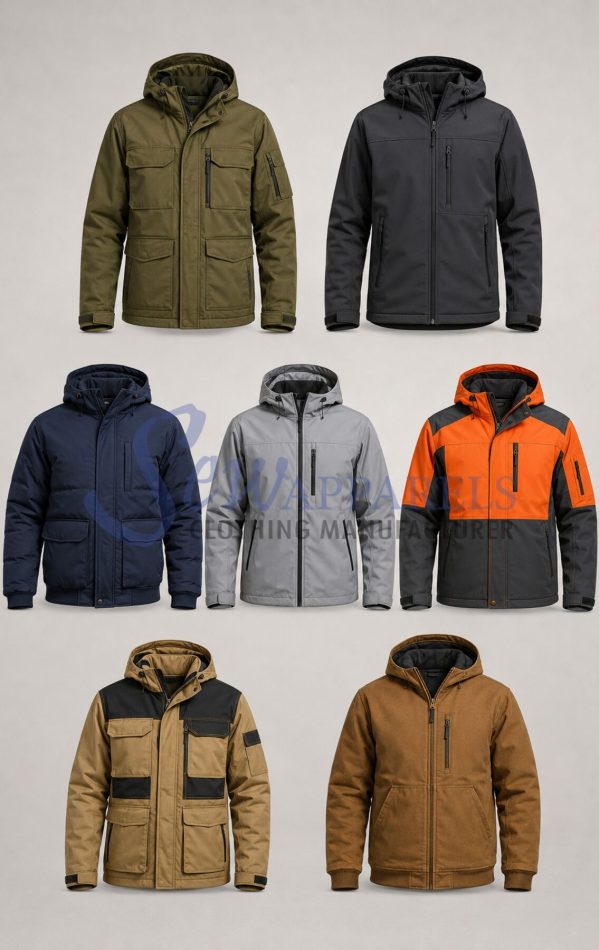
Start with the proposed use and the wording under consideration. A buyer may be assessing a material option, requesting evidence for a finished jacket or reviewing an existing supplier statement. Keep those tasks separate. This article does not set a universal waterproof threshold, establish compliance for a particular garment or claim that Sew Apparels has a specific test result for every jacket configuration.
1. Identify the work jacket water resistance test evidence
A rain resistance jacket supplier report needs a clear relationship to the product being ordered. Record the fabric code, finish, colour, sample revision and relevant construction details. Establish whether the sample was a fabric specimen, a component assembly or a finished garment. A report for a related material should not be treated as evidence for the ordered jacket without confirming the connection.
For work jacket water resistance test evidence, the water test sample identity of hooded work jackets should remain traceable through the specification. Identify which side or configuration was evaluated where relevant. If the jacket uses several materials, establish which of them appears in the report. The presence of a material reference does not demonstrate that every component or seam was covered.
Prepare a custom hooded work jacket manufacturing enquiry through the Hooded Work Jackets product page with the proposed requirement and evidence questions. Ask what is available for the actual configuration and what remains to be evaluated. Keep requested performance distinct from confirmed performance until the responsible review is complete.
A fictional evidence file could identify shell F-A, jacket J-A and claim wording C-A. Those references would help connect a laboratory report with the garment specification and approved description. They are illustrative identifiers, not real Sew Apparels products or results. Their purpose is to show how a purchasing team can avoid losing the identity link when reports are passed between departments.
2. Separate spray testing from penetration testing
The work jacket spray test versus hydrostatic test distinction matters before comparing any figures. Identify the outcome the method addresses and check whether that outcome is relevant to the proposed statement. A report title containing water resistance is not sufficient on its own. Review the method, sample and result rather than relying on a broad supplier summary.
ISO’s description of ISO 4920:2012 identifies a spray method for fabric resistance to surface wetting. It explicitly distinguishes that outcome from predicting rain penetration through fabric. For hooded work jackets, surface wetting report scope and spray rating limitations should therefore remain visible in the review, instead of being converted into an unsupported waterproof claim.
Work jacket water resistance test evidence involving a spray result can inform the relevant surface-wetting question. It does not become a penetration result because the fabric was described as water repellent. Keep the recorded result and its supported wording together. If a proposed statement concerns a different outcome, identify the additional evidence needed rather than stretching the original result.
ISO’s description of ISO 811:2018 addresses fabric resistance to water penetration using hydrostatic pressure. That is a different evidence category from surface wetting. The laboratory should determine the appropriate method and interpretation for the actual sample and requirement. Neither public standard summary supplies a universal acceptance criterion for every work jacket.
3. Compare complete reports with matching scope
For work jacket water resistance test evidence, obtain the complete report and identify the method edition, sample preparation, conditions, result and any stated deviations or limitations. Ask the laboratory to clarify unclear information. A figure copied into a product listing may omit details necessary to understand what was measured and whether it is relevant to the order.
Hydrostatic report comparison for hooded work jackets should establish whether the reports concern comparable materials and conditions. Record different treatment histories, finishes or sample configurations. If those differ, explain the limitation before ranking results. Do not assume that figures from unlike reports can be compared directly merely because both were measured using pressure.
Work jacket water resistance test evidence should also distinguish the original condition from the condition after any agreed care or other treatment. Identify exactly what history the tested specimen represents. An initial result should not become a claim about repeated laundering unless that scope is supported. Avoid borrowing a treatment schedule from an unrelated garment or material.
Fabric penetration evidence for hooded work jackets should be recorded as the specific finding reported. Preserve the units and report wording accurately in the buyer’s records, and keep interpretation attributable to the responsible reviewer. Do not convert a laboratory number into promised hours in rain or a guaranteed service life without an appropriate supporting basis.
4. Review fabric versus assembled garment coverage
Work jacket fabric versus garment water testing requires a deliberate distinction. A material report concerns its specified specimen and outcome. An assembled garment includes construction details that may require separate evaluation for the intended claim. Identify the relationship between the evidence and the complete jacket instead of assuming that the shell result automatically covers everything.
For work jacket water resistance test evidence, the jacket component test coverage of hooded work jackets should be mapped to the proposed description. Consider the hood, body, sleeves, closures, seams and any added decoration or construction change relevant to the review. This is a suggested evidence mapping process, not a universal laboratory procedure or a claim that every listed feature always requires the same test.
Seam evidence gaps should remain explicit. If the supplied evidence does not address the relevant seam construction, record the question and assign responsibility for resolving it. Do not describe a gap as a pass, and do not presume that a visual seam check establishes water penetration performance. Determine the appropriate evidence with the responsible technical team.
An assembled garment rain claim for hooded work jackets needs a basis that matches its actual scope. Ask which configuration, components and conditions have been assessed. Preserve any limitations in the approval record. A supplier’s fabric report may be useful evidence, but the reviewer still needs to determine what it can legitimately support for the finished product.
5. Keep product wording within the evidence
Water repellency wording review for hooded work jackets should connect each phrase to the evidence supporting it. Avoid treating water repellent, water resistant and waterproof as interchangeable labels with automatic meanings. Define the intended statement in the product brief and have the responsible reviewer confirm the basis and limitations for that wording.
Work jacket water resistance test evidence should make unsupported extensions easy to spot. A proposed sentence about the complete garment may be broader than a report limited to surface wetting of a shell specimen. A claim about performance after care may exceed an initial-condition report. Record the mismatch and resolve it before using the wording publicly.
Hooded jacket waterproof claim evidence should be assessed for the actual jacket revision. Changes to fabric, finish, seams, closures or decoration may affect the relevance of earlier evidence. Determine whether additional review is needed before carrying the claim forward. A similar appearance or unchanged style name does not establish that a modified garment has the same evidence basis.
Weather claim substantiation should preserve the distinction between an observation, a laboratory result and an approved statement. A wearer saying that a jacket felt dry during a short outing is a contextual observation, not a substitute for the required evidence. Use observations within their actual scope and avoid turning them into universal performance promises.
6. Build the rain claim approval matrix
The rain claim approval matrix for hooded work jackets can connect proposed wording, sample identity, report scope, component coverage and review status. Add the responsible person and next action for unresolved questions. Keep rejected or superseded wording distinguishable from approved wording. This creates a clear record for purchasing and the team preparing product descriptions.
A work jacket water resistance test evidence review should end with a decision that another person can follow. State which evidence was accepted for which requirement and preserve any limitations. If the evidence is incomplete, hold the relevant claim until it is resolved. Do not use a broad approval label to conceal differences between what was tested and what is being described.
When discussing private label hooded work jacket production, include the confirmed claim wording and evidence expectations in the product brief. Ask how changes and substitutions will be reviewed before approval. This gives the supplier a specific requirement without implying that a requested claim, test programme or performance level is already agreed for the order.
The existing Hooded Work Jackets Buying Guides connects this report review with related construction and purchasing decisions. Use those topics to prepare focused questions, while keeping actual reports and the approved specification authoritative. A general buying guide provides context; it does not prove the performance of a particular supplied jacket.
Questions before approving water-related claims
Does a spray rating prove the jacket is waterproof?
No. A fabric surface-wetting result addresses its defined outcome. It does not measure water penetration through the fabric or automatically establish the performance of an assembled jacket. Keep the proposed wording within the actual evidence scope.
Can a fabric report cover every seam and closure?
Do not assume that it does. Identify the specimen and relevant component coverage, then resolve any gaps with the responsible reviewer. A report should support only the scope it actually addresses.
What completes work jacket water resistance test evidence review?
Traceable samples, relevant methods, comparable reports, defined component coverage and approved wording complete the evidence review. Preserve its limitations, resolve outstanding claim questions and require a fresh relevance check when the ordered configuration changes.
For the construction review, compare the hooded work jacket weather flap design with the proposed claim scope. A flap design discussion helps specify the assembly; it does not replace test evidence for the selected configuration.