
Work joggers waistband elastic wash recovery should be evaluated as a finished waistband decision, rather than inferred from an elastic supplier’s description. Washing, drying, casing fabric and stitching can affect the assembly being approved. A waistband that measures differently after care does not automatically demonstrate elastic failure; the development team first needs consistent measurement conditions and an identified sample.
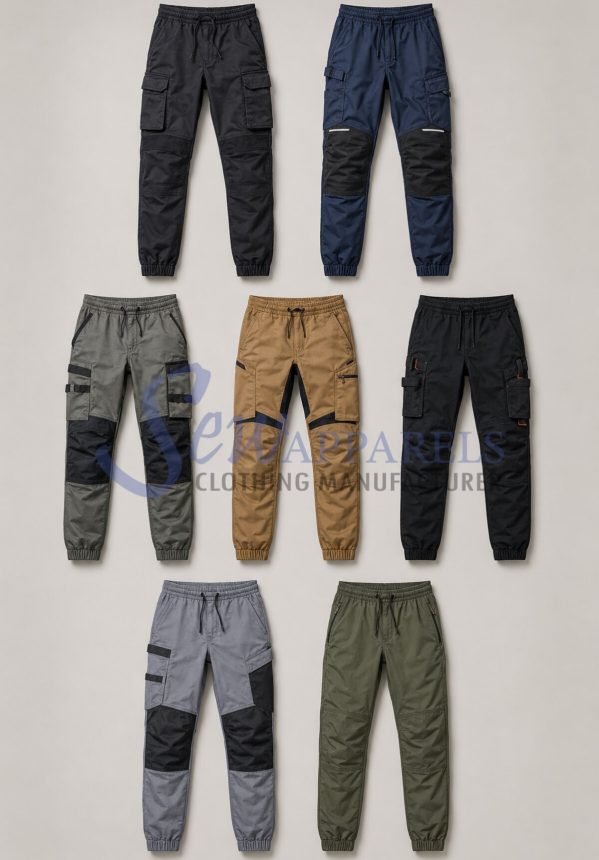
This guide to work joggers waistband elastic wash recovery explains how buyers can organize a before-and-after review. It separates relaxed dimensions, extension observations, construction appearance and wearer feedback. It does not claim a Sew Apparels test result, prescribe a universal recovery percentage or promise service life. Agree the care route and evidence requirements before approving the garment.
1. Define work joggers waistband elastic wash recovery scope
Start with a complete waistband description. Record the elastic reference, width, construction, joining arrangement, casing material and attachment method. Identify drawcords and other components that can influence how the waist behaves. A report for loose elastic should remain identified as component evidence; it cannot silently become approval of a differently constructed finished waistband.
A work jogger elastic relaxation sample should carry a garment size and development version. Preserve the matching material information and sample photographs. If several candidates use different elastics, label them before care or handling begins. Avoid relying on colour alone as identification, because samples may share a colour while differing in construction or component source.
Define what the buyer means by recovery. Is the concern relaxed waist size after care, response after an agreed extension, or wearer feedback about holding the garment? These are related observations but not interchangeable results. State each question separately so a favourable fit comment cannot replace an unresolved dimensional change in the approval worksheet.
A work joggers waistband tolerance agreement should identify measurement points, sample state and acceptance responsibility. Set any limits through the technical agreement and applicable evidence route. Do not borrow a percentage from an unrelated product and present it as the industry rule. The buyer needs criteria appropriate to the construction and intended garment programme.
2. Record the baseline without stretching it
Work joggers waistband elastic wash recovery needs a baseline collected under an agreed procedure. Work joggers relaxed waistband measurement should specify whether the record uses a laid-flat width, circumference or another defined dimension. Keep these terms distinct in the worksheet. A laid-flat value should not be compared directly with a circumference without the agreed interpretation.
Lay out the garment consistently and avoid pulling it into a convenient reading. Document closure position, drawcord state and the reference points used. If the waistband is curved, agree how it is presented and measured. Photograph the arrangement so the team can reproduce it. Repeat inconsistent readings through the agreed procedure rather than selecting the most favourable one.
For work joggers waist recovery conditioning, define the sample state before measurement with the technical team or laboratory. Record the relevant conditions and timing used. A reading taken immediately after handling may not represent the same state as one collected later. The record should show those differences instead of disguising them as material performance.
Separate work joggers elastic extension observation from a relaxed dimension. If a development review includes extension, document its arrangement, agreed extent, sequence and reading points. An uncontrolled hand pull is not a standardized elastic test. Do not translate the review into a formal performance figure unless the relevant method and evidence support that statement.
3. Agree the complete wash and dry route
Work joggers waistband elastic wash recovery depends on the care sequence being examined. A work joggers wash route elastic compatibility discussion should identify the proposed care instructions and whether the review concerns domestic or another specified route. Check component information with the supplier and define the actual sample procedure before washing begins.
The public scope of ISO 6330:2021 covers domestic washing and drying procedures for textile testing, including garments. It makes washing and drying part of the complete procedure and notes that parameters can affect results. This provides a reference for specifying a suitable domestic test route; it does not establish a waistband acceptance limit.
For an elasticated work trousers care trial, record the washing and drying arrangements actually used. Include the agreed number of sequences and any additional processing such as pressing, where relevant to the brief. Do not describe a household trial as an industrial laundry assessment. If a different route is intended, request an appropriate procedure from the technical team.
A work joggers finished waistband care pilot should retain the full assembly, including seams and casing, because those details are part of the decision. Keep an unprocessed reference where practical. If several samples are washed together, retain their identifiers throughout handling and drying. A useful report must explain which physical sample each observation describes.
4. Compare dimensions and construction separately
Work joggers waistband elastic wash recovery should be reviewed using the same defined measurement arrangement before and after care. Work jogger waistband extension after wash belongs in a separate record from relaxed waist change. A difference in the relaxed garment dimension does not by itself identify the cause, particularly where casing and shell fabric also changed.
For work joggers before after waistband comparison, show original and later readings with units and sample references. Where a calculation is requested, state its basis clearly and use the agreed baseline. Do not report more numerical precision than the measurement supports. Keep missing readings visible rather than estimating them to complete a tidy table.
Work joggers post wash waist relaxation observations should include the timing and condition of the reading. Check whether the sample was handled, extended or worn before measurement. These events can change the comparison basis. If two candidates were reviewed differently, resolve that mismatch before using the results to select a preferred elastic or construction.
Inspect work joggers elastic casing distortion as a construction observation. Note twisting, bunching, joining bulk, seam restriction or other visible changes actually present. Keep photographs tied to the affected location and version. Avoid diagnosing the elastic as defective solely from the outside appearance; the development team may need to examine how the components interact.
5. Choose the appropriate component evidence
Work joggers waistband elastic wash recovery can benefit from component evidence, provided its scope is understood. The public description of ISO 20932-3:2018 concerns elasticity and related properties of narrow fabrics. ISO also lists a 2025 amendment. Ask the testing provider to confirm the applicable method and amendment for the elastic being considered.
A work jogger waist recovery comparison should distinguish the component tested from the garment assembled. Component evidence may help investigate a problem or compare identified candidates. Finished assembly observations address additional interactions with the casing and attachment. Neither record should be rewritten as the other, and no method reference alone proves a sample has passed.
Keep the report identifier, specimen identity, preparation history and relevant conditions with the result. Request clarification if the elastic code or sample state is missing. Historical evidence for a different batch or finish may need a scope decision before it supports the order. The laboratory should resolve method applicability rather than the buyer guessing from a standard title.
Maintain a work joggers elastic behavior record that distinguishes laboratory findings, development measurements and informal observations. This makes the evidence understandable to purchasing, pattern and production teams. Record limitations beside the result. A confident phrase such as excellent recovery should not obscure the absence of a defined comparison or an agreed acceptance criterion.
6. Connect the result to fit and release
Work joggers waistband elastic wash recovery is one part of garment approval. Work joggers waist fit trial feedback should identify the wearer arrangement, garment size and sample condition. Ask what changed between the agreed before-and-after reviews. Keep comments about comfort, pressure and garment position separate from the measured dimensions and component test report.
Use a controlled, ordinary fit review appropriate to the development brief. The wearer should be able to stop when uncomfortable. Avoid health claims about circulation or injury prevention, and do not generalize one person’s comments to every customer. Include representative size considerations in the approval plan rather than treating a single sample as complete coverage.
For custom work jogger manufacturing, send the approved waistband specification, care route and evidence worksheet with the garment brief. For private label work jogger production, preserve those references when defining branding or assortment changes. Ask the supplier to identify proposed changes to elastic, casing or attachment before they replace the approved development basis.
Discuss the wider garment through the work joggers manufacturing page, and keep related decisions connected through Work Joggers Buying Guides. Release the material version and assembly together, with unresolved questions recorded and assigned before production approval.
Buyer questions before waistband approval
Does a waist measurement change prove elastic failure?
No. The complete assembly and comparison conditions need review. Casing dimensions, seams, sample handling and the state of measurement can influence the observation. Establish what changed before requesting a component replacement. A targeted review is more useful than changing several construction details at once and losing the ability to identify the original cause.
Is one care trial a lifetime guarantee?
No. Work joggers waistband elastic wash recovery should be described for the route and samples actually examined. A development pilot does not establish every customer’s care outcome or a guaranteed number of wears. State the evidence scope accurately and arrange further assessment when the purchasing requirement extends beyond the observations available.
What belongs in the final approval?
Summarize work joggers waistband elastic wash recovery with the component reference, garment version, measurement arrangement, care sequence, relevant findings and acceptance decision. Preserve any conditional items and the person responsible for resolving them. This creates a repeatable development record without inventing a pass result or promising that all elasticated work trousers behave identically.
Connect the approved waistband assembly to the woven versus knit work jogger quotation record. Confirm the same elastic, casing material and attachment scope are being priced. A substitution made during costing needs a relevance check before it inherits the earlier care and fit approval.