
Work polo ID badge attachment review should examine the badge, holder, fastener and garment together. A clip that works on one shirt can distort another fabric or sit awkwardly beside a placket. Buyers need an identified interface and a realistic ordinary-use review before approving a uniform detail. A neat photograph alone does not establish reliable access, fabric compatibility or suitability for a particular workplace.
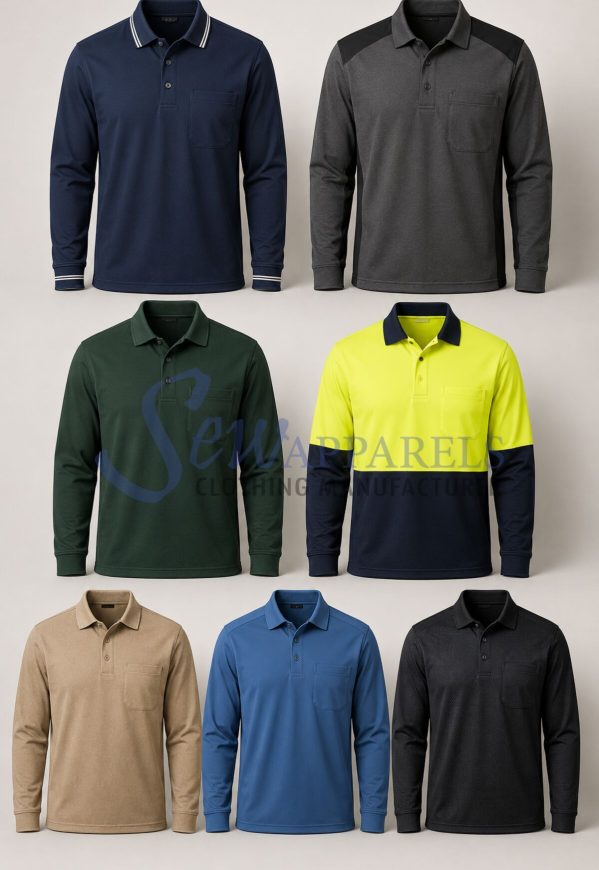
This guide to work polo ID badge attachment review helps development teams organize those decisions. It separates attachment geometry, garment support, wearer access, care and approval records. It does not claim a Sew Apparels test result, specify a universal badge load or certify a release mechanism. Workplace suitability must be addressed through the buyer’s applicable requirements and competent safety review.
1. Define work polo ID badge attachment review scope
Identify the complete badge arrangement. Record the card dimensions, holder reference, clip or strap type and any reel or additional accessory. Photograph the assembly and retain the sample used in development. A work polo ID holder attachment decision needs the actual parts, because two holders that accept the same card may have different cut-outs, edges and connection geometry.
A work polo identification badge clip should be described by its component reference rather than a generic metal clip label. Note the intended attachment point and how the clip is operated according to its supplier. Do not assume that different clip shapes share the same grip, compatibility or release function. Ask for relevant component information when the proposal is unclear.
As an example of product-specific information, DURABLE’s clip for name badges and ID cards is described as a rotating clip with a snap-button strap and compatibility with corresponding holder cut-outs. This illustrates the need to match components. It does not establish use of that brand in a Sew Apparels sample or compatibility with every polo.
Define the buyer’s intended identification task, including whether the card is displayed, removed or presented to a reader. Keep the workplace arrangement and any prohibited accessories in the brief. A suitable sample review begins with that scope, instead of selecting an attractive fastener and discovering later that it conflicts with the customer’s operating requirements.
2. Match the attachment to the garment construction
Work polo ID badge attachment review should identify a specific garment version, size and fabric. The work polo badge garment interface includes the visible material, any reinforcement and the construction at the attachment point. A clip gripping a layered placket is not the same arrangement as one attached to an unsupported body panel. Record the proposed location clearly.
A work polo badge loop specification should define the loop material, finished dimensions, orientation, attachment method and measurement points. Identify the fastener it is intended to accept. Avoid approving a loose loop sample without reviewing its position on the garment. Access and appearance can change when the loop is sewn into the actual construction.
For work polo placket badge usability, examine whether the holder interferes with buttons, opening or ordinary dressing. Check how the garment sits with the intended badge installed. A wearer should not need to distort the placket simply to position the card. Keep the badge arrangement separate from any decorative chest detail unless their relationship is explicitly part of the brief.
Record local support details without assuming that more reinforcement always improves the outcome. A development change can affect stiffness, bulk and appearance. Ask the sample team to explain the proposed construction and review it as an assembly. This produces a targeted decision instead of adding materials until the sample becomes difficult to wear or operate.
3. Observe loaded appearance and fabric interaction
Work polo ID badge attachment review needs a baseline view before the badge is installed. A work polo badge weight sample trial should use the identified complete holder and card arrangement, with its relevant loading recorded. Do not invent a universal maximum weight. The review should examine the proposed components and the buyer’s agreed ordinary-use conditions.
For work polo badge clip fabric distortion, compare unloaded and loaded garment views under consistent conditions. Note pulling, puckering, local sagging or displaced seams actually observed. Record location and sample version so the pattern or construction team can investigate. A photograph of a flat shirt does not replace the view on the intended wearer arrangement.
Check the material at the contact point after agreed attachment and removal operations. Describe any visible marks, snagging or change without prematurely diagnosing a cause. The concern may involve the component shape, the garment support or the operation. Preserve the evidence and propose one controlled revision at a time where practical.
A work polo ID attachment comparison should keep garment, badge and review arrangements matched when evaluating options. If one proposal uses a different holder or sample size, identify the mismatch rather than ranking the options immediately. A useful comparison tells the buyer what changed and which observations need repeating after the revised assembly is available.
4. Check card access and component operation
Work polo ID badge attachment review should include work polo identification card access in the ordinary task defined by the buyer. Observe whether the wearer can present or remove the card without unnecessary garment movement. Record the position used and any access difficulty. Do not generalize a successful demonstration to every wearer, reader location or task arrangement.
A work polo removable ID card interface should distinguish removing the card from its holder, detaching the holder and releasing a garment clip. These can be different actions. Keep instructions and review notes specific to the relevant operation. A supplier’s component description may explain compatibility without establishing that every action is convenient on the finished garment.
For work polo identification clip release, inspect the actual supplier information and agreed ordinary operation. Do not call a detachable clip a safety release or breakaway mechanism without appropriate evidence for that claim. A hand-operated opening demonstration is not proof of a controlled release force or suitability near machinery.
Keep access observations separate from retention observations. A holder can be easy to remove while its position shifts unexpectedly during the agreed ordinary review. Conversely, it may remain in place but require awkward manipulation. Preserve both findings so the approval decision can address the intended function rather than compressing all comments into a single successful label.
5. Review care and workplace boundaries
Work polo ID badge attachment review should specify what remains attached during care. For work polo badge attachment after washing, distinguish a permanent garment loop from removable clips, cards and holders. Follow the agreed component and garment instructions. Do not place an accessory into a care trial merely because the shirt itself has a proposed wash route.
Record the sample state before and after the defined care sequence. Examine the relevant loop, seam and support details, then repeat the agreed ordinary attachment checks where appropriate. If removable components were excluded, state that clearly. A successful garment care observation should not be reported as evidence for accessories that were never included.
Work polo badge holder snag observations must remain within a safe, controlled development arrangement. Do not deliberately expose a wearer to moving machinery or create a hazardous catch to test the badge. HSE’s introduction to machinery safety highlights entanglement concerns involving loose or dangling items. This is Great Britain safety background, not certification of a garment attachment; confirm the applicable local workplace requirements.
The buyer’s competent safety team should determine whether the proposed badge arrangement is suitable for the actual workplace and applicable rules. A uniform supplier’s ordinary usability review cannot replace that assessment. Record any restrictions before finalizing the detail. If a specialist protective or release requirement exists, define the necessary evidence separately instead of implying it from the appearance of a clip.
6. Approve an identified interface and revision record
Work polo ID badge attachment review should conclude with work polo badge loop sample approval tied to the actual component arrangement. Record the garment version, attachment location, holder and fastener references, care scope and observed limits. Include photographs and relevant specification points. This lets later reviewers understand exactly what was accepted and what remains outside approval.
A work polo ID holder support record should show revisions to loop placement, reinforcement, component selection or construction. Identify the observations that must be repeated after a change. Approval of an earlier fastener should not automatically cover a substitute with different geometry. Keep obsolete sample versions marked so purchasing does not order from an outdated drawing.
For illustration, one candidate may clip directly onto a placket while another uses a specified sewn loop. These are hypothetical development options, not Sew Apparels test results. Compare the identified assemblies under the agreed ordinary conditions. Record the trade-offs in appearance and access instead of announcing that either approach is always superior.
For custom work polo shirt manufacturing, include the accepted interface specification with the wider garment brief. For private label work polo shirt production, keep branding placement and identification details coordinated. Ask the supplier to flag component or construction changes before production release, and retain the buyer’s workplace restrictions with the approval pack.
Buyer questions before approving the badge detail
Can one clip be approved for every polo fabric?
No. Work polo ID badge attachment review needs the relevant garment and support arrangement. A result on one assembly does not automatically cover another material, location or component. Define the intended approval scope and review meaningful changes. Component compatibility and finished garment usability should both remain traceable to the samples examined.
Does easy removal establish a safety release?
No. Convenient ordinary operation is different from a defined safety function. Keep terminology aligned with the actual component information and evidence. If the customer requires a specific release performance, obtain the appropriate specification and assessment through the responsible technical team before making that claim.
Where should the final decision be recorded?
Keep work polo ID badge attachment review in the garment development pack with the accepted sample references and limits. Discuss the complete product through the work polo shirts manufacturing page, and connect related decisions through Work Polo Shirts Buying Guides. Resolve conditional interface questions before release.
Coordinate badge placement with the work polo shirts embroidered logo stabilisation review where the features share a chest or placket area. Record the actual supporting construction and keep access to both features clear. A decorative reinforcement should not be treated as evidence of badge-load or release performance.