
A woven jacket supplier capability questionnaire connects the proposed jacket construction with evidence of who can develop, assemble and finish it. A factory’s general product list does not show that it can reproduce your particular lining, pocket, interlining and pressing requirements. Buyers need questions tied to the actual design and a clear record of the answers.
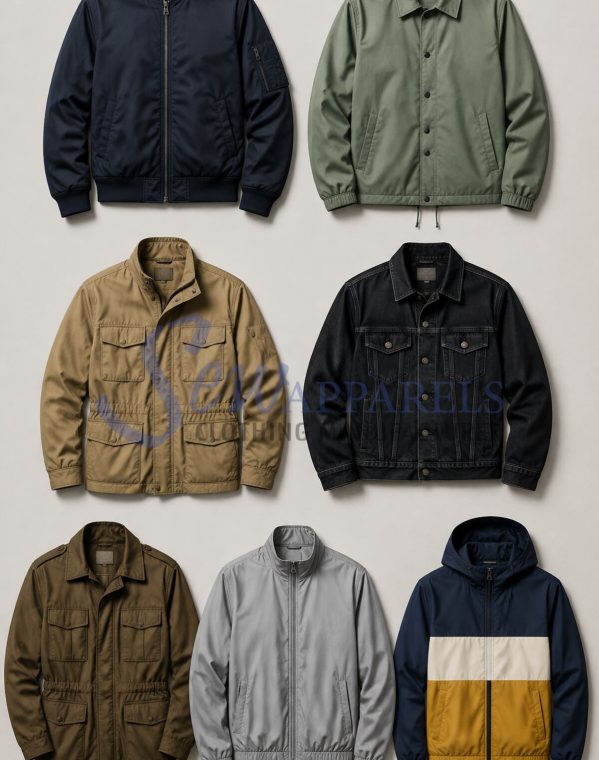
This guide explains five checks for assessing supplier capability before confirming the quotation scope. It covers operation mapping, relevant samples, process responsibilities and a bounded development trial. It does not rank factories or assume that any supplier owns particular equipment or certifications.
For custom woven jacket manufacturing, share the construction pack and critical appearance requirements first. A woven jacket supplier capability questionnaire helps both parties identify what is confirmed, what needs sampling and what remains outside the proposed scope.
1. Build the woven jacket supplier capability questionnaire around operations
Break the design into the operations that determine its appearance and function. Include panel preparation, interlining application, pocket construction, lining assembly, fastener attachment, seam finishing and final pressing where relevant. Ask about the exact operation instead of accepting a general statement that jackets are manufactured.
Use one row per critical operation in the woven jacket construction capability matrix. Give each row four fields:
- Design requirement: what the operation must achieve.
- Proposed process owner: who will perform it.
- Evidence requested: what the reviewer needs to assess it.
- Unresolved question: what still needs an answer.
Mark an operation as not applicable when the design does not require it. A longer checklist should not create unnecessary work.
Include woven jacket fusing capability questions when the construction uses fusible interlining. Ask how the proposed shell and interlining combination will be evaluated, how application guidance is obtained and how the accepted result will be recorded. Do not prescribe a universal temperature, pressure or time without the actual material instructions and trials.
For woven jacket lining assembly supplier review, identify the lining arrangement, attachment points and movement requirements. Ask for evidence of the relevant inside construction and how it will be checked on the sample. A photograph of the outer jacket cannot show whether the lining pulls or hangs incorrectly.
The CottonWorks sourcing and manufacturing resource separates garment manufacturing, finishing and quality assurance as areas of textile knowledge. Use that process perspective to organise questions. An educational resource is not an endorsement of a factory or proof that the proposed operation has been demonstrated.
Keep the woven jacket supplier capability questionnaire specific to the current design revision. If an added pocket, lining or structured panel introduces a new operation, review that row again. Earlier acceptance of a simpler jacket should not silently become acceptance of a more demanding construction.
2. Ask for relevant samples and process evidence
Request tailored jacket supplier sample evidence that relates to the proposed construction. State which feature should be visible and why it matters. Where the supplier cannot share another customer’s garment or details, ask for an authorised demonstration sample or a development trial using your own agreed materials.
Define woven jacket production reference scope before interpreting references. Record whether the example used similar fabric, lining and finish, which operations were performed, and whether it was a sample or production order. A reference from a different construction may offer context without answering the critical question.
Ask for woven jacket machinery capability evidence where a particular process depends on equipment. Identify the intended operation and ask how the equipment is used for it. Ownership alone does not prove a repeatable result; setup, handling, material behaviour and the demonstrated output still need review.
Review woven jacket pressing sample evidence on the intended shell and assembly. Observe the approved shape, seam impressions, surface shine and inside appearance. Ask how the reference will be protected during production and which changes need another pressing trial.
The Coats soft and secure seams bulletin discusses seam strength, appearance, stretch, bulk and softness, and notes that thread choices need to suit fabric and construction. These are useful questions when reviewing a stitched sample. Its representative thread recommendations are not a universal recipe for every woven jacket, nor evidence of a supplier’s actual seam quality.
The woven jacket supplier capability questionnaire should distinguish photographs, written descriptions and physical results. Label each evidence item with its source, sample identity and review date. Record what it demonstrates rather than giving every supplied image the same approval status.
3. Clarify in-house and outsourced responsibilities
Set jacket specialist operation supplier scope for each process needing a separate specialist. Ask who performs it, where materials are sent and who checks the returned work. A coordinated external process may be practical, but its role should be visible in the scope and approval record.
Obtain woven jacket outsourced process disclosure before confirming the production route. Identify the relevant operations rather than asking a broad yes-or-no question about outsourcing. Distinguish proposed arrangements from arrangements already confirmed for the enquiry.
Use woven jacket subcontract approval questions to establish what happens if the named process provider changes. Agree which material, sample or buyer review is required before a substitution. Do not assume the alternative provider can reproduce the approved appearance simply because it performs the same general type of work.
A woven jacket manufacturing responsibility map should connect material receipt, operation completion, inspection, correction and final approval. Name the organisation or role accountable at each handover. Avoid leaving a critical finish between two parties who each assume the other is responsible for checking it.
Ask who retains the accepted sample, measurements and process references. Confirm how the packing team receives the approved finish instructions after pressing. The relationship between manufacturing stages matters because damage or distortion can appear after an earlier operation has passed its own check.
The woven jacket supplier capability questionnaire should record unresolved responsibilities as gaps. They are not completed answers merely because someone has proposed a supplier. Resolve the process owner and acceptance route before treating the relevant part of the quotation as confirmed.
4. Agree a bounded trial and review criteria
Define woven jacket factory trial order scope in writing. State the design revision, materials, operations and sample or trial quantity agreed for the enquiry. Do not interpret a trial as a promise of unrestricted production capacity or approval for constructions it did not include.
Choose review criteria before the sample is made. Include the critical outer appearance, inside construction, fastening operation and relevant measurements. Describe how the buyer will inspect these features and which reference controls the judgement. Avoid changing the acceptance basis only after a sample arrives.
Make a woven jacket quality document request for records relevant to this trial. Ask for the measurement report, material identities, inspection observations and corrections required by the agreed review. Request certification information only when applicable, and verify its scope rather than treating an unrelated certificate as product approval.
Separate observed capability from remaining development work. A trial may show that one pocket construction is achievable while the lining attachment still needs correction. Record those outcomes individually. One acceptable feature should not make every row in the capability matrix pass.
Retain the rejected or corrected observations as well as the accepted sample. Describe the adjustment and how it was reassessed. Where a process changes, confirm whether the change affects fit, surface appearance or another operation before closing the issue.
Use the woven jacket supplier capability questionnaire to summarise the trial’s limits. State what was tested, what material combination was used and what was not assessed. A clear boundary makes the evidence more useful when the buyer later reviews a revised fabric or a more complex style.
5. Connect the findings to the quotation
List woven jacket supplier quotation prerequisites from the capability review. These may include final material selection, an accepted specialist process, corrected sample details or a confirmed finish reference. Give each prerequisite an action owner and identify its effect on the proposed scope.
Ask the supplier to distinguish included operations from optional or unconfirmed work. A price that excludes a specialist finish cannot be compared fairly with one that includes it. Confirm how additional development and material changes will be reviewed for the actual enquiry without inventing standard charges.
A woven jacket supplier review worksheet should show the requirement, evidence reviewed, outcome, remaining gap and quotation implication. Keep factual observations separate from the buyer’s selection decision. Avoid converting a subjective preference into an unsupported claim that one factory is the best.
Confirm the relationship between sampling and production responsibilities. If a demonstration sample was prepared through a different route, ask how the intended production route will be qualified. The ability to produce one sample is useful evidence but does not answer every question about repeat manufacture.
Finish the woven jacket supplier capability questionnaire with a conditional decision: accepted for the defined scope, further trial required, or a specified operation unresolved. The decision should refer to the evidence and construction revision. Do not use a blanket approval that hides the conditions attached to the proposed quotation.
An operation-based review example
Consider a jacket with lining, an interlined front and a specified pocket finish. Give each feature its own row. For the front, request the shell and interlining references and the evaluated result. For the lining, request the inside assembly sample. For the pocket, identify the finish reference and the review observations.
If the front is accepted but the lining pulls during the agreed movement check, keep the lining row open. If the pocket is completed externally, record that process owner and the handover check. This prevents a general response such as “jacket sample approved” from hiding two different unfinished decisions.
Update the woven jacket supplier capability questionnaire when those issues are resolved. Record the revised sample and acceptance, then align the quotation scope. Keep previous observations traceable so a later material change can be assessed against the reason for the original decision.
Where the questionnaire includes fusible fronts or reinforcement, review woven jacket interlining placement with the proposed shell and support material. Keep the placement drawing and trial result linked to the operation row so the capability discussion concerns the actual construction.
Questions before supplier selection
Does a machine list prove capability?
No. It identifies proposed resources. Ask for relevant operation evidence and assess the result on the intended material and construction.
Is an outsourced operation automatically unacceptable?
No. The buyer should understand the arrangement, responsible parties and approval route. Confirm whether that route satisfies the specific enquiry.
How should a startup brand begin?
Send a clear construction pack and prioritise the critical features. Discuss a realistic sample scope, available materials and order requirements. A limited first enquiry still needs evidence and documented responsibilities.
Send a construction-led enquiry
For private label woven jacket production, combine the construction pack, operation matrix and review findings. Use the Woven Jackets Buying Guides to coordinate related development decisions. Confirm the evidence, responsibilities and quotation conditions before moving from a supplier proposal to an approved production scope.