
Woven dress fit range development starts with the customers a brand intends to serve, not simply with a longer list of size labels. Two people with a similar bust circumference can have different waist, hip, shoulder and torso proportions. A single dress block may therefore need more than routine enlargement to support the intended range.
The practical goal of woven dress fit range development is to define the body profiles, garment silhouette and evidence needed for approval. This guide explains how buyers can plan separate blocks where justified, review samples across sizes and connect those decisions with order records. It does not supply a universal size chart or promise that one block will fit every customer.
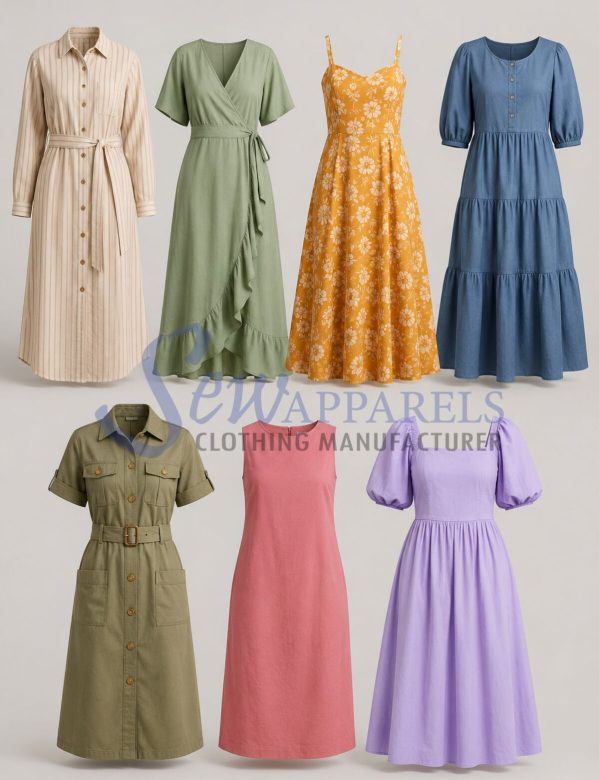
1. Define woven dress fit range development
Identify the intended market, wearing occasion, silhouette and fit preference. A relaxed tiered dress, close-fitting sheath and structured shirt dress do not require identical ease or review priorities. Decide what the brand means by its fit labels and which customer measurements support those descriptions before asking a supplier to develop patterns.
Keep size and shape as related but distinct decisions. A size range describes the offered measurement progression; a shape range can change relationships between measurements within that progression. Avoid calling a fit “curvy” or “straight” without a documented profile and approved sample that explains the intended difference.
Use relevant customer evidence
Review woven dress customer body data with its source, measurement definitions and limits. A small fitting panel can identify issues but should not automatically be treated as representative of an entire market. Separate observations, commercial assumptions and approved target measurements so each decision has a clear basis.
The published scope of ISO 8559-1 describes anthropometric measurement definitions that can support clothing size and shape profiles. It provides measurement context, not a finished dress chart for your brand. Have the technical team establish consistent measurement practice and the suitable development references.
2. Separate body measurements from garment measurements
A woven dress bust waist hip chart should label whether values describe the target body or the finished garment. Include units and measurement definitions. Garment dimensions also reflect design and wearing ease, so they should not be copied directly from a body chart without considering the intended silhouette.
Record additional measurements needed for the style, such as stature, torso length or relevant upper-body references. Bust, waist and hip circumferences alone may not explain a shoulder, armhole or waist-position issue. Select inputs through the development brief rather than collecting an extensive chart with no clear connection to the dress.
Define useful evidence for the chart
Woven dress size chart evidence should connect the public size guidance with the approved target profiles and fitting reviews. Explain how a buyer will choose a size and where a measurement falls outside the intended range. Do not use a familiar size label from another brand as proof of equivalence.
Cashmerette’s sizing guide illustrates that a pattern system can consider high bust, full bust, waist and hip and offer different cup options. It is an example of a defined sizing approach, not a chart to copy for Sew Apparels or a guarantee that its labels correspond to your customers.
3. Decide when separate blocks are justified
A discussion of woven dress straight curvy fit blocks should identify the specific proportional differences the brand wants to address. These may affect bodice shaping, waist suppression, hip distribution or other pattern relationships. Qualified patternmakers should determine the necessary changes and test them in the intended design.
Do not assume that adding circumference uniformly will resolve a shape issue. Equally, avoid introducing several blocks solely because a label sounds marketable. Each proposed block should have a clear target profile, an identifiable pattern and a sample review showing why the option belongs in the range.
Control grading within each block
For woven dress separate block grading, document the selected base size and the progression to other sizes for each block. Review whether the rules suit the target profiles and garment features. A rule approved for one block should not be transferred automatically to another without technical assessment.
Establish woven dress fit block ownership in the development records. Identify who maintains patterns, approves revisions and releases the current files. Woven dress fit range development becomes difficult to control when two teams use different base blocks or an old revision remains attached to a new technical pack.
4. Plan samples that answer the fit questions
A woven dress fit range sample plan should state which block and size each sample represents, what is being evaluated and who approves it. Cover the important areas of uncertainty rather than selecting samples only for presentation. Specify the fabric, support layers and closures because they can affect the completed garment.
Record the sample stage clearly. A development substitute can be useful for an early pattern discussion, but confirm which conclusions remain provisional until the intended material is used. Drape, structure and other assembly characteristics may change the fit impression without a change to the nominal pattern dimensions.
Select fitting references carefully
For woven dress fit model selection, match the review reference to the documented profile as closely as practical and record relevant differences. One model’s preference is useful feedback but does not define the entire customer segment. Keep reference measurements and sample dimensions separate in the review.
A woven dress cross size fit review should examine proportion, waist position, front and back balance, armhole comfort and movement where relevant. Identify which sizes and blocks were actually reviewed. A base-size approval should not be described as evidence for every size when those sizes have not been assessed.
5. Compare fit ranges using consistent criteria
A woven dress fit range comparison should hold the intended design and review conditions clear while documenting block differences. Compare appearance, coverage, movement and the areas of concern identified earlier. Keep photographs or observations against named samples so feedback can be traced to a specific revision.
During woven dress body shape fit feedback, ask reviewers to describe the issue and its location. A comment such as “tight at the upper hip when sitting” is more useful than “this fit is bad.” Record wearer preference separately from an objective garment observation so the technical team can interpret both appropriately.
Make corrections traceable
Assign each correction to the relevant block, size and pattern revision. State whether a change is intended across the range or only in an identified option. When a correction affects several pattern relationships, review the completed garment again rather than approving isolated measurements without checking balance.
Keep an accepted sample reference for each released option and record any remaining limitation. Woven dress fit range development should produce a clear decision: which option is approved, for which target profile and under which specification. Avoid presenting development observations as proof that every possible wearer will be satisfied.
6. Connect the fit range with commercial planning
Define woven dress shape range order assumptions before requesting a production quotation. Break quantities down by block, size and colour, and identify which figures are confirmed versus provisional. Additional options can affect pattern work, sampling and order allocation; ask for those implications instead of assuming they are included. Connect the size allocation with the fabric consumption quotation so its marker assumptions represent the approved fit options.
A woven dress fit range SKU mapping register should connect each offered option with its pattern, garment size label and order identity. The distinction needs to remain visible during cutting, sewing and packing. Similar-looking dresses from different blocks should not depend on an operator’s memory to keep them separate.
Build the technical handover
A woven dress multi block technical pack should identify block-specific patterns, measurements, grading, accepted samples and any shared components. State which instructions apply to all options and which vary. This reduces the risk of a revised measurement table being applied to the wrong block.
For custom woven dress manufacturing, send the target profiles, sample plan, fabric references and quantity allocation together. Confirm development responsibilities, pattern access, sample charges and timing directly. Woven dress fit range development should be agreed for the actual project rather than inferred from a general product description.
For private label woven dress production, retain the fit option in product data, labels and purchase records. Startup brands can prepare a focused first range while discussing minimum quantities and support. Confirm any project-specific MOQ and included development work; this guide does not promise that all block options share identical commercial conditions.
Fit range worksheet for buyer approval
A woven dress fit range worksheet can bring the decisions into one review file:
- Target market, silhouette, fit preference and evidence source.
- Body profile definitions, units and measurement practice.
- Block references, base sizes and grading revisions.
- Finished garment specifications and intended ease.
- Sample coverage, materials and fitting references.
- Observations, corrections and accepted sample identities.
- Order allocation, SKU mapping and release responsibility.
Use the worksheet to identify gaps before release rather than leaving unexplained blanks in the technical pack. If a block is still being developed, state that clearly and avoid including it as an approved option. Woven dress fit range development is complete for production only when the responsible team has approved the intended scope.
Common questions about dress fit ranges
Is a larger size automatically a curvy fit?
No. A size increase and a change in body proportions are different questions. Define the target profile and review whether the pattern needs separate development. Woven dress fit range development should explain what an option changes rather than relying on the size label alone.
Can the same measurement chart serve all blocks?
Shared fields may be possible, but any differences need to be explicit. Distinguish body guidance from finished garment specifications and identify the block to which each applies. Ask the technical team to confirm the chart structure before using it for pattern approval or customer guidance.
Where should a brand begin?
Use the woven dress manufacturing page for enquiry context and the woven dress buying guides for related development decisions. Bring a defined customer profile and identified sample requirements. A traceable woven dress fit range development plan can then guide patterns, approval and purchasing together.